Burmese Python Hatchling Inventory Management: Complete Breeder Guide
By HatchLedger Editorial Team · Published 2025-05-09 · Updated Mar 13, 2026
A Burmese python hatch can produce 50-100 individual animals in a single event. Processing, housing, and tracking that many animals requires a systematic inventory approach from the moment eggs begin to pip. Without a clear system in place before the hatch, you'll end up with partially documented animals and a chaotic first few weeks. Breeders using integrated software report 30% less time on administrative tasks -- critical when you have 70 hatchlings that all need individual records, individual housing, and individual attention through their first feeding.
TL;DR
- Burmese pythons (Python bivittatus) are among the largest constrictors in captivity, with breeding females commonly exceeding 100-200 lbs.
- Clutch sizes average 25-50 eggs, making Burmese pythons among the most productive large constrictors in captive breeding.
- Cycling typically involves a 4-8 week period of reduced temperatures (dropping 8-12 degrees Fahrenheit) and reduced feeding frequency.
- Incubation parameters runs 60-65 days at 88-90 degrees Fahrenheit, with females capable of thermoregulating eggs by muscular shivering.
- Compliance requirements requirements for Burmese python ownership and interstate transport vary by state, with federal protections under the Lacey Act applying in some jurisdictions.
Inventory management for Burmese hatchlings shares the same principles as any other species, but the scale demands more advance preparation and a more rigorous process.
Preparing Before the Hatch
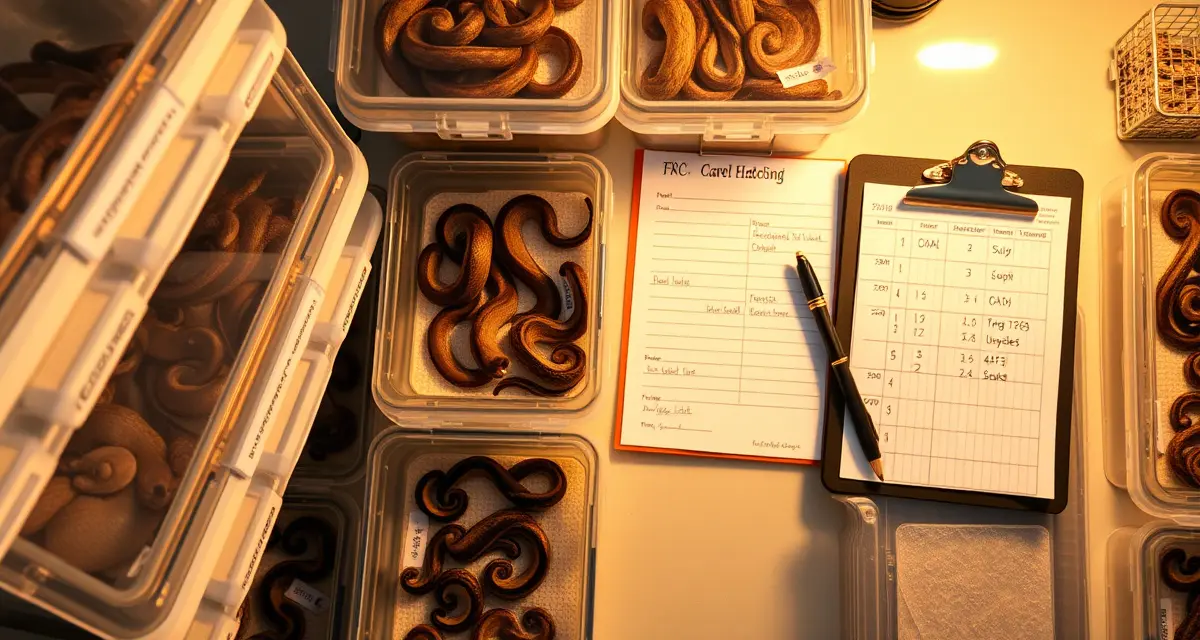
Set up your hatchling housing before eggs begin to pip. Each hatchling needs its own container -- 28-quart or 32-quart tubs work well for the first few months given the hatchling's starting size (18-24 inches). For a clutch of 70 eggs, that means 70 tubs staged and ready before you're dealing with 70 hatchlings simultaneously.
Prepare your labeling system in advance. Have numbered labels, cage cards, or ID tags ready to go. The ID system you choose should be one that links easily to your records software -- numerical IDs, breeding codes, or another consistent format.
Have your scale ready for birth weights. Weigh each hatchling as you process it and record the weight immediately. Birth weight is a useful baseline for growth assessment and helps you identify the smaller/larger animals in a cohort.
Processing Hatchlings at Emergence
Burmese hatchlings typically pip (cut through the egg shell with their egg tooth) over a period of 1-3 days for a single clutch. Don't rush hatchlings by pulling them from eggs -- let them emerge at their own pace. An animal that's been in the egg for 65 days can wait another 12-24 hours after pipping before you assist or move it.
As hatchlings emerge, process each one in sequence: assign ID, weigh, note morph characteristics, and place in pre-labeled individual housing. Keep a birth log running alongside the physical processing so every animal that gets a tub also gets a record.
For large clutches with morph genetics, preliminary morph assessment at birth determines potential genetic status (visual morph vs. possible het vs. normal). This assessment may need to be provisional for some morphs -- genetic testing or breeding-out may be required to confirm het status in non-visual animals.
Building Individual Records from Birth Data
Every hatchling's record starts with the data you capture at birth. From there, each subsequent event -- first shed, first feeding, weight checks, health observations, sales -- gets added to the individual record. The birth record is your baseline; everything else builds on it.
Linking hatchling records to the parent clutch record is important for data integrity. You want to be able to pull up any individual animal and see not just its own history but also its parent pair, its genetic background, and how its performance compares to cohort siblings. This context helps you evaluate whether a particular line is producing strong feeders, whether male genetics correlate with offspring quality, and other questions that require cohort-level data.
HatchLedger creates individual animal records linked to the parent clutch automatically. When you process 70 hatchlings, each one gets its own record in the same system where the clutch data already exists.
Managing Rapid Growth and Housing Transitions
Burmese hatchlings grow extremely fast. Animals that hatched at 70 grams may weigh 400-500 grams by six months. Housing that was appropriate at hatch will be inadequate within a few months. Your inventory management needs to track when animals need housing upgrades.
Flag animals in your records for enclosure size review at regular intervals (every 2-3 months for the first year). When you're doing feeding rounds and notice an animal has clearly outgrown its current housing, having a note system that lets you queue that animal for a housing change prevents the problem from persisting.
Housing transitions need to be logged. If an animal moves from rack housing to an individual enclosure, that's a record-worthy event that provides context for any behavioral or health changes that follow.
HatchLedger connects your inventory records to clutch P&L so the ongoing cost of housing and feeding each hatchling contributes to your per-animal cost calculations.
Frequently Asked Questions
What is the best approach to Burmese python hatchling inventory management?
Prepare individual housing and your ID system before the hatch begins. Process each hatchling sequentially at emergence: assign ID, weigh, note morph characteristics, and place in labeled housing. Log each animal in your records system before moving to the next. Build records that link to the parent clutch and capture feeding history, shed events, and weight data from birth forward. Flag animals for housing size reviews regularly and log all enclosure transitions.
How do professional breeders handle Burmese python hatchling inventory at scale?
Professionals who produce large Burmese clutches treat the hatch as a planned production event with pre-staged housing, labeling systems, and record-entry workflows. They process animals systematically rather than randomly, which ensures every hatchling in a 70-animal cohort gets the same documentation from day one. Regular feeding and weight tracking identifies animals falling behind the cohort average early, when intervention is most effective. Their inventory records also support informed sales decisions -- they know exactly what each animal cost to produce and what its current feeding and health status is.
What software helps manage Burmese python hatchling inventory?
HatchLedger tracks every animal, clutch, and sale record for Burmese python breeders, with documentation that supports regulatory compliance and buyer confidence. When managing large clutches and compliance requirements simultaneously, a connected system prevents the record-keeping gaps that create problems at sale. Free for up to 20 animals.
Are Burmese pythons legal to own and breed in all US states?
No. Burmese pythons are listed as an injurious species under the Lacey Act, which restricts interstate transport. Several states have additional bans on ownership entirely. Check current state and federal regulations before acquiring or transporting animals. USARK maintains updated resources on applicable regulations.
How large should a Burmese python enclosure be for a breeding pair?
Breeding females typically require enclosures of at least 8x4 feet and often larger for full-grown adults. Dedicated breeding rooms or custom builds are standard at scale. Thermal gradient with hot spots at 88-92 degrees Fahrenheit and ambient temperatures in the mid-70s allows proper thermoregulation.
What is Burmese Python Hatchling Inventory Management: Complete Breeder Guide?
Burmese Python Hatchling Inventory Management: Complete Breeder Guide is a comprehensive resource published on HatchLedger covering every step of tracking, housing, and documenting Burmese python hatchlings from pip to first feeding. It addresses the unique challenges of managing clutches of 25-50+ eggs, providing breeders with structured workflows, record-keeping frameworks, and software recommendations to handle large hatch events efficiently and with minimal administrative overhead.
How much does Burmese Python Hatchling Inventory Management: Complete Breeder Guide cost?
The guide itself is free to read on HatchLedger. Costs associated with implementing the practices described — such as inventory or hatchling management software — vary by platform, typically ranging from free tiers to paid subscriptions. Physical supplies like individual tubs, labeling materials, and feeding logs represent additional one-time or recurring expenses. The guide helps breeders evaluate options and invest only in tools that match their operation's scale.
How does Burmese Python Hatchling Inventory Management: Complete Breeder Guide work?
The guide walks breeders through a step-by-step system: assigning individual IDs at pip, setting up dedicated hatchling housing, logging weights and feeding records per animal, and using integrated software to centralize data. It covers cycling and incubation parameters — 88-90°F for 60-65 days — and explains how to build pre-hatch checklists so documentation starts before the first animal emerges, preventing chaotic catch-up record-keeping afterward.
What are the benefits of Burmese Python Hatchling Inventory Management: Complete Breeder Guide?
Key benefits include reduced administrative time — breeders using integrated software report 30% savings — improved accuracy of individual animal records, and better compliance readiness for state regulations governing Burmese python ownership and transport. Organized inventory also improves buyer communication, supports waitlist management, and helps identify feeding or health issues early across a large cohort of genetically valuable hatchlings.
Who needs Burmese Python Hatchling Inventory Management: Complete Breeder Guide?
This guide is essential for serious Burmese python breeders managing clutches of 25-50+ eggs per season. It is particularly valuable for operations scaling beyond a single clutch annually, where manual tracking breaks down quickly. Hobbyist breeders transitioning to higher-volume production, as well as established breeders looking to professionalize record-keeping ahead of sales or regulatory compliance reviews, will find the structured approach immediately applicable.
How long does Burmese Python Hatchling Inventory Management: Complete Breeder Guide take?
Reading the guide takes approximately 15-30 minutes. Implementing the full inventory system — setting up housing, labeling animals, and configuring tracking software — typically requires 2-4 hours of preparation before a hatch event. Ongoing per-animal record entry adds only minutes daily. Breeders who invest the setup time before eggs pip report significantly smoother first weeks, avoiding the backlog that accumulates when 70 hatchlings arrive without a system already in place.
Related Articles
- Reticulated Python Hatchling Inventory Management: Complete Breeder Guide
- Boa Constrictor Hatchling Inventory Management: Complete Breeder Guide
- Burmese Python Hatchling Care Guide: Complete Breeder Guide
- Corn Snake Hatchling Inventory Management: Complete Breeder Guide
Sources
- USARK (United States Association of Reptile Keepers)
- Association of Reptilian and Amphibian Veterinarians (ARAV)
- US Fish and Wildlife Service (Injurious Wildlife regulations)
- Journal of Herpetology (Society for the Study of Amphibians and Reptiles)
- Florida Fish and Wildlife Conservation Commission
Get Started with HatchLedger
Burmese python breeding involves large animals, large clutches, and compliance documentation that is difficult to manage without a dedicated system. HatchLedger tracks every animal, clutch, and sale record in one place, giving you the documentation you need for regulatory compliance and buyer confidence. Try it free with up to 20 animals.