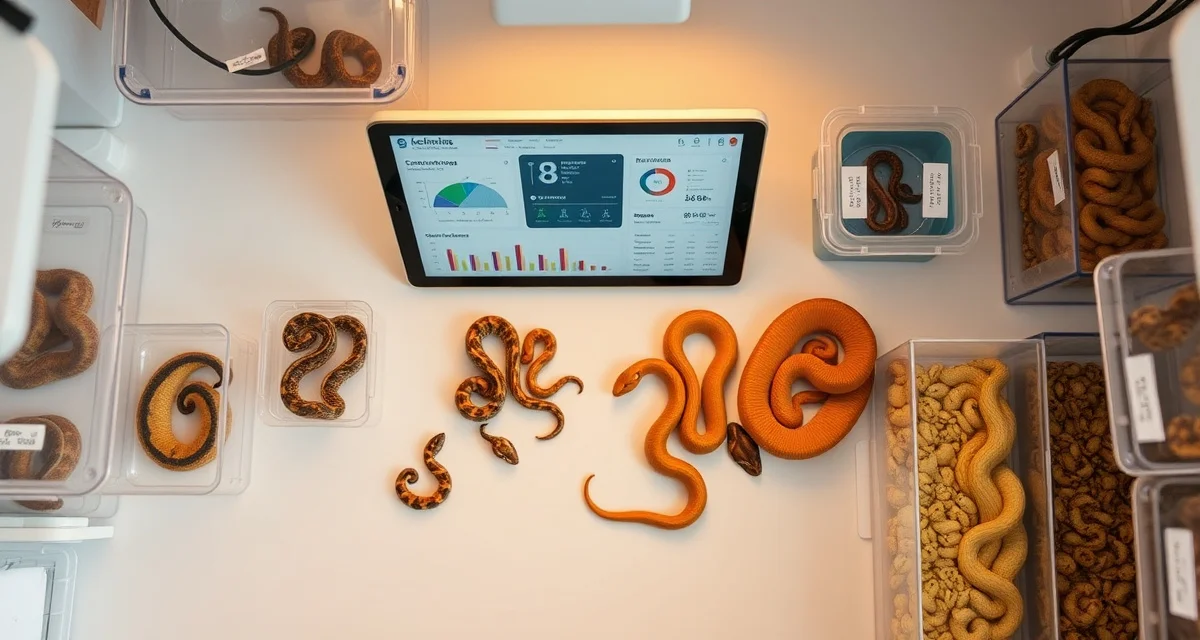
Corn Snake Hatchling Inventory Management: Complete Breeder Guide
Corn snake hatchling inventory management is where operational efficiency meets genetic accuracy. A productive corn snake breeding season can produce 100 to 300 hatchlings from multiple clutches, each with their own morph identity, genetic status, feeding history, and sale status. Keeping track of all of this without a system leads to errors: animals sold twice, genetic documentation that doesn't match the animal, sale records that don't support accurate P&L calculations. Breeders using integrated software report 30% less time on administrative tasks, which at peak hatchling season means recovering hours per week.
TL;DR
- Corn snakes (Pantherophis guttatus) are the most widely bred colubrid in captivity, with hundreds of documented morphs spanning all three major inheritance patterns.
- Seasonal cycling of 60-90 days at 50-60 degrees Fahrenheit is the standard cycling protocol for reliable spring breeding.
- Clutch sizes average 12-24 eggs for adult females, with experienced breeders often producing 2 clutches per season from well-conditioned females.
- Incubation setup runs 55-65 days at 78-82 degrees Fahrenheit, cooler than most python species.
- Corn snake morph genetics include multiple allelic series, including the amelanistic and anerythristic pathways, that interact in non-obvious ways.
Building Your Inventory From the Ground Up
ID Assignment at Hatch
Every hatchling receives a unique ID at hatch. Don't delay this step. A hatchling without an ID is at risk of being misattributed or skipped in records.
Use a convention that links the hatchling to its clutch: C-24-003-01 means clutch 3 from 2024, animal 1. Apply a small label to each tub matching the hatchling ID. This physical label corresponds to the digital record in your inventory system.
What to Record at Hatch
- Hatchling ID
- Clutch ID (parent link)
- Hatch date
- Hatch weight
- Visual morph assessment (mark uncertain morphs for follow-up as the animal develops)
- Any visible abnormalities
- Sex if determinable at hatch (most corn snake hatchlings are probed or popped when larger)
This initial record is the foundation that all subsequent data builds on. Doing it well at hatch is far easier than trying to reconstruct it later.
Tracking Through the Pre-Sale Period
Feeding Records
Log every feeding attempt with date, prey type, prey size, method, and outcome. For a hatchling cohort of 50 animals, this means 50 individual feeding logs updated multiple times per month.
This is where spreadsheets start to fail. A spreadsheet with 50 rows, each needing multiple columns of feeding history updated regularly, becomes unwieldy fast. A single wrong row reference corrupts genetic attribution permanently.
HatchLedger's reptile breeder hub structures feeding history at the individual animal level. You navigate to an animal, log the feeding event, and it belongs to that animal exclusively. No shared row references, no risk of misattribution.
Weight Records
Weigh hatchlings weekly for the first 90 days. Log every weight with date. A simple weight trend is visible at a glance with digital records: you can see whether a hatchling is gaining consistently or stalling.
Weight loss or stagnation in a hatchling that isn't eating is a health flag. Catch it early in your weight log rather than noticing it visually when the animal is visibly thin.
Morph Confirmation
Some corn snake morphs are immediately obvious at hatch. Others develop more clearly as the animal grows. Update morph records as identification becomes more certain. Mark animals as "pending confirmation" for traits that need more time.
Het status documentation is critical. Know the difference between confirmed het, possible het (with percentage), and normal. Document accurately for every hatchling from its known parentage.
Managing Sale Status
Your inventory needs to track the sale status of every animal in real time:
- Available: Ready for sale, feeding established
- Not yet selling: Still becoming established feeder
- Reserved: Deposit received, not yet fully paid
- Sold and delivered
- Held back (personal collection)
Deposits require their own sub-records: buyer name, deposit amount, date received, which animal it applies to, and balance due. An animal "reserved" with a deposit shouldn't show as available to other buyers.
Reptile breeder software comparison resources consistently flag deposit management as a significant gap in basic animal tracking tools. HatchLedger includes deposit tracking linked to individual animals and your clutch financial records.
Connecting Inventory to P&L
Your hatchling inventory is also your revenue pipeline. Each hatchling that sells contributes revenue to its clutch P&L. Each deposit received is a future revenue commitment.
When you know what each animal in your inventory is worth at current market rates, you can forecast your season's expected revenue and compare it against known costs. This forward-looking view lets you identify whether you're tracking toward a profitable season early enough to adjust pricing or marketing efforts.
Frequently Asked Questions
What is the best approach to corn snake hatchling inventory management?
Assign IDs at hatch and create individual records immediately. Log all feeding attempts, weights, and shed dates consistently throughout the pre-sale period. Track morph and het status accurately based on known parentage. Maintain current sale status for every animal including deposit records. Connect your hatchling records to your clutch financial records so P&L calculates as sales occur. A digital system designed for breeding programs is essential for collections producing more than 25 to 30 hatchlings per season.
How do professional breeders handle corn snake hatchling inventory management?
Professional corn snake breeders run tight inventory management as a core operational function. They assign IDs at hatch, update feeding records daily during the feeding establishment period, confirm morph identification before listing animals for sale, and track every deposit with formal documentation. They review their inventory status regularly to identify which animals need attention (problem feeders, animals reserved but not yet paid in full) and to communicate accurate availability to interested buyers. Most use dedicated breeding software to maintain accuracy at the hatchling counts a productive season generates.
What software helps manage corn snake hatchling inventory management?
HatchLedger is purpose-built for reptile breeders, connecting animal records, breeding history, clutch outcomes, and financial tracking in one system. Unlike generic spreadsheets, it's designed around the specific workflow of an active breeding season. Free for up to 20 animals.
Can corn snakes produce two clutches in a single breeding season?
Yes, many adult corn snake females will double-clutch reliably, especially when kept at ideal temperatures and fed aggressively between clutches. Allow females at least 4-6 weeks of heavy feeding between the first and second clutch. Tracking body weight before and after each clutch helps assess whether a female is in condition for a second clutch that season.
What temperature should corn snake eggs be incubated at?
Corn snake eggs incubate best at 78-82 degrees Fahrenheit. Higher temperatures up to 84 degrees accelerate development but reduce the hatch window and can increase developmental problems. Below 75 degrees slows development significantly. Unlike ball python eggs, corn snake eggs tolerate a wider temperature range reasonably well.
What are the most profitable corn snake morphs for breeders?
Multi-gene combination morphs command the highest prices. Motley, Tessera, and Scaleless are structural genes that add significant value to color morph animals. Scaleless corn snakes in particular fetch $300-800 or more depending on color morph combination. Single-gene morphs like Amelanistic and Anerythristic are common and prices are compressed; combinations including structural genes maintain stronger margins.
Sources
- USARK (United States Association of Reptile Keepers)
- Association of Reptilian and Amphibian Veterinarians (ARAV)
- Herpetological Review (Society for the Study of Amphibians and Reptiles)
- Reptiles Magazine (Bowtie Inc.)
- Society for the Study of Amphibians and Reptiles (SSAR)
Get Started with HatchLedger
Corn snake breeders managing multiple morphs, double-clutching females, and complex genetic documentation benefit from a system that links animal records to clutch outcomes and keeps morph genetics traceable across generations. HatchLedger handles all of this, free for up to 20 animals.