Boa Constrictor Hatchling Inventory Management: Complete Breeder Guide
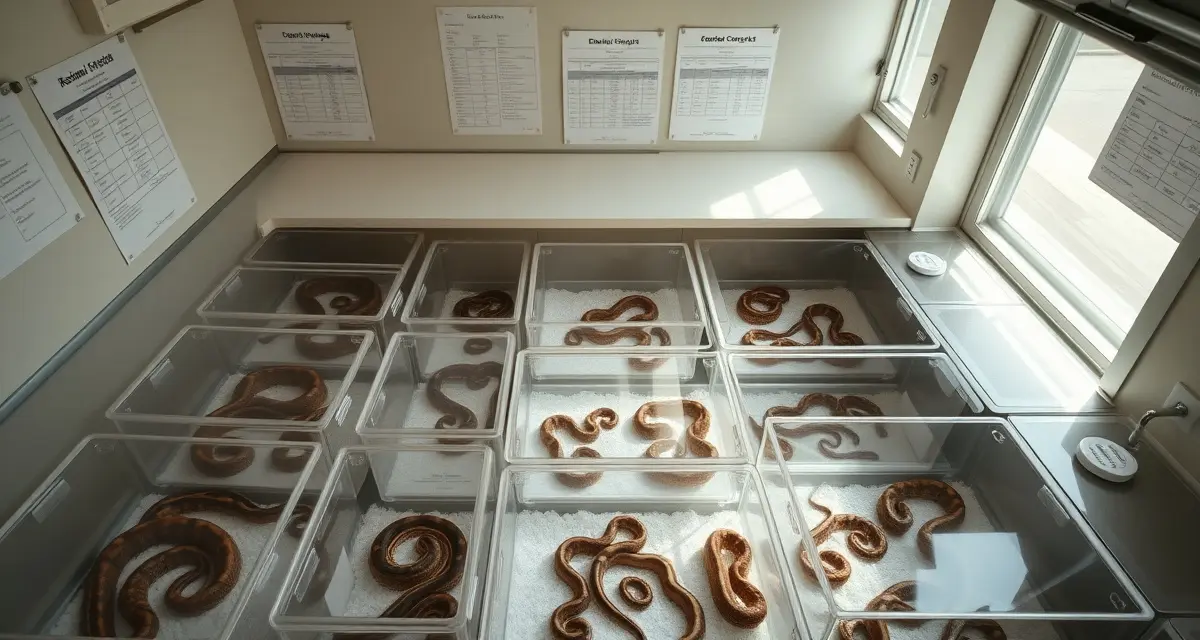
Managing a boa neonate cohort efficiently requires a real inventory system from day one. When a female delivers 30-40 live young, you need to process each animal individually -- assign IDs, record birth data, set up individual housing -- often within the same session. Breeders using integrated software report 30% less time on administrative tasks, which is critical when you're working through a large litter and need to move efficiently without losing track of any individual animal.
TL;DR
- Boa constrictors are viviparous (live-bearing), with gestation lasting 5-8 months depending on subspecies and husbandry conditions.
- Seasonal cycling typically starts in October with a 5-10 degree Fahrenheit temperature reduction and reduced photoperiod.
- Litter sizes average 15-25 neonates for Boa constrictor imperator, though some localities and true red-tails average smaller litters.
- Confirming pregnancy in boas is subtler than in ball pythons and often requires close behavioral observation or portable ultrasound.
- Logging every pairing date and gestation-period observation gives you the data to accurately predict birth windows and prepare appropriate neonate housing.
The transition from birth record to individual inventory is where many breeders' systems break down. A single post on a notebook page saying "Female X delivered 28 live young" is not an inventory record. Individual IDs, birth data, and a tracking system for each neonate's progress through the pre-sale pipeline are what you actually need.
Assigning Individual IDs at Birth
Every neonate should receive a unique ID before it leaves the birth enclosure. Your ID system needs to be consistent and durable. Options include:
Numbered cage cards or tags. Simple and visual. Place a numbered card in each individual tub immediately when you house the neonate. The tub number becomes the animal ID until you enter it into your records system.
Sequential breeding codes. Many breeders use a code that encodes the dam ID, breeding season year, and neonate number. For example: "BC24-F03-012" might mean "Boa Constrictor, 2024 season, Female 03, Neonate 12." This system makes records searchable and self-documenting.
Label makers. Printed stick-on labels with the ID applied directly to the tub work well for rack systems. Use waterproof labels and apply them to the tub itself, not the lid, which may be swapped.
The system matters less than the consistency. Every animal needs a unique ID that connects to its record in your management system.
Birth Record Data to Capture
When you process a litter, capture the following for each neonate:
- Unique animal ID
- Dam ID and sire ID
- Date of birth
- Birth weight (grams, if you have a scale available)
- Observed morph characteristics (visual morph, or "normal/possible het" for recessive projects)
- Any abnormalities noted at birth (kinked spine, missing eyes, etc.)
- Number in litter (neonate 1 of 28, 2 of 28, etc.)
This data is your baseline. Everything that follows -- feeding history, shed records, weight growth, sale records -- builds on this foundation.
Tracking Neonates Through the Pre-Sale Pipeline
Most breeders don't sell boas immediately after birth. Neonates need to shed, start feeding consistently, and grow to a size and condition that makes them marketable. This pre-sale period typically runs 60-90 days from birth but can extend significantly for slow starters or smaller animals that need extra time.
Your inventory management tracks each animal's progress through this pipeline:
- Born -- ID assigned, birth record complete
- First shed -- date recorded, shed completeness noted
- First feeding -- date, prey type, prey size recorded
- Consistently feeding -- typically 3-5 consecutive accepted meals
- Available for sale -- meets your minimum sale criteria
- Sold -- buyer information, sale price, date of transaction
HatchLedger provides a tracking structure for each animal from birth through sale. Rather than building this pipeline in a spreadsheet, you get a ready-made system where each stage is logged with timestamps.
Managing Slow Feeders Within the Cohort
In any litter, some neonates will lag behind on feeding. Your inventory system needs to make these animals visible so they get appropriate attention rather than being overlooked when you're managing 30+ neonates at once.
Flag slow feeders in your records with a note on their last feeding attempt date and outcome. When you do a feeding round, the flagged animals get extra attention before you move on. When a slow feeder finally accepts its first meal, that's a milestone that gets logged immediately.
Animals that remain problematic feeders after 60+ days post-shed often need veterinary evaluation. Your feeding log history gives your vet the context they need to assess whether the refusal pattern is behavioral or health-related.
When to List and How to Present Inventory
Neonates are most marketable when they have 3-5 consistent feeding records. This demonstrates that the animal is established and reduces the risk premium for buyers. Animals listed before they're eating consistently should be priced to reflect that risk, or held until they're more established.
When you list an animal, your inventory record should generate the key data points a buyer wants: date of birth, parentage, known genetics, current weight, feeding frequency, and prey type. HatchLedger connects your inventory records to your P&L, so you know your cost-per-animal and can set prices that reflect your actual investment.
Frequently Asked Questions
What is the best approach to boa constrictor neonate inventory management?
Assign unique IDs at birth, before you transfer neonates to individual housing. Capture birth weight, dam and sire IDs, and initial morph observations for each animal. Track each neonate through defined pipeline stages: first shed, first feeding, consistently feeding, available for sale. Flag slow feeders so they get appropriate attention rather than getting lost in a large cohort. Keep records linked to individual IDs, not just a litter-level summary.
How do professional breeders handle boa constrictor neonate inventory?
Professional breeders process each animal individually from the moment of birth, assigning IDs and entering birth data before moving on to the next step. They maintain pipeline tracking so they know exactly where every neonate stands at any given time -- how many are eating, how many are on their first shed, how many are available for sale. This visibility prevents animals from sitting in back racks for months without attention. Buyers also appreciate being able to ask "when did this animal last eat?" and getting a specific, logged date rather than an approximate answer.
What software helps manage boa constrictor neonate inventory?
HatchLedger is purpose-built for reptile breeders, connecting animal records, breeding history, clutch outcomes, and financial tracking in one system. Unlike generic spreadsheets, it's designed around the specific workflow of an active breeding season. Free for up to 20 animals.
How do you sex boa constrictor neonates?
Boa constrictor neonates can be sexed by probing or by popping, both of which should be performed by an experienced keeper to avoid injury. Males typically probe to 4-8 subcaudal scales and females probe to 2-3. Recording sex in your records at birth is important for accurate inventory and sales documentation.
How long does it take a boa constrictor to reach breeding weight?
Most B. c. imperator females reach breeding weight (typically 3,000-5,000g depending on locality) at 3-4 years under good feeding conditions. True red-tailed boas (B. c. constrictor) grow larger and may take 4-5 years. Males of most localities are ready to breed at 18-24 months.
Can boa constrictors produce back-to-back litters in consecutive years?
Most experienced breeders rest females for a full season after a large litter to allow proper body condition recovery. A female that drops significant weight during a long gestation needs adequate recovery time before the next breeding cycle. Tracking body weight before and after gestation is the best guide.
Sources
- USARK (United States Association of Reptile Keepers)
- Association of Reptilian and Amphibian Veterinarians (ARAV)
- Herpetologica (Herpetologists League)
- Reptiles Canada Magazine
- World Animal Protection
Get Started with HatchLedger
Boa constrictor breeding involves months of gestation monitoring, pairing records, and litter documentation that is difficult to track reliably across multiple females using notebooks or generic spreadsheets. HatchLedger gives you a single connected system for all of it, from cycling start through neonate sale. Try it free with up to 20 animals.