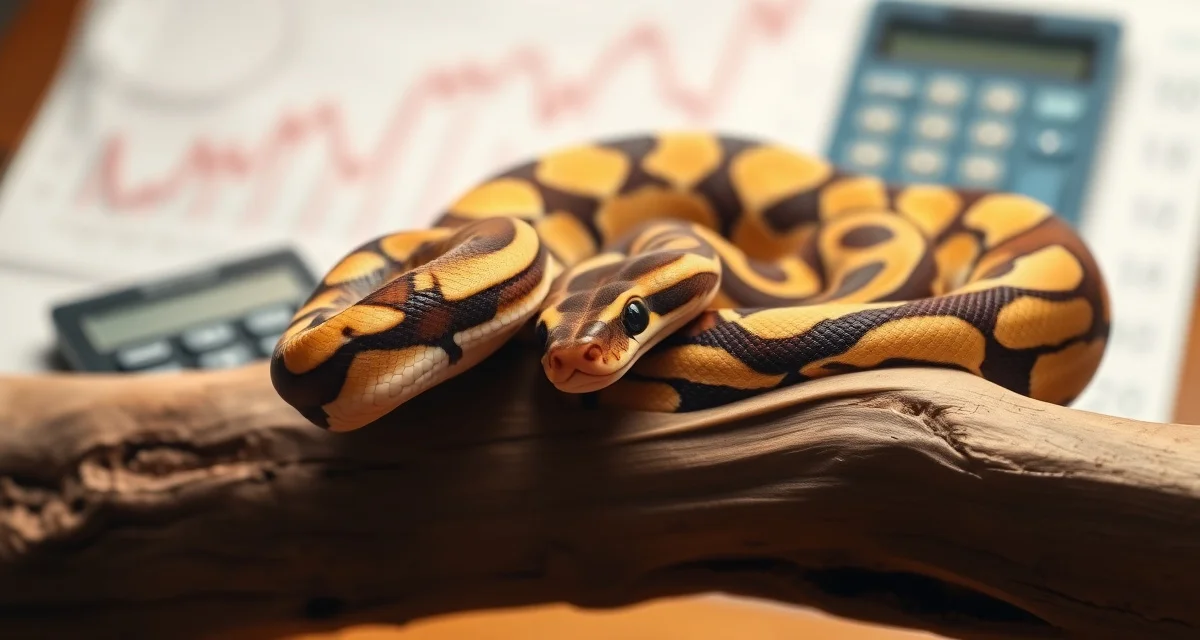
Case Study: Banana Ball Python Project ROI Analysis
By HatchLedger Editorial Team · Published 2025-03-17 · Updated Mar 13, 2026
Banana ball pythons have one of the most interesting economic histories in the modern morph market. At their peak, single-gene Banana hatchlings sold for $1,500-3,000. Today, single-gene Bananas sell for $50-150. That's a 95%+ price collapse in roughly a decade. And yet, breeders who pivoted their Banana programs toward high-value combos are still generating strong returns on the gene.
TL;DR
- Ball python breeding operations require systematic record-keeping from pre-season preparation through end-of-season sales.
- Females at 1,200-1,500g or more are the target weight before introducing them to a breeding male.
- Ovulation detection is the key event that anchors pre-lay shed and lay date calculations.
- Clutch profitability guide depends on understanding actual cost basis per animal, not just gross sale revenue.
- Well-documented animals with complete feeding histories and clear genetic records consistently sell faster and at higher prices.
This case study analyzes what a Banana project ROI looks like today, what combo strategy makes the most sense, and how the economics have shifted from where they were five years ago.
Banana genetics guide: A Quick Refresher
Banana (also sold as Coral Glow by breeders from certain founding lines) is a co-dominant morph with some unusual genetic characteristics:
Sex-linked color expression: Male and female Bananas often express differently. Males from Banana x non-Banana pairings tend to be "maker" males (they inherit the Banana gene on the Y chromosome in a non-standard inheritance pattern) or standard Bananas depending on which parent contributed the gene. The freckle gene produces black speckles that increase with age, and this expression is more pronounced in males from certain lines.
Freckle accumulation: Banana animals develop black flecks ("freckles") as they age. Some buyers love this. Others prefer clean animals without freckles. This creates a two-tier market within the Banana morph itself.
Super Banana: The Super Banana is a pale yellow to white animal. These are striking but the market for single-gene Super Banana animals has compressed similarly to single-gene Bananas.
The Price Collapse: What Happened
When Banana entered the wider market in the mid-2010s, limited supply and high demand drove prices up dramatically. As more breeders acquired Banana breeding animals and scaled production, supply grew faster than demand. Within a few years, the single-gene Banana price had dropped to a fraction of its peak.
This is the standard commodity cycle for ball python morphs. It's not unique to Banana: Pastel, Spider, Cinnamon, and dozens of other morphs followed the same trajectory. What's instructive about Banana is how clearly the combo strategy maintained value where single-gene production didn't.
Where Banana Value Lives Today
Single-gene Banana: $50-150. Commodity pricing.
Banana in combinations:
- Banana Pastel: $120-200. Modestly above commodity.
- Banana Clown: $800-1,500+. notably above commodity.
- Banana Pied: $700-1,500+. High demand, strong prices.
- Banana Enchi Pied: $1,500-3,000+. Complex combo premium.
- Super Banana Clown: $2,000-4,000+. Super form in high-value combo.
The lesson is not that Banana is a poor gene. It's that single-gene production of any widely distributed morph is poor economics in a mature market. The gene's value is as a component in combination animals, not in isolation.
Building a Current Banana ROI Analysis
For this case study, the breeder starts with existing Banana animals already in their collection from previous seasons and evaluates three strategic directions:
Strategy A: Continue single-gene Banana production
Four Banana females paired to Banana males. Expected outcome: mix of Super Banana, Banana, and normal offspring. Average revenue per hatchling at current market: $80 (blended across gene types).
8-egg average clutch x 4 clutches = 32 hatchlings x $80 = $2,560 total revenue.
Cost: 8 adult animals at $40/month care cost for 12 months = $3,840 in carrying costs alone.
Net: -$1,280 before shipping, listing fees, or incubation.
Single-gene Banana production at current market prices is economically negative when animal care costs are properly accounted for.
Strategy B: Banana females paired to Clown males or Clown hets
Banana female x het Clown male = offspring that include Banana het Clown and Banana animals.
These are not visual Clown animals yet. But Banana het Clown offspring sell for $200-400 to breeders building Clown programs. Pairing a Banana female to a visual Clown male produces: 50% Banana Clown, 50% Banana (no Clown gene). No hets, no normals.
4 pairings with Banana x visual Clown: $800-1,500 per visual Banana Clown. A 6-egg clutch with 3 Banana Clowns = $2,400-4,500 from those 3 animals alone.
Net on a 4-clutch Banana x Clown strategy: easily $8,000-18,000, depending on combo specifics and animal quality.
Strategy C: Banana x Pied combinations
Similar analysis. Banana Pied animals command $700-1,500 each. A clutch where 25% are visual Banana Pied (from Banana het Pied x Banana het Pied pairing) returns strong revenue from the visual animals even if the rest of the clutch is hets.
The ROI Conclusion
Banana's ROI in 2025 depends entirely on what you pair it with. Used in isolation, it's a money-losing proposition at current single-gene prices. Used as a component in Clown, Pied, or complex multi-gene combos, it's still a valuable and profitable gene.
This is why the breeders who bought into Banana early and adapted their programs toward combos continued to profit while breeders who stayed with single-gene production watched their margins collapse. The gene didn't fail; the strategy did.
Tracking the ROI Over Time
Understanding your actual Banana project ROI requires tracking income from Banana-related pairings against the cost of maintaining the animals involved. This sounds straightforward but requires consistent record-keeping.
The HatchLedger platform connects clutch records to basic financial data so you can calculate per-clutch and per-pairing margins. Breeders using integrated software report 30% less time on administrative tasks, and more importantly, they have the actual data to make decisions like the strategy comparison above rather than relying on rough estimates.
Knowing that your Banana x Normal pairings are operating at negative margin while your Banana x Clown pairings are generating $1,200 per hatchling is the kind of data that drives better decisions the following season. Without the records, you're working from impression.
The reptile breeder software comparison covers how different tools handle the financial tracking side of this kind of project ROI analysis.
Adapting Combo Strategy Year to Year
Combo strategies need to evolve with the market. If Banana Clown prices drop 50% in the next three years, the analysis changes. Breeders who are tracking their actual per-clutch financials will see that signal in the data before they've committed another full season to a pairing that no longer pencils out.
The breeders who got hurt in the Banana price collapse were mostly the ones who didn't have financial tracking connected to their clutch data, and so didn't see the margin compression coming until it was already severe.
Frequently Asked Questions
What is the best approach to banana ball python project ROI?
Evaluate Banana as a combo component, not a single-gene product. The current market doesn't support profitable single-gene Banana production when animal care costs are fully accounted. Build toward Banana Clown, Banana Pied, or other high-value combo targets where the Banana gene contributes meaningfully to per-animal value. Track per-clutch revenue against actual costs to know your real ROI, not your estimated one.
How do professional breeders handle banana ball python project ROI?
Professional breeders review per-clutch financials at the end of each season and make pairing decisions for the following year based on which combinations actually produced the best margins. For Banana, this almost universally means pivoting away from single-gene production toward complex combinations with high-value recessive genes.
What records should every reptile breeder maintain per animal?
At minimum: acquisition date and source, morph and genetic documentation, feeding log, weight history, any veterinary treatments, and breeding history including pairing dates, clutch of origin for captive-bred animals, and offspring records. These records serve your own management, buyer documentation, regulatory compliance, and long-term genetic tracking.
How should reptile breeders document genetics for buyers?
A complete genetic record for sale includes the animal's visual morph name, confirmed het genes and their basis (parentage documentation or proven-out production), possible het genes with probability percentages, hatch date, and parent morph information. Including clutch-of-origin records lets buyers independently verify the claims.
What is Case Study: Banana Ball Python Project ROI Analysis?
This case study examines the economic trajectory of Banana ball pythons in the morph market, analyzing how a gene that once commanded $1,500–3,000 per hatchling collapsed to $50–150 today. It walks through combo breeding strategies, actual cost basis calculations, and how breeders are still generating strong returns by pairing Banana with high-value morphs rather than producing single-gene animals.
How much does Case Study: Banana Ball Python Project ROI Analysis cost?
The case study itself is free content on HatchLedger. The breeding project it analyzes involves real capital costs: female ball pythons at breeding weight (1,200–1,500g+), a quality Banana male, housing, feeding, and veterinary care. Total startup investment for a small Banana combo project typically ranges from $500 to several thousand dollars depending on the combo genes you pair with Banana.
How does Case Study: Banana Ball Python Project ROI Analysis work?
The analysis breaks down a Banana breeding project from pre-season female conditioning through ovulation detection, pre-lay shed, clutch lay, incubation, hatching, and final sale. It calculates cost basis per animal against actual sale prices for single-gene versus combo offspring, showing which pairings produce the strongest ROI given today's deflated single-gene Banana market.
What are the benefits of Case Study: Banana Ball Python Project ROI Analysis?
The study gives breeders a realistic financial framework rather than relying on gross revenue alone. Key benefits include understanding true cost basis per hatchling, identifying which Banana combos retain premium pricing, and learning how systematic record-keeping—feeding histories, genetic documentation, ovulation dates—directly improves sale speed and final prices achieved.
Who needs Case Study: Banana Ball Python Project ROI Analysis?
This analysis is most relevant for hobbyist and small-scale professional breeders considering adding Banana to an existing collection, breeders already holding Banana animals wondering whether to continue or pivot their program, and anyone evaluating ball python breeding as a side income. It's particularly useful for those who want data-driven decision-making rather than relying on outdated morph price assumptions.
How long does Case Study: Banana Ball Python Project ROI Analysis take?
Reading the case study takes 10–15 minutes. Applying its lessons to an active breeding project spans a full season: female conditioning begins months before breeding, incubation runs 55–60 days post-lay, and hatchlings may take weeks to months to sell. Expect 9–12 months from breeding introduction to final sale receipts when measuring real-world project ROI.
Related Articles
Sources
- USARK (United States Association of Reptile Keepers)
- Association of Reptilian and Amphibian Veterinarians (ARAV)
- World of Ball Pythons (WoBP genetics reference database)
- MorphMarket (reptile industry marketplace)
- Reptiles Magazine (Bowtie Inc.)
Get Started with HatchLedger
Every part of a ball python breeding operation -- from pairing records to clutch documentation to financial tracking -- works better when the data is connected rather than scattered across notebooks and spreadsheets. HatchLedger is built for exactly that. Try it free with up to 20 animals.