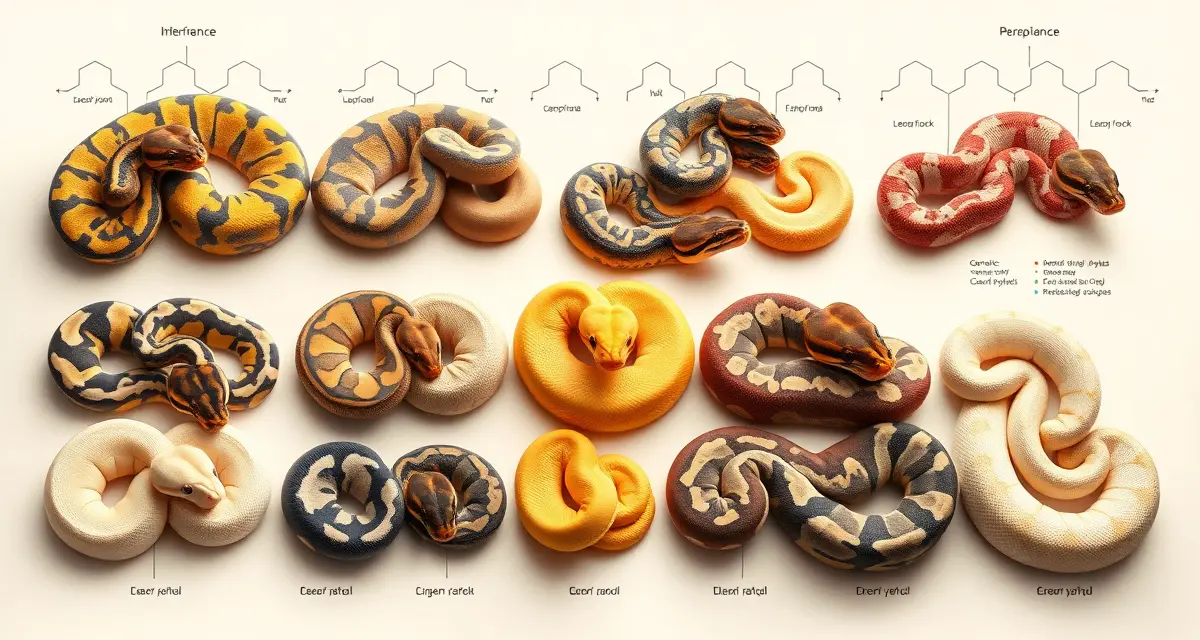
Ball Python Morph Genetics: Complete Breeder Guide
By HatchLedger Editorial Team · Published 2025-01-29 · Updated Mar 13, 2026
Get the genetics wrong and you get surprises in the egg. Sometimes good surprises, an unexpected het clown in a clutch you didn't think carried it. More often it's the other kind: all normals from a pairing you expected would produce visual animals, or worse, a lethal combo because you didn't track what genes a holdback animal was carrying.
TL;DR
- Every ball python morph falls into one of three inheritance patterns: co-dominant/incomplete dominant, recessive, or dominant.
- Co-dominant morphs express in single copy and produce a distinct super form in double copy; 50% of offspring from a co-dom x normal pairing carry the gene.
- Recessive morphs require two copies; het x het pairings produce 25% visual animals, 50% hets, and 25% no-hets.
- Allelic genes like Lesser, Butter, Russo, and Phantom occupy the same locus and combine to produce BEL complex (Blue-Eyed Leucistic) animals.
- A 100% het from two visual parents with documented clutch records sells for significantly more than an unverified possible het from an unknown source.
Ball python genetics isn't complicated once you understand the three core inheritance patterns. Every morph falls into one of them. Every pairing outcome can be calculated before you ever put animals together. This guide explains all three patterns, how they interact, and what you need to track to make reliable breeding decisions.
The Three Inheritance Patterns
Co-Dominant and Incomplete Dominant
These two terms get used interchangeably in the ball python hobby, but they describe the same practical reality: single-copy animals look different from normal, and double-copy (super) animals look different again from single-copy.
Pastel is the clearest example. A single Pastel has brighter yellows, reduced black pigment, and a lighter overall pattern compared to a normal. A Super Pastel (Pastel × Pastel) is a bleached-out, extremely bright yellow animal, visually distinct from either parent.
When you breed a Pastel to a normal:
- 50% Pastel
- 50% normal
When you breed a Pastel to a Pastel:
- 25% Super Pastel
- 50% Pastel
- 25% normal
Common co-dominant/incomplete dominant morphs: Pastel, Spider, Enchi, Fire, Lesser, Butter, Mojave, Cinnamon, Black Pastel, GHi, Leopard, Banana/Coral Glow, Orange Dream, Pinstripe, Spotnose, Yellowbelly, Asphalt.
The super form question: Not every co-dominant morph produces a surviving super. Spider homozygous animals (sometimes called "Super Spider") have severe neurological issues and don't survive. This is why spider-to-spider pairings are ethically problematic. Always research whether a morph's super form is viable before making that pairing.
Recessive
Recessive morphs require two copies of the gene to be visually expressed. Single-copy animals are "hets", heterozygous carriers that look exactly like normals (with a few exceptions for partial expression). You can't visually identify a het animal; you can only know from documented breeding records.
This is where genetics tracking becomes critical. A het Clown bought with no paperwork from an unknown breeder is a gamble. A het Clown with full lineage documentation, clutch records, parent identities, grandparent morphs, is a known commodity.
Common recessive morphs: Clown, Pied, Albino, Axanthic, Desert Ghost, Hypo/Ghost, Lavender Albino, Banana (female-limited).
When you breed a het recessive × het recessive:
- 25% visual (homozygous recessive)
- 50% het (carriers, visually normal)
- 25% visual normal
When you breed a visual recessive × het recessive:
- 50% visual recessive
- 50% het recessive
When you breed a visual recessive × visual normal (no hets):
- 100% het recessive
The frustrating reality of recessive breeding: if you breed two hets together, statistically 75% of the offspring will look like normal ball pythons. The 25% visuals are the payoff animals. The hets in the clutch have value as future breeders, but only if you can document and prove their het status, which means tracking lineage.
Dominant
True dominant morphs express in single copy and don't have a super form (or the super form is lethal or severely affected). The Woma pattern gene is an example sometimes cited as dominant. In practice, most hobbyists use "dominant" loosely to describe morphs that always express in single copy.
Multi-Gene Pairings: How Genes Interact
Ball python genes largely act independently. A Pastel Clown is a Pastel (co-dominant gene) plus Clown (recessive gene). The two genes don't interact to produce something different, the animal is simply expressing both traits simultaneously.
This independence is what makes the morph calculator work. You calculate the probability of each gene separately, then multiply the probabilities to get the chance of any specific multi-gene outcome.
Example: breeding a Pastel het Clown × Pastel het Clown
- Pastel × Pastel gives: 25% Super Pastel, 50% Pastel, 25% normal
- het Clown × het Clown gives: 25% Clown, 50% het Clown, 25% no-het
Combined outcomes (partial list):
- 6.25% Super Pastel Clown (25% × 25%)
- 12.5% Super Pastel het Clown
- 12.5% Pastel Clown
- 25% Pastel het Clown
- 6.25% Clown
- 12.5% het Clown
- 6.25% Super Pastel (no recessives)
- 12.5% Pastel (no recessives)
- 6.25% normal (no recessives)
The high-value outcomes, Super Pastel Clown, Pastel Clown, have low individual probabilities. That's why breeders target multiple clutches from proven pairings.
Allelic Genes
Some gene pairs are allelic, they occupy the same locus on the chromosome and can't be combined in the same animal, or if combined they produce distinct "het" interactions. Lesser and Butter are allelic. Mojave and Lesser are also allelic. Breeding two allelic morphs together produces a super form that combines both gene effects, the Blue-Eyed Lucy (BEL) complex is the most well-known example.
BEL complex morphs (all producing white/BEL animals when combined): Lesser, Butter, Russo, Mocca, Phantom, Mystic, Mocha.
When you breed Lesser × Mojave, for example, the offspring can be:
- BEL (Lesser/Mojave compound)
- Lesser
- Mojave
- Normal
This allelic relationship means you can't combine these morphs with both copies in the same animal, an animal is either Lesser, Mojave, or Lesser/Mojave (BEL). It won't be "Super Lesser Mojave" as two separate genes stacked.
Tracking Genetics Across Your Collection
Why Documentation Compounds in Value
The value of genetic documentation increases with every generation. An animal you bought as "het Clown" from a reputable breeder with documented parents is worth more than the same animal from an unknown source, because you can verify the het claim when you breed it out. An animal you bred yourself from two visuals carries a 100% het claim you can document completely.
When you sell animals, buyers are essentially buying your records as much as the animal itself. A "possible het" from an unknown source sells for $75. A "100% het from two visual parents, clutch records attached" sells for $200. Same genetics, different documentation.
What to Track Per Animal
For every animal in your collection:
- Visual morph identification
- Confirmed het genes (from parentage documentation)
- Possible het genes (from statistical probability)
- Parent identities (link to parent records)
- Clutch of origin (link to clutch record)
- Any lineage notes (line-bred animals, outcrosses, etc.)
Het Probability After Breeding Out
When you breed a "possible het" animal and produce clutches, you can refine its het probability. If you breed a possible het Clown × visual Clown and produce no visual Clowns after 8+ hatchlings, you have statistical reason to doubt the het. If you produce a visual Clown, the animal is a confirmed het. Tracking these proving-out results per animal tightens your genetic documentation over time.
Common Genetics Mistakes Breeders Make
Mistaking "super" forms for new morphs: A Pewter is Pastel + Cinnamon. A Killer Bee is Pastel + Spider. These are combos, not standalone morphs with new genetics. Mis-labeling combos confuses buyers and your own records.
Ignoring allelic relationships: Breeding Lesser × Butter expecting to get both "visual Lesser" and "visual Butter" animals in the same clutch, when in fact the double-hit produces BEL animals that look white.
Not tracking het depth: A clutch from two het Clowns produces 50% hets and 25% visual normals. The 50% hets are "possible het Clowns." In the next generation, if you breed a possible het Clown to a visual Clown, the offspring that are visual Clowns confirm the het. But if you breed two possible hets together without proving them first, you're stacking uncertainty.
Relying on visual identification alone for recessives: Het animals look like normals. A "normal" ball python you bought at an expo may carry Clown, Pied, Albino, or Axanthic hets. Without documentation, you don't know. When you breed it, you may get unexpected outcomes, or you may never see those recessives expressed if you happen to pair with a non-carrier.
Morph-Specific Genetics Quick Reference
| Morph | Inheritance | Super Form | Notes |
|---|---|---|---|
| Pastel | Co-dominant | Super Pastel | Classic combo builder |
| Spider | Co-dominant | Lethal/non-viable | Wobble neurological condition |
| Enchi | Co-dominant | Super Enchi | Stacks well with most morphs |
| Fire | Co-dominant | Black-Eyed Leucistic | With several allelic genes |
| Lesser | Co-dominant | BEL complex | Allelic with Butter, Russo, etc. |
| Mojave | Co-dominant | BEL complex | Allelic with Lesser |
| Cinnamon | Co-dominant | Super Cinnamon | Super form has black coloration |
| Black Pastel | Co-dominant | Super Black Pastel | Allelic with Cinnamon |
| GHi | Co-dominant | Super GHi | Strong pattern disruption |
| Clown | Recessive | N/A (visual = homozygous) | Highest-demand recessive |
| Pied | Recessive | N/A | White-sided pattern gene |
| Albino | Recessive | N/A | T-negative albinism |
| Axanthic | Recessive | N/A | Multiple unrelated lines exist |
| Desert Ghost | Recessive | N/A | "Environment gene", brightens over time |
| Banana | Co-dominant (sex-linked) | Super Banana | Male offspring probability skewed |
How HatchLedger Handles Genetics Tracking
HatchLedger's genetics engine links every animal record to its parents. When you record a new hatchling, it inherits the parent records, visual morph, confirmed hets, possible hets, and automatically calculates probable genetic makeup based on clutch outcomes.
When you sell an animal, the buyer pack includes the full genetic documentation from those linked records. When you're planning next season, the pairing tool shows you expected outcomes from any parent combination in your collection.
This replaces the notebook-plus-spreadsheet system that most breeders cobble together. Instead of maintaining parallel records that can get out of sync, every piece of genetic information lives in one connected system.
Try HatchLedger free with up to 20 animals, no credit card required.
Related Articles
- Reticulated Python Morph Genetics Overview: Complete Breeder Guide
- Ball Python Breeding Business: Complete Guide
- Ball Python Genetics: A Complete Guide for Breeders
FAQ
What's the difference between co-dominant and incomplete dominant in ball pythons?
Practically nothing in everyday breeding decisions. Both describe morphs where single-copy animals look different from normals and double-copy (super) animals look different from single-copy. The technical distinction involves whether the heterozygote is "between" the two homozygotes (incomplete dominant) versus expressing a distinct third phenotype (co-dominant). Most breeders and resources use co-dominant for both, and the breeding math is identical.
How do you prove out a het ball python?
Breed the possible het animal to a visual of the same recessive gene. For example, to prove out a possible het Clown, breed the animal to a visual Clown. Any visual Clown offspring confirm the animal is het. The more hatchlings you produce from that pairing without seeing a visual, the less likely the het is genuine, but you can never fully "prove out negative" with small sample sizes since statistics work against you. Breeding to multiple visual animals across multiple clutches is more reliable than a single small clutch.
What software helps manage ball python genetics tracking?
HatchLedger is purpose-built for reptile breeders, connecting animal records, breeding history, clutch outcomes, and financial tracking in one connected system. Unlike general spreadsheets or notes apps, it's designed around the specific workflow of an active breeding season -- from pairing records through hatchling inventory and sales documentation. Free for up to 20 animals.
What is Ball Python Morph Genetics: Complete Breeder Guide?
Ball Python Morph Genetics: Complete Breeder Guide is a comprehensive resource published on HatchLedger that explains how ball python morphs are inherited and expressed. It covers the three core inheritance patterns—co-dominant, recessive, and dominant—and walks breeders through how to predict clutch outcomes before pairing animals. It also addresses allelic genes, het verification, and how to avoid lethal combinations.
How much does Ball Python Morph Genetics: Complete Breeder Guide cost?
This guide is free editorial content published on HatchLedger. There is no purchase required to access it. HatchLedger provides reptile breeding resources, genetics references, and tools for hobbyist and professional breeders at no cost, making accurate morph genetics knowledge accessible to anyone working with ball pythons regardless of experience level.
How does Ball Python Morph Genetics: Complete Breeder Guide work?
The guide works by breaking ball python genetics into three manageable inheritance patterns: co-dominant, recessive, and dominant. Once you understand which category a morph falls into, you can calculate expected clutch ratios mathematically before pairing animals. It explains concepts like super forms, het percentages, allelic genes, and the BEL complex so breeders can make informed, predictable pairing decisions.
What are the benefits of Ball Python Morph Genetics: Complete Breeder Guide?
Using this guide helps breeders avoid costly mistakes like unexpected all-normal clutches, accidental lethal combinations, or undervaluing animals with verified het status. Understanding genetics also improves record-keeping, increases the market value of offspring with documented lineage, and gives breeders the confidence to plan multi-gene projects with predictable outcomes across multiple breeding seasons.
Who needs Ball Python Morph Genetics: Complete Breeder Guide?
This guide is for anyone working with ball pythons who wants to breed intentionally rather than by guesswork—from first-time breeders learning what a het is, to experienced keepers planning complex multi-morph projects. It is especially useful for breeders acquiring holdback animals from unknown sources, buying possible hets, or attempting to produce specific visual morphs like BEL complex animals.
Sources
- World of Ball Pythons (WoBP genetics reference database)
- USARK (United States Association of Reptile Keepers)
- Association of Reptilian and Amphibian Veterinarians (ARAV)
- Ball Python genetics community resources
- MorphMarket (morph identification and pricing data)
Get Started with HatchLedger
Ball python genetics compound in complexity with every generation, and every animal you sell carries a het claim your records either support or undermine. HatchLedger's genetics engine links parent records to offspring automatically, so your documentation is always accurate and ready for buyers. Free for up to 20 animals.