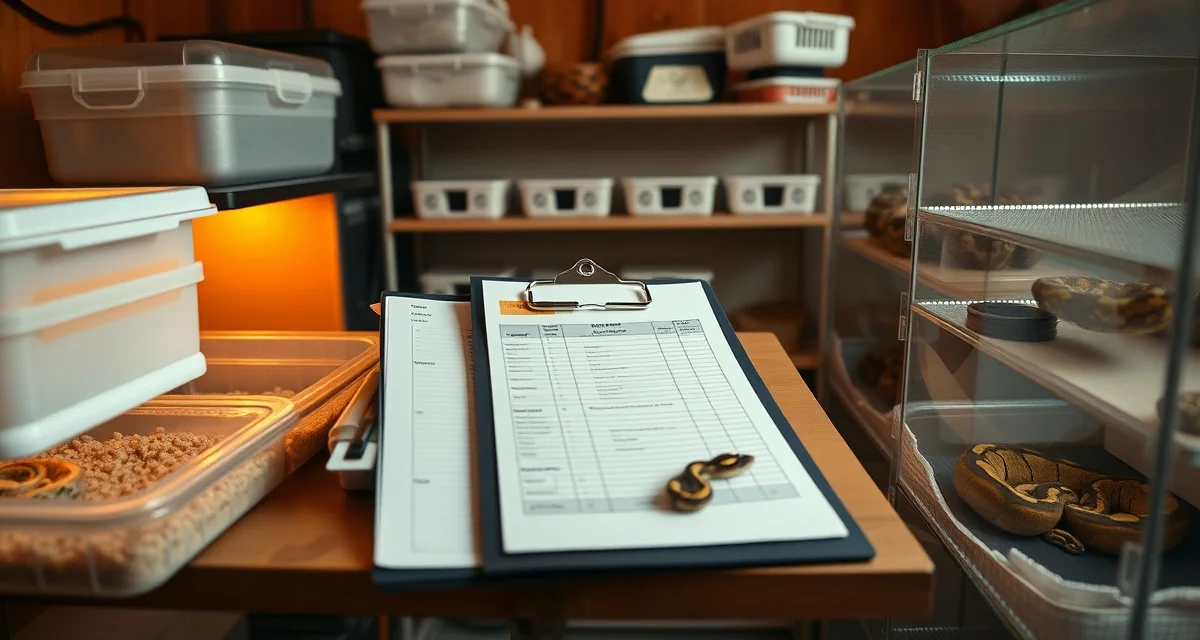
Case Study: First Ball Python Breeding Season Results
Your first ball python breeding season is unlike any other. You'll learn more in six months than in the previous two years of keeping pet snakes. You'll also make mistakes that cost you money, sleep, and occasionally an animal. Understanding what to expect, where the surprises tend to hit, and how to set yourself up for an honest first-season assessment changes how useful that season becomes as a foundation.
TL;DR
- Ball python breeding operations require systematic record-keeping from pre-season preparation through end-of-season sales.
- Females at 1,200-1,500g or more are the target weight before introducing them to a breeding male.
- Ovulation detection is the key event that anchors pre-lay shed and lay date calculations.
- Clutch profitability guide depends on understanding actual cost basis per animal, not just gross sale revenue.
- Well-documented animals with complete feeding histories and clear genetic records consistently sell faster and at higher prices.
This case study follows a first-season ball python breeder through the full arc of their first breeding year, from preparation through hatch to final financial accounting.
Before the Season: What Most First-Timers Underestimate
The breeder in this case study has been keeping ball pythons for two years before the first breeding season. They have 12 animals: three adult females (all 1,500g or above), two adult males, and seven animals of various younger ages. The females include a Pastel, a Mojave, and a 100% het Clown normal. The males include a Banana Pastel and a standard Pastel.
The expectation going in: run three pairings, get two or three clutches, sell some nice animals, make some money.
The reality: breeding season is longer, more complicated, and more expensive than it looks from the outside.
Underestimate #1: Conditioning takes time and money. The females need to be at optimal weight before conditioning for breeding. The het Clown female is slightly underweight at 1,350g. Getting her to 1,600g+ before cooling takes three months of consistent feeding. The prey cost is minor per animal, but it's a real cost that many first-time breeders don't factor into their season calculations.
Underestimate #2: Not all pairings result in eggs. Two of the three planned pairings lock up in the first three weeks of conditioning. One pairing produces only one observed lock throughout the entire season. The Mojave female does not ovulate. This is normal and expected by experienced breeders, but for a first-season breeder expecting three clutches, getting two is a disappointment.
Underestimate #3: Incubation requires equipment and attention. The first clutch is incubated in a styrofoam cooler with a heat cable and a thermostat, a functional setup but one that requires daily monitoring. When the thermostat probe slips during week four and temperatures spike to 94°F for six hours, the breeder checks the setup because they happened to check the thermometer that morning. Not because they had an alert system. The eggs survive, but it's close.
The Clutches
Clutch 1: Pastel female x Banana Pastel male
9 eggs laid, 8 fertile. After 57 days of incubation at 88-89°F, 8 hatchlings: 2 Banana Pastel, 2 Pastel, 2 Banana, 1 normal, 1 animal that pipped but didn't emerge and was assisted out in poor condition. The assisted hatchling survived but was weaker and slower to establish on feed.
Clutch 2: Het Clown female x Banana Pastel male
6 eggs, all fertile. 6 hatchlings: 1 Banana 100% het Clown, 1 Banana (no Clown gene), 2 100% het Clown normals, 1 normal, and 1 Banana Pastel with no Clown gene. No visual Clowns (expected: 25% chance of visual, which statistically requires more clutches to prove out).
No visual Clowns from the het x het pairing. This is statistically possible, a 25% expected ratio means it absolutely can happen without any visual animals in a 6-egg clutch. But for a first-season breeder who expected to see a Clown, it's a deflating result. Experienced breeders know this is how recessive genetics guide work.
Selling the Hatchlings
The breeder lists animals on MorphMarket in September. The experience reveals several realities:
Photography matters a lot. The first few photos are taken quickly on a plastic tub lid under fluorescent lighting. Inquiries are slow. When the breeder takes better photos in natural light against a neutral background, messages pick up noticeably. Listing quality has a direct effect on inquiry volume and sale price.
Buyers ask detailed questions. "When were they born?" "When did they take their first meal?" "Are they on f/t?" "What are their parents?" "Do you have photos of the parents?" Being able to answer these questions immediately, with accurate records, closes sales faster. Fumbling the answers loses buyers.
The assisted hatchling sells last and at a discount. Despite being genuinely healthy by the time it goes to sale, the history of needing assistance means the breeder discloses this to buyers. Most pass. It eventually sells for $60 less than siblings.
Het animals sell more slowly than visuals. The 100% het Clown animals generate notable interest from other breeders building Clown projects. But they take 5-6 weeks to sell, while the Banana and Banana Pastel animals sell within a week of listing. Cash flow is uneven.
Financial Accounting: First Season Reality
Revenue:
- 2 Banana Pastel: $180 each = $360
- 2 Pastel: $80 each = $160
- 2 Banana: $120 each = $240
- 1 normal: $60
- 1 assisted hatchling: $60
- 1 Banana 100% het Clown: $250
- 2 100% het Clown normals: $120 each = $240
- 1 Banana (no het): $120
- 1 Banana Pastel (no het): $180
Total revenue: $1,670
Costs:
- Original animal acquisition (prorated for breeding animals): $1,200
- Annual care costs for all animals (food, electricity, substrate): $1,800 for the full collection
- Incubation equipment: $150
- MorphMarket listing fees and shipping supplies: $180
- Vet consultation for assisted hatch: $85
Total costs (first season): $3,415
First season net: -$1,745
This number looks discouraging. But it needs context: it includes the full acquisition cost of the breeding animals, which are multi-year assets that will generate revenue for years. Without that acquisition cost, the season returns a modest positive on operating costs alone. And Year Two, with established animals and no acquisition cost to amortize, will look notably better.
Lessons Documented for Year Two
The most valuable outcome of a first season isn't the revenue: it's what you learn if you're paying attention.
The HatchLedger platform lets you document observations, clutch notes, and financial outcomes throughout the season rather than trying to reconstruct everything at the end. Breeders using integrated software report 30% less time on administrative tasks, but the deeper benefit for first-season breeders is having a structured record to analyze rather than relying on memory.
Lessons from this case study's first season:
- Temperature monitoring needs redundancy, not just a thermostat
- Better photography is worth the time investment before listing
- Recessive project timelines require realistic expectation-setting
- Het animals take longer to sell and should be planned for in cash flow projections
- Assisted hatchlings should be fully disclosed immediately at listing, not as an afterthought
Year Two with this foundation is a much more informed, much more strategic season.
The reptile breeder software comparison covers tools that support this kind of season-to-season learning and financial tracking.
Frequently Asked Questions
What is the best approach to ball python first season case study?
Approach your first season as an education investment, not purely a profit opportunity. Track every expense and every outcome from the beginning, document what worked and what didn't for each clutch and each pairing, and set realistic financial expectations that account for full acquisition costs and the slower revenue from het animals. The data you collect in Year One makes Year Two notably more profitable.
How do professional breeders handle ball python first season case study?
Experienced breeders mentor first-time breeders to focus on learning systems: animal conditioning, incubation monitoring, hatchling care, and sales process. They emphasize record-keeping from Day One and realistic financial modeling that includes acquisition cost amortization. Most recommend starting smaller than you think you need to, because fewer pairings done well teaches more than many pairings done carelessly.
What records should every reptile breeder maintain per animal?
At minimum: acquisition date and source, morph and genetic documentation, feeding log, weight history, any veterinary treatments, and breeding history including pairing dates, clutch of origin for captive-bred animals, and offspring records. These records serve your own management, buyer documentation, regulatory compliance, and long-term genetic tracking.
How should reptile breeders document genetics for buyers?
A complete genetic record for sale includes the animal's visual morph name, confirmed het genes and their basis (parentage documentation or proven-out production), possible het genes with probability percentages, hatch date, and parent morph information. Including clutch-of-origin records lets buyers independently verify the claims.
Sources
- USARK (United States Association of Reptile Keepers)
- Association of Reptilian and Amphibian Veterinarians (ARAV)
- World of Ball Pythons (WoBP genetics reference database)
- MorphMarket (reptile industry marketplace)
- Reptiles Magazine (Bowtie Inc.)
Get Started with HatchLedger
Every part of a ball python breeding operation -- from pairing records to clutch documentation to financial tracking -- works better when the data is connected rather than scattered across notebooks and spreadsheets. HatchLedger is built for exactly that. Try it free with up to 20 animals.