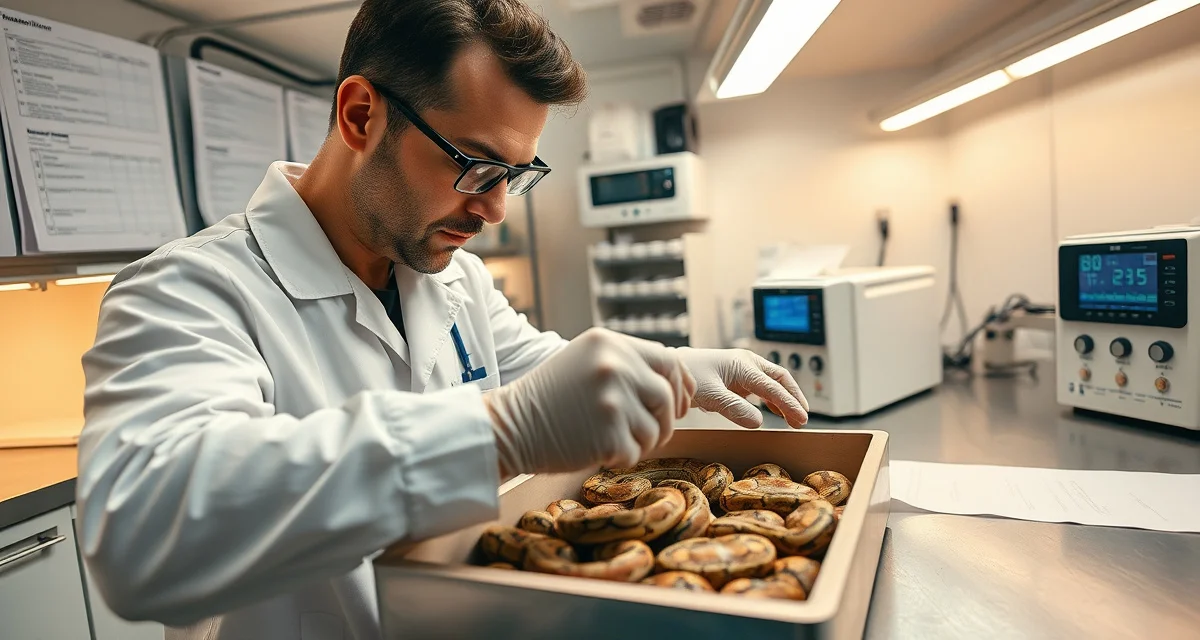
Ball Python Breeding: Complete Hub for Professional Breeders
By HatchLedger Editorial Team · Published 2025-02-15 · Updated Mar 13, 2026
Ball python breeding looks simple from the outside. Put two animals together, collect eggs, hatch babies, sell them. Do that a few seasons and you quickly find out it's a logistics problem, a genetics problem, a financial planning problem, and a customer management problem, all running simultaneously from October through August.
TL;DR
- Ball python breeding season runs October through March for pairings, January through May for egg laying, and April through July for hatching.
- Females should weigh at least 1,200g before breeding, with most experienced breeders preferring 1,500g or more.
- Ovulation detection is a 24-48 hour window that anchors the entire downstream timeline -- missing it means estimating rather than calculating lay and hatch dates.
- Average clutch sizes are 4-6 eggs, with ranges of 1-11; larger, older females tend toward the higher end.
- Administrative complexity scales faster than animal count -- a solid record-keeping system is necessary before 30+ animals, not after.
This hub covers every stage of that process: pairing decisions, ovulation tracking, incubation management, hatchling processing, genetics documentation, and the sales cycle that follows. Whether you're running 15 animals out of a spare bedroom or managing 300 in a dedicated reptile room, the fundamentals are the same. The complexity just scales.
The Problem With How Most Breeders Operate
Most breeders start with a notebook. Then a spreadsheet. Then two spreadsheets. Then a folder of photos, a notes app, a separate feeding log, and a financial tracker that's always three months out of date.
By mid-season, when you've got four clutches in the incubator, six pairs still cycling, and 30 hatchlings that need to eat before they go on sale, the system breaks down. You can't remember which Pastel het Clown female you paired last, whether egg #4 from clutch 2 was looking viable last week, or what you actually spent on feeders in September.
That information gap costs money. A missed pairing window means waiting another season. Poor incubation documentation means you can't diagnose what went wrong with a bad clutch. No financial tracking means you don't know which morphs actually make you money.
How a Structured Breeding Operation Works
Season Planning
Ball python breeding season in the northern hemisphere typically runs October through March for pairings, with egg laying happening January through May and hatching from April through July, though some females will go later.
Before the season starts, you need to know:
- Which females are at breeding weight (typically 1,200g minimum, most experienced breeders prefer 1,500g+)
- Which males are conditioned and healthy
- What morphs you're pairing and what outcomes you're targeting
- How many clutches your incubator setup can handle simultaneously
Planning pairings before the season means you're not making reactive decisions in February when a female you hadn't planned on breeding starts looking gravid.
Cooling and Conditioning
Ball pythons don't require true brumation like many colubrids, but a temperature drop stimulates breeding behavior. Most breeders drop ambient temps 3-5°F in September/October, from standard 88-90°F hot spots to 82-84°F ambient, with night drops to 72-76°F.
Feeding frequency also drops during this period. Females in particular should be well-fed going into the season but not overfed in the weeks before introduction, an overweight female is more likely to go off feed and delay ovulation.
Pairing and Lock Documentation
Once you introduce a pair, lock documentation matters. Log the date of every confirmed lock. Ball pythons can lock multiple times across several weeks, a female may lock 8-15 times before ovulating. The gap between first lock and ovulation is highly variable, which is why date tracking matters for estimating when to look for ovulation signs.
Not every introduction results in a lock. Males can be disinterested, females can be unreceptive, or timing may be off. If you're seeing no locks after 2-3 introductions over 2 weeks, pull the pair and try a different male or revisit conditioning.
Ovulation Detection
Ovulation is the event that determines your entire incubation timeline. The female develops a visible mid-body swell, typically lasting 24-48 hours, that can be easy to miss if you're not checking frequently. Post-ovulation, the female will go through a pre-lay shed approximately 28-35 days later, and eggs will be laid roughly 28-35 days after that shed.
If you miss the ovulation but catch the pre-lay shed, you can still estimate lay date accurately. If you miss both, you're guessing, and that creates problems when managing multiple clutches in the same incubator.
Clutch Management
Ball python clutch sizes average 4-6 eggs but can range from 1-11. Larger females tend to produce larger clutches. First-time breeders often produce smaller clutches.
When eggs are laid:
- Check each egg for fertility (fertile eggs are white, firm, and slightly sticky when laid, slugs are yellow, deflated, and separate from the clutch)
- Pull eggs carefully if you're artificial incubating, don't rotate them once positioned
- Weigh the clutch immediately for baseline tracking
- Set up your incubation container with appropriate substrate (vermiculite at roughly 1:1 water-to-substrate by weight, or perlite)
Incubation Parameters
Ball python eggs incubate at 88-90°F. Higher temps speed development but reduce hatch window and increase deformity risk. Lower temps slow everything down and can cause developmental issues below 85°F.
Humidity should stay at 95-100% inside the egg box. Eggs that desiccate will dimple and often die. The substrate should maintain moisture without standing water in the box.
At 88-90°F, expect hatching at 54-60 days from lay date. Cooler temps can push this to 65-70 days.
Hatchling Processing
Hatchlings typically pip 1-3 days before fully emerging. Don't assist too early, give them 24-48 hours after pip before intervening. Once out, document:
- Hatch date
- Weight (healthy hatchlings typically weigh 55-90g)
- Morph identification
- Any physical notes
First shed usually happens 7-14 days post-hatch. Most breeders wait until after first shed to attempt first feed. Offer an appropriately sized frozen/thawed mouse or rat pup. Ball python hatchlings can be stubborn feeders, this is normal. Scenting, small prey size, and darkened feeding boxes all help.
Key Features for Managing a Breeding Operation
Pairing and Cycle Tracking
Logging every introduction, lock, ovulation, and pre-lay shed date creates a complete breeding record per female. When that female produces a clutch, you can trace the genetics forward. When something goes wrong, a failed pairing, a problem clutch, a hatchling with developmental issues, you can trace backward.
Incubation Timeline Management
With multiple clutches in the incubator, knowing which eggs were laid when and when to expect pips prevents scrambles. Hatch window alerts mean you're not missing late-night or early-morning pip events that need attention.
Genetics and Lineage Engine
Ball python genetics gets complicated fast. A Pastel het Clown looks identical to a visual Pastel with no recessives. A Super Cinnamon is visually distinct from a regular Cinnamon but the difference only matters if you know the parents. Tracking parent morphs, confirmed genetics, and het status, and being able to pull that information for every animal, prevents mistakes and improves sale documentation.
Hatchling Inventory Tracking
When you're processing 60 hatchlings across five clutches, inventory tracking prevents mis-labeling errors. Each animal gets a record: morph ID, hatch date, weight, feeding history, sex (if probed or popped), and sale status.
Buyer Pack Generator
Buyers increasingly expect documentation. A complete buyer pack typically includes: morph name and genetic makeup, hatch date, weight at sale, feeding history, parent information, and care guidance. Generating this automatically from your existing records saves time and improves buyer experience.
Budget Calculator and Clutch P&L
Every clutch has a cost basis: the proportional acquisition cost of the parents, feeder costs allocated to the breeding season, incubation supplies, electricity, and time. Knowing what a clutch cost to produce tells you what margin you're actually making, not just gross revenue.
HatchLedger vs. Alternative Approaches
| Feature | HatchLedger | Google Sheets | HerpTrack | MorphMarket |
|---|---|---|---|---|
| Breeding cycle tracking | Yes | Manual | Basic | No |
| Genetics/lineage engine | Yes | Manual | No | Visual only |
| Incubation timeline + alerts | Yes | Manual | No | No |
| Hatchling inventory | Yes | Manual | Basic | Listings only |
| Buyer pack generation | Yes | No | No | No |
| Budget/P&L tracking | Yes | Manual | No | No |
| Multi-user access | Yes (Collective plan) | Via sharing | No | No |
| Price | $19-$99/mo | Free | Free | $10-$30/mo |
MorphMarket is a marketplace, not an operations platform. It's excellent for selling animals -- it's where buyers look -- but it doesn't track your breeding cycles, incubation timelines, or financials. You still need a system behind it.
HerpTrack is free and handles basic husbandry logging, but it doesn't connect feeding records to breeding outcomes, doesn't have financial tracking, and isn't built for the workflow of an active breeding season.
Spreadsheets work until they don't. When you're maintaining 10+ tabs, cross-referencing parent genetics manually, and emailing yourself reminders about hatch windows, you're spending time on administration that could go toward the animals.
Related Articles
- Ball Python Breeding Business: Complete Guide
- Breeding Records for Tax Purposes: What Ball Python Breeders Need to Track
- Scaling a Ball Python Breeding Program from Hobbyist to Professional
- Ball Python Pied Morph Breeding Projects: Complete Guide
FAQ
What weight should a female ball python be before breeding?
Most experienced breeders won't breed females under 1,200g, and many prefer to wait until 1,500g. Weight matters more than age -- a female that hits 1,500g at 18 months is ready before a female that's 3 years old but only 900g due to poor feeding history. Males can breed at smaller sizes, typically 400-600g, though larger males tend to be more reliable.
How many clutches can a female ball python produce per year?
Most females produce one clutch per season. Some will double-clutch -- typically high-producing individuals kept in very consistent conditions -- but this is the exception. Pushing a female to double-clutch every season without adequate recovery time and nutrition will wear her down over multiple years. Track body weight before and after breeding season to monitor condition.
How long does ball python incubation take?
At 88-90 degrees Fahrenheit, expect 54-60 days from lay date to hatch. Slightly lower temps (86-87 degrees) can push this to 65+ days. Higher temps above 91 degrees risk developmental problems and are generally avoided. Humidity maintained at 95% or higher throughout is as important as temperature. Track individual clutch lay dates so you know when to start watching for pips.
How many breeding females can one person manage effectively?
Most solo breeders can actively manage 15-30 breeding females while keeping administration under control. Beyond 30 breeding females, the combination of pairing schedules, ovulation monitoring, incubation management, hatchling processing, and sales becomes very difficult to track without dedicated software. The limiting factor is usually administrative time, not physical animal care time.
What is the biggest mistake first-year ball python breeders make?
Missing the ovulation swell. The window is 24-48 hours, and if you are not checking females daily during the pairing period, it is easy to miss. Without the ovulation date, you lose your anchors for pre-lay shed window and expected lay date. The downstream effect is that you are watching multiple females without knowing which is about to lay.
What is Ball Python Breeding: Complete Hub for Professional Breeders?
Ball Python Breeding: Complete Hub for Professional Breeders is a comprehensive guide published on HatchLedger covering every stage of the ball python breeding process. It addresses pairing decisions, ovulation tracking, incubation management, hatchling processing, genetics documentation, and the sales cycle. Designed for breeders at all scales—from 15 animals in a spare bedroom to 300 in a dedicated reptile room—it treats breeding as the logistics, genetics, financial, and customer management challenge it actually is across a season running October through August.
How much does Ball Python Breeding: Complete Hub for Professional Breeders cost?
HatchLedger's Ball Python Breeding hub is free to read. HatchLedger is an online resource for reptile breeders, and this guide is published as educational content available to anyone. Some tools or record-keeping features on HatchLedger may require an account or subscription, but the core breeding guide itself carries no cost to access.
How does Ball Python Breeding: Complete Hub for Professional Breeders work?
The guide walks breeders through the full seasonal cycle: pairing females (minimum 1,200g, ideally 1,500g+) starting in October, monitoring for the 24–48 hour ovulation window that anchors all downstream dates, managing incubation of average 4–6 egg clutches, and processing hatchlings through to sale. It also covers record-keeping systems—essential before you reach 30+ animals—and genetics documentation, giving breeders a repeatable operational framework rather than ad hoc season-by-season decisions.
Sources
- USARK (United States Association of Reptile Keepers)
- Association of Reptilian and Amphibian Veterinarians (ARAV)
- World of Ball Pythons (WoBP genetics reference database)
- MorphMarket (reptile industry marketplace)
- Reptiles Magazine (Bowtie Inc.)
Get Started with HatchLedger
Whether you are running 15 animals or 300, pairing records, ovulation dates, incubation timelines, hatchling inventories, and financials all need to live somewhere organized and connected. HatchLedger is built for exactly that workflow. Try it free with up to 20 animals -- no credit card required.