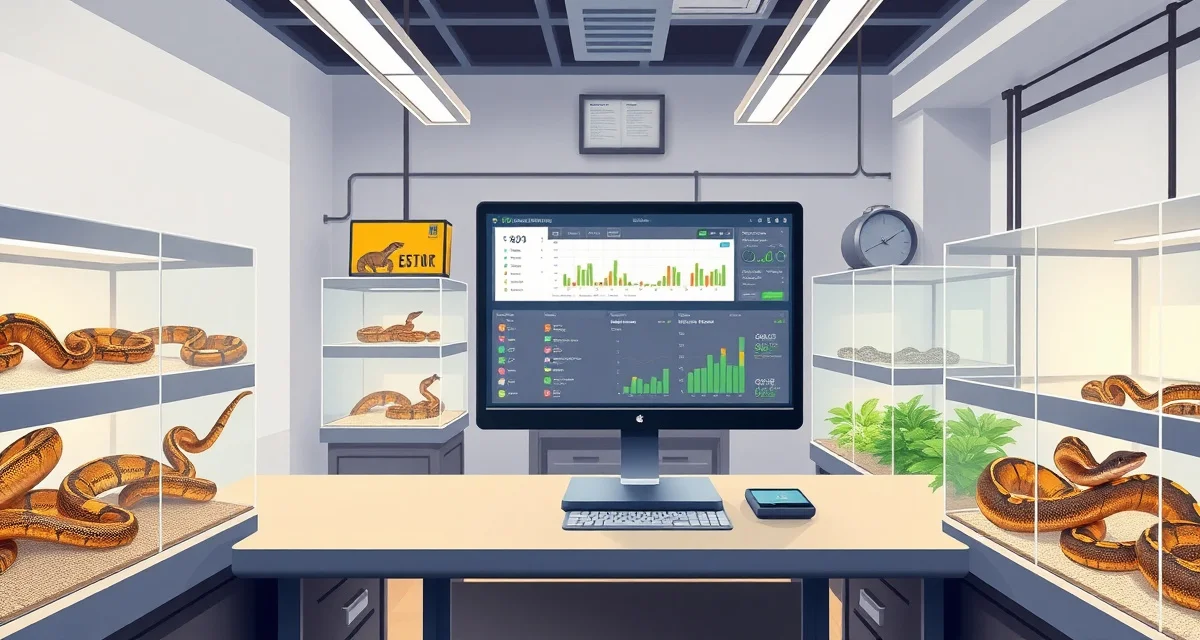
Case Study: Managing 100 Ball Pythons with HatchLedger
A hundred ball pythons sounds like a milestone. And it is. But somewhere around 60-70 animals, most breeders start to realize that the systems they used when they had 20 snakes don't work anymore. The notepad and memory combination breaks down. The spreadsheet with 40 tabs becomes a maintenance burden. Animals get mislabeled. Feeding records fall behind. At the end of the season, you're not sure which clutches actually made money.
TL;DR
- Ball python breeding operations require systematic record-keeping from pre-season preparation through end-of-season sales.
- Females at 1,200-1,500g or more are the target weight before introducing them to a breeding male.
- Ovulation detection is the key event that anchors pre-lay shed and lay date calculations.
- Clutch profitability guide depends on understanding actual cost basis per animal, not just gross sale revenue.
- Well-documented animals with complete feeding histories and clear genetic records consistently sell faster and at higher prices.
This case study walks through what a 100-animal operation actually looks like, where the management challenges are, and how purpose-built software changes the experience.
What a 100-Animal Collection Looks Like
A hundred ball pythons is a serious breeding operation, but it's not enormous by industry standards. At this scale, you probably have:
- 20-25 breeding females, varying in age and genetic complexity
- 15-20 breeding males
- 30-40 animals in various juvenile and sub-adult stages (holdbacks, animals from last season, animals growing toward breeding age)
- 10-15 hatchlings from the current season
The genetic complexity is notable. If you're running a diverse program with multiple recessive projects plus co-dominant combos, you might have animals carrying 3-5 different gene combinations. Tracking which animal is which, what it carries genetically, and where it is in your collection is non-trivial.
The Feeding Challenge
One hundred animals need to eat roughly every 7-14 days. That's somewhere between 50 and 100 feeding events per week. Some are adults on large rats. Some are hatchlings on pinky mice. Some are gravid females who are refusing. Some are males off feed during breeding season.
Managing this manually means either an elaborate paper calendar system or extremely reliable memory. Most breeders who've scaled past 50 animals have a story about the week they forgot to feed a whole rack section, or the time they fed an animal twice and caused a regurgitation because they lost track.
A digital feeding log that's animal-specific and date-stamped eliminates this class of error. You check the record, you know the last feeding date, you log the new feeding when it happens. The log is searchable: when a buyer asks "how often does this animal eat?" you can pull up the last six months of feeding history instantly.
The Health Tracking Problem
At 100 animals, health events become statistically inevitable. You'll have animals going through retained shed. A respiratory infection will show up somewhere. A breeding female will have a difficult lay. A hatchling won't establish on feed.
Each of these events needs to be logged against the specific animal and tracked through resolution. When did the symptoms start? What treatment was given? What was the outcome? If the respiratory infection recurs three months later, the vet needs that history.
Without a health log, this information lives in your memory until it doesn't. After six months, you might remember that an animal "had some breathing issues last spring" but not the dates, the treatment, or what resolved it.
The Genetic Complexity at Scale
At 100 animals across multiple recessive and co-dominant projects, managing genetic records manually is where most breeders hit a wall. The questions that need immediate answers during pairing season:
- Which females are visual Clown?
- Which females are 100% het Pied?
- Which males carry both Banana and het Clown?
- Which animals from last season's clutches are pos-het for Axanthic?
If the answers are in a spreadsheet with one row per animal, pulling this information requires sorting, filtering, and often hunting through multiple tabs to cross-reference parentage. If it's in a purpose-built animal record system, you filter by gene and the list appears.
Pairing decisions at 100 animals require this kind of genetic query capacity. Trying to hold it all in memory or navigate a flat spreadsheet during active breeding season creates errors and missed opportunities.
What HatchLedger Actually Changed
In the context of this case study, the breeder transitioned from a combination of spreadsheets, a paper feeding calendar, and a separate health journal to HatchLedger mid-season.
The first immediate change: every animal got a digital record. Name, ID, date of birth, genetic profile, weight history, feeding history. The setup took two full days but produced a searchable, thorough database of the entire collection.
Second change: feeding logs went into HatchLedger daily instead of a paper calendar. Within two weeks, the breeder had already caught two animals whose last feeding was logged further back than expected, one of which turned out to have a minor respiratory issue.
Third change: clutch records connected to parent records automatically. When a clutch hatched, the hatchlings were entered as offspring of the specific pairing, inheriting parentage documentation automatically. Het status could be calculated from parent genetics guide rather than having to work it out manually for every hatchling.
At the end of the first full season with HatchLedger, the breeder ran a clutch P&L for every breeding pair. Total revenue per clutch, total estimated costs (prorated from annual feeding and care expenses), and net margin by pairing. This had never been done before: every previous season's financials were a rough estimate.
The results were instructive. Three pairings consistently underperformed financially. Two were underperforming because the animals were priced too low compared to what similar animals were selling for on MorphMarket. One was genuinely a poor pairing in terms of genetic value of offspring, the combination wasn't producing animals anyone wanted to pay a premium for.
Breeders using integrated software report 30% less time on administrative tasks. In this case, the time savings came primarily from eliminating the daily effort of maintaining parallel systems (spreadsheet, paper calendar, health journal) and from the time saved at the end of the season when financial reconciliation previously took three weeks and now took a few hours.
The Ball Python Breeding Hub as Reference
Running a 100-animal collection requires systematic access to husbandry information as well as record-keeping tools. The breeding hub provides context for decision-making across genetics, incubation, health, and business management, complementing the data management that HatchLedger provides.
What Still Requires Attention at This Scale
HatchLedger doesn't automate care. It doesn't feed the animals, check temperatures, or identify problems visually. The physical daily care of 100 animals still requires showing up and paying attention. What software does is make the management overhead of that care much more manageable, so that attention stays on the animals rather than on the administrative burden of tracking everything that happens to them.
The reptile breeder software comparison covers how HatchLedger compares to spreadsheets and other tools for operations at different scales.
Frequently Asked Questions
What is the best approach to managing 100 ball pythons case study?
Build systematic processes for feeding, health monitoring, and genetic record-keeping before you reach 100 animals, not after. At this scale, ad hoc tracking systems consistently fail. Purpose-built software gives you searchable animal records, feeding logs with date history, health event tracking, and per-clutch financial data in one connected system that scales with your operation.
How do professional breeders handle managing 100 ball pythons case study?
Professional breeders at this scale treat record-keeping as a core operational function, not an afterthought. They log every feeding event, every health observation, and every clutch outcome in a system that's searchable and exportable. They run per-clutch financial analysis at the end of each season to identify which pairings are generating real margin and which need to be reconsidered.
What records should every reptile breeder maintain per animal?
At minimum: acquisition date and source, morph and genetic documentation, feeding log, weight history, any veterinary treatments, and breeding history including pairing dates, clutch of origin for captive-bred animals, and offspring records. These records serve your own management, buyer documentation, regulatory compliance, and long-term genetic tracking.
How should reptile breeders document genetics for buyers?
A complete genetic record for sale includes the animal's visual morph name, confirmed het genes and their basis (parentage documentation or proven-out production), possible het genes with probability percentages, hatch date, and parent morph information. Including clutch-of-origin records lets buyers independently verify the claims.
Sources
- USARK (United States Association of Reptile Keepers)
- Association of Reptilian and Amphibian Veterinarians (ARAV)
- World of Ball Pythons (WoBP genetics reference database)
- MorphMarket (reptile industry marketplace)
- Reptiles Magazine (Bowtie Inc.)
Get Started with HatchLedger
Every part of a ball python breeding operation -- from pairing records to clutch documentation to financial tracking -- works better when the data is connected rather than scattered across notebooks and spreadsheets. HatchLedger is built for exactly that. Try it free with up to 20 animals.