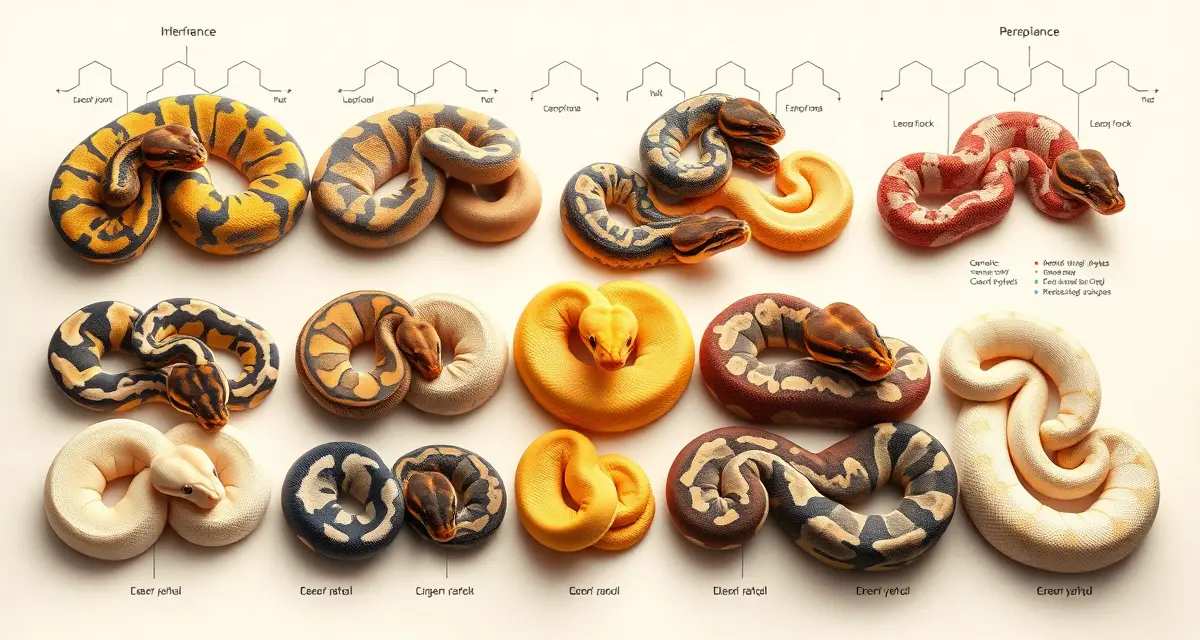
Ball Python Genetics: A Complete Guide for Breeders
Ball python genetics is one of the most documented systems in reptile keeping. With hundreds of identified morphs and decades of breeding data, the underlying patterns are well understood. Knowing those patterns is what separates a breeder who plans pairings from one who hopes for interesting outcomes.
Three Inheritance Patterns
Every ball python morph falls into one of three genetic categories. These categories determine how the gene is inherited, how it expresses visually, and how you have to approach breeding projects.
Recessive Morphs
Recessive morphs require two copies of the gene to express visually. A single copy produces no visible change in appearance, the animal is a het (heterozygous carrier).
Key recessive morphs:
- Piebald: incomplete white patterning, variable expression from small white patches to mostly white with colored head
- Clown: reduced, flowing pattern with deep reddish-brown coloration, highly variable expression
- Axanthic: reduces yellow pigment, producing black, white, and gray animals
- Ultramel: reduces melanin, producing a warm orange-brown with red eyes; related to caramel albino genetics
- Albino (Amelanotic): no black pigment, bright yellow and white with red/pink eyes
- Lavender Albino: no black pigment, lavender-tinted whites with reddish pattern
- Ghost (Hypo): reduces black pigment moderately, producing a "washed out" appearance
Breeding recessives: To produce visual recessive offspring, you need two het parents, one visual and one het parent, or two visual parents. When both parents are het, expected ratio is 25% visual, 50% het, 25% normal (visually identical to normal, no het for this gene).
Het verification: You cannot see a het. A normal-looking ball python might be het for piebald, clown, or any recessive. The only ways to verify het status are: documented parents where genetics are confirmed, or test breeding (pairing to a visual and producing visual offspring).
Codominant Morphs
Codominant morphs express visually with one copy of the gene and produce a distinct "super" form with two copies.
Key codominant morphs:
- Pastel: brightened yellows, reduced black banding, enhanced pattern
- Enchi: amber base, reduced inter-saddle pattern, combinatorial value
- Fire: reduced black pigment, contributes to Blue-Eyed Lucy complex
- Lesser and Butter: moderate color change, central to BEL complex combinations
- Mojave: strong pattern, mid-saddle blushing, BEL complex
- Phantom, Mystic, Russo: pattern modifiers, all BEL complex contributors
- Black Pastel and Cinnamon: darkening genes, Fire complex, problematic super forms
- Champagne: mild wobble in single copy, lethal in super form
The Blue-Eyed Lucy (BEL): Any combination of two Fire complex genes, Fire, Lesser, Butter, Mojave, Phantom, Mystic, Russo, and others, produces an all-white snake with blue eyes. Fire/Fire (Super Fire) produces white with dark eyes. Knowing which genes are in your collection and which combinations produce BELs is essential for intentional breeding.
Dominant Morphs
True dominant morphs express with one copy and do not produce a meaningfully different super form, or the super form is not viable. In ball python breeding, some sources use "dominant" loosely for codominants, but true dominant morphs include:
- Spider: high-contrast spider web pattern; all visual Spiders carry the gene. Two copies (Super Spider) is rarely or never produced because sperm carrying two copies may not function. Spider carries a wobble neurological condition affecting balance and coordination to varying degrees.
- Pinstripe: thin, reduced dorsal stripe pattern; reduces pattern significantly
- Woma: flattened, flowing pattern; the Woma gene also causes neurological issues in some animals
- Bongo: a recently confirmed dominant from Africa
Dominant morphs pass the gene to 50% of offspring when bred to a normal. Unlike codominants, breeding dominant-to-dominant does not produce a distinct super form that survives.
The Het System
"Het" is short for heterozygous. An animal that is het for piebald carries one copy of the piebald gene and looks like a normal (or like whatever other morphs it visually expresses). If it carries Pastel codominantly, it's a Pastel het Piebald.
Possible het vs. confirmed het:
When both parents of an animal are documented hets, the animal has a 67% chance of being het itself (from 25% visual : 50% het : 25% normal offspring ratio, the non-visual animals are 2/3 het, 1/3 normal). This is sold as "66% possible het" or just "possible het."
Confirmed het status requires either:
- Both parents being visual for the recessive (guarantees het offspring)
- Test breeding: the animal has produced visual offspring when paired to a visual or het animal
Accurate het documentation is one of the most valuable things you can maintain in a breeding program. HatchLedger tracks confirmed, possible, and unknown het status per gene per animal, and updates probable het percentages automatically based on parent records.
Multi-Gene Animals
Animals expressing multiple genes are where the complexity compounds. A Pastel Fire het Clown looks like a Pastel Fire. Its het Clown status is invisible. When you pair it to a female that's also het Clown, 25% of the offspring will be Pastel Fire Clown, Pastel Clown, Fire Clown, or Normal Clown, visual Clowns with or without the additional codominant genes.
Understanding all the genes in play is the foundation of intentional combo breeding.
Related content: Ball Python Co-Dominant Morphs | Het Genetics Breeding Records | Recessive Morph Projects
Sources
- World of Ball Pythons genetics database
- Ball Python Breeders Association genetics documentation
- USARK reptile genetics resources