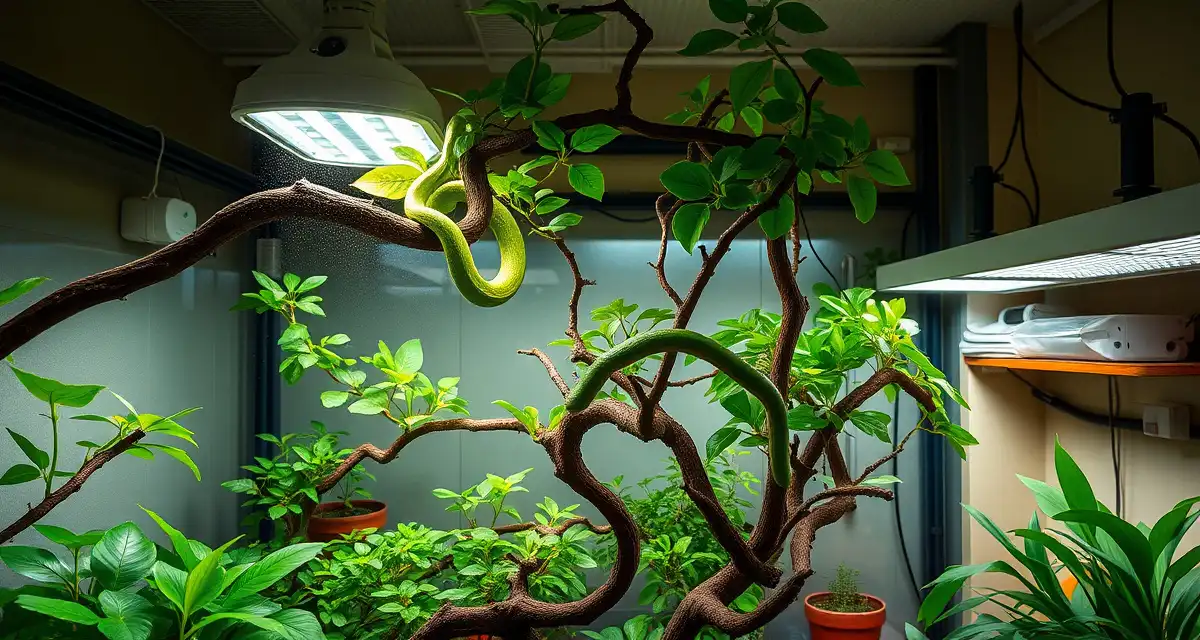
Green Tree Python Breeder Setup and Housing: Complete Breeder Guide
By HatchLedger Editorial Team · Published 2025-05-22 · Updated Mar 13, 2026
Green tree python breeder setup and housing decisions directly affect your animals' health, breeding performance, and your operational efficiency. GTPs have specific requirements that differ significantly from ground-dwelling pythons, and a breeding room designed without understanding these needs will create ongoing problems. Breeders using integrated software report 30% less time on administrative tasks, and a well-designed physical setup reduces daily care time even further.
TL;DR
- Green tree pythons (Morelia viridis) are arboreal specialists requiring perch-based enclosures and husbandry quite different from terrestrial pythons.
- Breeding is triggered by a dry season simulation with reduced humidity and a modest temperature reduction over 6-8 weeks.
- Clutch sizes average 12-25 eggs, with Biak locale animals producing larger clutches than Sorong or Aru.
- Incubation runs 47-52 days at 84-86 degrees Fahrenheit, shorter than most python species at equivalent temperatures.
- Locale documentation is critical: Biak, Sorong, Aru, Kofiau, and locality blends all carry distinct market values and buyer expectations.
This guide covers the practical decisions involved in setting up a GTP breeding facility, from individual enclosure selection to room-level design considerations.
Individual Enclosure Selection
Enclosure Types
GTP breeders use several enclosure styles, each with trade-offs:
PVC front-opening arboreal enclosures are a popular choice for breeding programs. They hold humidity well, are easy to clean, and provide good temperature retention. The front-opening design allows easy access for feeding and husbandry without reaching in from above, which can stress arboreal animals.
Glass terrariums with mesh tops provide visibility and work well in humid climates but can be difficult to maintain humidity in dry regions. They're heavier and more fragile than PVC.
Custom-built PVC or aluminum enclosures allow you to design around your specific room layout and collection size. For breeders with 20+ animals, custom builds can be more cost-effective than purchasing equivalent commercial enclosures.
Screen enclosures provide excellent ventilation but require additional humidity management. In arid climates, maintaining appropriate humidity in screen enclosures is challenging and adds to daily care demands.
Enclosure Sizing
Adult breeding females benefit from enclosures at least 24" x 24" x 36" (width x depth x height). Males can be housed in slightly smaller units. Hatchlings and juveniles should be in smaller enclosures sized to their current size, moving up as they grow.
Avoid oversizing hatchling enclosures. Young GTPs feel exposed in too much space and may refuse to feed or show increased stress.
Perch Setup Within Enclosures
Every GTP enclosure needs at minimum one main perch at mid-to-upper height. Horizontal or gently angled perches at the diameter of the animal's mid-body are standard. Provide perches at different heights to allow the animal to thermoregulate by moving along the temperature gradient.
Natural branches need regular cleaning and eventual replacement. PVC pipe wrapped in rope or cork-veneered branches are low-maintenance alternatives.
Heating and Lighting Systems
Heating
GTPs don't use belly heat the way ball pythons or other ground-dwelling species do. They thermoregulate by moving between zones at different ambient temperatures within their enclosure. Provide ambient warmth from above using radiant heat panels, deep heat projectors, or ceramic heat emitters on thermostats.
Target a warm zone of 84-88°F at the top perch area and a cooler zone of 78-80°F toward the bottom of the enclosure. Allow nighttime temperatures to drop slightly to 76-80°F.
Every heat source should be on a quality thermostat with a probe at the appropriate location. Use thermostats rated for reptile keeping; cheap dimmer switches offer inadequate protection.
Lighting
Provide a 12-hour light cycle. LED lighting in the 6500K range supports plant health if you're keeping live plants and provides appropriate visual lighting for your animals. UVB lighting for GTPs remains a subject of debate, but there's growing evidence that low-level UVB access supports overall health.
Place your lights on timers for consistent photoperiod. During breeding seasonal cycling, you'll adjust photoperiod length as part of your seasonal protocol.
Humidity Management
Misting Systems
Manual misting twice daily works for small collections of 5 to 10 animals. For larger collections, automated misting systems save significant time and provide more consistent humidity delivery.
Automated systems can be set to mist on a schedule, typically morning and early evening. If your animals are rack-housed or in close proximity, design the misting system so each enclosure receives adequate coverage without over-saturating enclosures near the mister output.
Drainage
High humidity environments produce significant water. Plan your room's drainage before setting up enclosures, not after. Enclosures that overflow onto wood surfaces cause mold growth and structural damage over time.
Tile or epoxy-coated concrete flooring is preferable to wood for a GTP breeding room. Drainage systems positioned under enclosure areas prevent water accumulation.
Breeding Room Layout
Quarantine Space
Your breeding room should include or be adjacent to a dedicated quarantine space. This is a separate area with distinct equipment, lighting, and airflow from your main collection. New animals go here for 90+ days before joining the main collection.
Organization for Scale
As your collection grows beyond 10 to 15 animals, organization becomes critical. Label every enclosure with the animal's ID, morph, and locale. Keep a physical reference that matches animals to enclosure locations, updated whenever animals move.
Digital records in HatchLedger's reptile breeder hub allow you to log enclosure location for each animal and update it when animals move. This becomes essential when you're cycling multiple females through different housing setups during breeding season.
Storage and Work Areas
Plan for storage of supplies: feeders, substrate, cleaning equipment, incubation materials, hatchling enclosures. A dedicated work surface for feeding prep, record-keeping, and animal handling reduces cross-contamination between enclosures.
Incubation Setup
Your breeding room or an adjacent space needs a dedicated incubation area. Incubators should be away from direct sunlight and temperature extremes. If multiple incubators are running simultaneously, position them so heat output doesn't affect each other's temperatures.
Label every incubation container with clutch ID, lay date, and expected hatch window. Connect these physical labels to your digital records in reptile breeder software comparison-recommended software so that every piece of information about a clutch is centralized.
Frequently Asked Questions
What is the best approach to green tree python breeder setup and housing?
Prioritize arboreal enclosures with appropriate height, front-opening access, and reliable humidity retention. Install every heat source on a quality thermostat and verify temperatures at perch level with a secondary probe. Design your room with drainage planned for high-humidity environments. Include a separate quarantine space from day one, even if it's just a separate room with dedicated equipment. Label every enclosure clearly and maintain digital records that connect each animal to its housing location. A well-designed setup reduces daily care time and supports better animal outcomes.
How do professional breeders handle green tree python breeder setup and housing?
Professional GTP breeders design their facilities with efficiency and scalability in mind. They use enclosure types that minimize humidity maintenance work, install automated misting systems for collections beyond 10 animals, and plan drainage and flooring before setting up their first enclosure. They maintain strict separation between quarantine and main collection spaces, and they label and document everything from enclosure assignments to maintenance schedules. Their setups support the data collection that drives better breeding outcomes: consistent temperatures, reliable humidity, and organized record-keeping.
What software helps manage green tree python breeder setup and housing?
HatchLedger is purpose-built for reptile breeders, connecting animal records, breeding history, clutch outcomes, and financial tracking in one system. Unlike generic spreadsheets, it's designed around the specific workflow of an active breeding season. Free for up to 20 animals.
Why is locale documentation so important for green tree pythons?
Buyers of green tree pythons are often very specific about locality. Biak animals are prized for large adult size and a blue ontogenetic coloration phase. Sorong and Aru animals are known for consistent solid green adult coloration. Locality blends from unknown crosses are worth significantly less than documented pure-locale animals. Recording locale information from acquisition through sale is essential.
How long does it take green tree python neonates to change color?
The ontogenetic color change from yellow or red neonate coloration to adult green takes approximately 6-12 months in most locales. Biak animals often go through a blue phase during the transition. Buyers of neonates should understand the timeline. Photographing animals at regular intervals through the color change documents the process and makes for compelling sales content.
What is Green Tree Python Breeder Setup and Housing: Complete Breeder Guide?
This is a comprehensive guide covering everything needed to establish a green tree python breeding facility. It addresses enclosure design for arboreal species, breeding season simulation through dry season cycling, locale-specific documentation for Biak, Sorong, Aru, and Kofiau animals, egg incubation protocols at 84-86°F over 47-52 days, and operational efficiency strategies. The guide is designed for serious breeders who want a professional, well-organized setup.
How much does Green Tree Python Breeder Setup and Housing: Complete Breeder Guide cost?
The guide itself is free content published on HatchLedger. Costs associated with actually building a GTP breeder setup vary widely depending on scale, but expect to invest in perch-based enclosures, temperature and humidity control equipment, incubation systems, and record-keeping tools. HatchLedger's breeding management software, referenced throughout the guide, offers its own pricing tier separate from the article content.
How does Green Tree Python Breeder Setup and Housing: Complete Breeder Guide work?
The guide walks breeders through each phase of GTP husbandry: designing arboreal enclosures with appropriate perching, triggering breeding via a 6-8 week dry season simulation with reduced humidity and modest temperature drops, monitoring clutch production averaging 12-25 eggs, and running incubation at 84-86°F for 47-52 days. It also covers locale tracking and integrating software to reduce administrative overhead by up to 30%.
What are the benefits of Green Tree Python Breeder Setup and Housing: Complete Breeder Guide?
Following this guide helps breeders avoid the common pitfall of applying terrestrial python husbandry to an arboreal species. Benefits include healthier animals, more consistent breeding triggers, better clutch outcomes, accurate locale documentation that supports higher market values, and a more efficient daily care routine. Breeders using the recommended software integrations report significantly less time spent on administrative record-keeping.
Who needs Green Tree Python Breeder Setup and Housing: Complete Breeder Guide?
This guide is aimed at intermediate to advanced reptile keepers transitioning into or scaling up green tree python breeding. It suits hobbyist breeders building their first dedicated GTP room as well as established breeders looking to improve consistency and organization. Anyone working with multiple locales—Biak, Sorong, Aru, Kofiau—who needs reliable documentation and record-keeping will find the operational sections especially relevant.
How long does Green Tree Python Breeder Setup and Housing: Complete Breeder Guide take?
Reading the guide takes 15-20 minutes. Physically setting up a GTP breeding room typically spans several weeks, depending on sourcing enclosures, installing environmental controls, and establishing animals. The breeding cycle itself requires a 6-8 week conditioning period before pairing, followed by a 47-52 day incubation period. From first conditioning to hatchlings, breeders should plan for approximately 3-4 months end to end.
Related Articles
Sources
- USARK (United States Association of Reptile Keepers)
- Association of Reptilian and Amphibian Veterinarians (ARAV)
- CITES Appendix II (international trade documentation)
- Herpetofauna (Australian Herpetological Society)
- Green Tree Python Foundation
Get Started with HatchLedger
Green tree python breeding demands locale documentation, cycling records, and clutch management that generic spreadsheets handle poorly. HatchLedger keeps your locale lineage, breeding history, and per-clutch records connected so buyers get complete documentation and you build a traceable breeding program. Try it free with up to 20 animals.