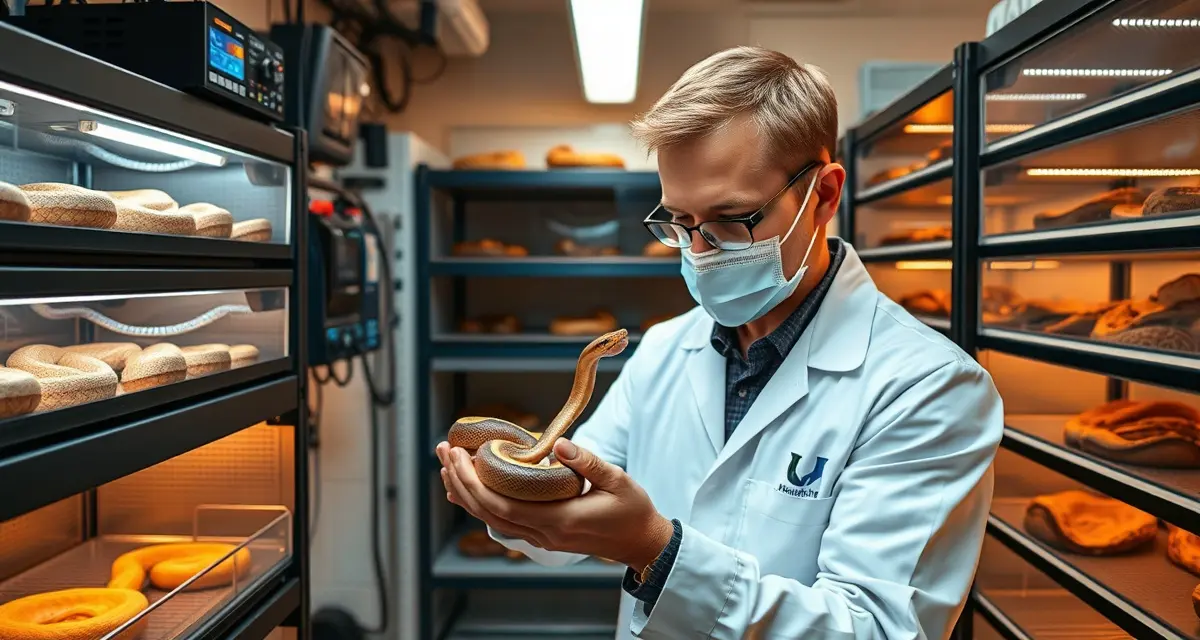
Blood Python Breeder Setup and Housing: Complete Breeder Guide
Setting up a blood python breeding facility is more forgiving than Burmese python infrastructure but more demanding than ball python rack rooms. Blood pythons need larger individual enclosures than ball pythons of similar length due to their heavy body mass, and their humidity and temperature requirements mean more thought about enclosure design and room management. Breeders using integrated software report 30% less time on administrative tasks, which is time available for the thoughtful facility design that blood python breeding quality requires.
TL;DR
- Adult blood python females need a minimum enclosure size of 4'x2'x2', with heavier females benefiting from 5'x2'x2' or 4'x3'x2' configurations.
- Target enclosure humidity of 75-85% requires active infrastructure: automatic misters, moisture-retaining substrate (cypress mulch or coco fiber), or room-level humidifiers, not estimation.
- Overhead heat sources (ceramic heat emitters or deep heat projectors) on proportional thermostats outperform UTH-only setups, with warm side temps of 88-92F and cool ambient at 78-82F.
- Front-opening PVC or ABS enclosures reduce defensive behavior and feeding accidents compared to top-access designs.
- New acquisitions require 60-90 days in a physically separate quarantine area with dedicated tools before joining the main collection.
- Room layout should place male and female enclosures in clearly distinct zones with individual animal ID labels on every enclosure to prevent mix-ups during breeding season.
Enclosure Sizing and Design
Adult blood pythons are stocky, heavy animals. A 4-foot female blood python weighs considerably more than a 4-foot ball python and has different space needs. Minimum enclosure dimensions for adult breeding females: 4'x2'x2'. Larger females benefit from 5'x2'x2' or 4'x3'x2' configurations.
Front-opening enclosures are strongly preferred. Blood pythons are less defensive in front-access setups where they can see your approach rather than being surprised from above. This behavioral difference significantly reduces feeding accidents and stress-related health issues.
PVC or ABS enclosures work well for blood pythons and handle humidity better than melamine-panel setups. Wood enclosures with PVC lining are also viable but require more maintenance against moisture damage over time. When evaluating enclosure materials, it helps to also consider reptile enclosure humidity retention by material type before committing to a large purchase.
Humidity Infrastructure
High humidity (75-85%) requires active management in most climate-controlled buildings where ambient humidity is lower. Options include:
Substrate moisture. Cyprus mulch, coco fiber, and similar substrates hold moisture and slowly release it into the enclosure air. Regular misting maintains substrate moisture and directly raises enclosure humidity.
Automatic misting systems. These are worth the investment for a larger collection. A timed misting system that runs 1-2 times daily in each enclosure maintains consistent humidity without daily manual misting.
Room humidifiers. Running a room-level humidifier in your reptile room raises ambient humidity, which reduces the evaporative load on individual enclosures.
Whatever approach you use, measure actual enclosure humidity with digital hygrometers rather than estimating. The target is 75-85% -- not "feels humid enough."
Heating System Design
Overhead heat sources work better for blood pythons than UTH alone. Ceramic heat emitters, deep heat projectors, or basking lamps (for daytime use only) create warm ambient air from above, which more closely mimics how warm conditions work in tropical environments. The warm side should reach 88-92F with cool ambient at 78-82F.
Proportional thermostats on all heat sources prevent temperature spikes that stress animals and can damage eggs during incubation periods. Pairing your thermostat setup with a solid reptile breeder incubation tracking system ensures temperature events are logged alongside clutch records.
Room Organization for Breeding Season
Blood python breeding management involves introducing males to female enclosures on a rotating schedule. Design your room layout so male and female enclosures are in clearly distinct areas and each enclosure is accessible without moving other enclosures.
Labeling every enclosure with an individual animal ID that connects to your records prevents the errors that happen when you're working quickly during breeding season and a label gets swapped or worn off. Connecting those IDs to a blood python breeding pair records system makes it easy to review pairing history without digging through notebooks.
Quarantine Area
A separate quarantine area is essential for responsible management. New blood python acquisitions should be quarantined for 60-90 days before introduction to the main collection. The quarantine area should be physically separated from your main breeding area, with entirely separate tools and personal protective equipment.
HatchLedger tracks enclosure assignments and animal locations, connecting your physical facility organization to your records.
HatchLedger connects facility costs to your breeding program's financial performance.
Frequently Asked Questions
What is the best approach to blood python breeder setup and housing?
Use front-opening PVC or ABS enclosures sized appropriately for adults (minimum 4'x2'x2'). Invest in humidity management infrastructure -- automatic misters, moisture-retaining substrate, or room humidifiers -- to maintain 75-85% reliably. Use overhead heat sources on proportional thermostats for appropriate thermal gradients. Design your room for breeding season workflow with clearly labeled enclosures and easy access. Maintain a separate quarantine area for all new acquisitions.
How do professional breeders handle blood python breeding facility setup?
Professional blood python breeders design humidity management into their facility infrastructure rather than managing it with manual interventions. They use front-opening enclosures, maintain separate quarantine areas, and label their facilities clearly enough that day-to-day management is efficient and error-resistant. They also build their electrical systems to handle the load of multiple enclosures with overhead heat sources, which draws more power than UTH-only rack setups.
What software helps manage blood python housing records?
HatchLedger tracks each animal's enclosure location alongside their full husbandry and breeding records. When an animal moves or when you reconfigure your facility, those changes are logged. The complete facility management picture -- who's where, when they last ate, what their current breeding status is -- is accessible in one system rather than reconstructed from memory.
How many blood pythons can realistically be managed in a home breeding setup?
Most home breeders work with 10-30 animals before space and humidity management become limiting factors. Because each adult female requires a minimum 4'x2'x2' enclosure with overhead heating, electrical load and room square footage fill up faster than with ball python rack systems. Starting with a smaller group and expanding infrastructure before adding animals is a more sustainable approach than scaling animals first.
Do blood pythons require a cooling period to trigger breeding behavior?
Blood pythons do not require the same temperature drop that triggers breeding in ball pythons. However, many breeders report improved breeding response when they introduce males during the cooler months of the year and maintain a slight reduction in ambient room temperature (78-80F cool side rather than 82F). Consistency in the male introduction schedule matters more than a dramatic temperature change.
What electrical load should I plan for when building out a blood python room?
Because blood pythons require overhead heat sources rather than UTH-only setups, electrical demand per enclosure is higher than a comparable ball python rack. A room with 20 adult enclosures, each running a ceramic heat emitter or deep heat projector on a proportional thermostat, can draw 15-25 amps depending on wattage. Consulting an electrician before building out a dedicated reptile room prevents circuit overloads and ensures your setup meets local code requirements.
How should I document animal movements between enclosures during breeding season?
Every time a male is introduced to a female enclosure or an animal is moved for any reason, that event should be logged with the date, the animal IDs involved, and the outcome if observed. Relying on memory across a 60-90 day breeding season with multiple pairs leads to gaps in pairing history that affect future breeding decisions. HatchLedger logs these movements alongside feeding and health records so the full picture of each animal's season is preserved.
Sources
- Ball Python and Blood Python Husbandry Guidelines, Association of Reptilian and Amphibian Veterinarians (ARAV)
- Python Husbandry and Welfare Standards, British and Irish Association of Zoos and Aquariums (BIAZA) Reptile Working Group
- Reptile Humidity and Thermal Environment Management, University of Florida IFAS Extension, Wildlife Ecology and Conservation
- Captive Python Health and Biosecurity Protocols, United States Association of Reptile Keepers (USARK)
- Reptile Breeder Facility Design Considerations, Reptiles Magazine Industry Resource Archive
Get Started with HatchLedger
Blood python breeding requires more facility planning than most other python species, and the records that support that planning, enclosure assignments, pairing schedules, quarantine timelines, and clutch outcomes, are too interconnected to manage reliably across separate notebooks or spreadsheets. HatchLedger keeps all of it in one place, so your facility organization and your animal records stay in sync through every breeding season. Try HatchLedger free and see how much clearer your operation looks when the records match the room.