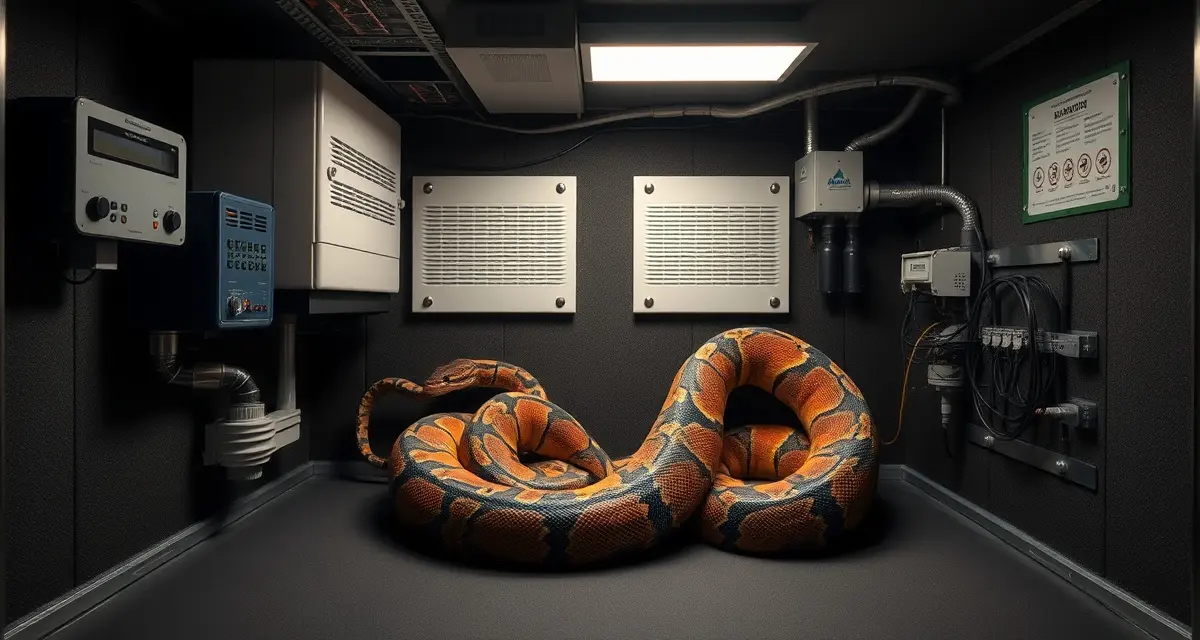
Burmese Python Breeder Setup and Housing: Complete Breeder Guide
By HatchLedger Editorial Team · Published 2025-03-12 · Updated Mar 13, 2026
Setting up a Burmese python breeding facility is a serious infrastructure project. These animals grow to 12-18+ feet and require custom enclosures, dedicated electrical infrastructure, and safety protocols that most residential reptile rooms never need. Breeders using integrated software report 30% less time on administrative tasks, which is time you need back when the physical demands of a Burmese breeding operation are substantially higher than working with smaller species.
TL;DR
- Burmese pythons (Python bivittatus) are among the largest constrictors in captivity, with breeding females commonly exceeding 100-200 lbs.
- Clutch sizes average 25-50 eggs, making Burmese pythons among the most productive large constrictors in captive breeding.
- Cycling typically involves a 4-8 week period of reduced temperatures (dropping 8-12 degrees Fahrenheit) and reduced feeding frequency.
- Incubation parameters runs 60-65 days at 88-90 degrees Fahrenheit, with females capable of thermoregulating eggs by muscular shivering.
- Compliance requirements requirements for Burmese python ownership and interstate transport vary by state, with federal protections under the Lacey Act applying in some jurisdictions.
Planning your facility correctly before you acquire animals saves significant money and frustration down the road. Retrofitting a space that wasn't designed for large constrictors is expensive and often produces a facility that never works as well as it would have with proper planning.
Space Requirements
The first consideration is how many breeding animals you're planning to house and at what sizes. An adult female Burmese at 12-14 feet needs an enclosure of at minimum 8'x4'x4'. If you're planning two to three breeding females and one or two males, you're looking at a room footprint that needs to accommodate 5+ large enclosures plus aisles for safe access.
Calculate your square footage requirements realistically before you commit to a space. Include aisle space for two-person access (you need to move around the enclosures with a second person during handling), storage for equipment and supplies, and room for a quarantine area separate from your main breeding collection.
Ceiling height matters. Tall enclosures need enough clearance to open lids or top panels. Standard 8-foot ceilings work for most setups but may be tight with very tall enclosures.
Electrical Requirements
Large constrictor enclosures consume significant electrical power. Each large RHP or heat emitter setup draws 150-300 watts continuously. Multiple large enclosures in a room can easily exceed 2,000 watts of continuous heating load. Add lighting, ventilation fans, and other equipment, and you're looking at a dedicated 20-amp circuit or multiple circuits for a full Burmese breeding room.
Have a licensed electrician evaluate your available capacity and install dedicated circuits for your reptile room before you fill it with animals. Circuit breakers that trip in the middle of the night can allow temperatures to drop to dangerous levels before you discover the problem. Temperature monitoring with alerts is worth the investment for large constrictor facilities.
Enclosure Construction
Custom-built enclosures are the standard for adult Burmese pythons. Most commercial enclosures top out at 6'x2'x2' or similar, which isn't adequate for breeding adults. Wooden enclosures with interior PVC lining (melamine is not suitable -- it doesn't hold up to humidity) are the most common DIY approach.
Critical features for Burmese enclosures:
- Lock latches on all doors and panels. These animals are strong enough to push open unsecured doors.
- Multiple access points. Being able to access the animal from more than one angle makes routine care much safer.
- Ventilation. Large enclosures need airflow to prevent humidity buildup and to ensure oxygen exchange. Screened panels or drilled ventilation holes with covers work.
- Substrate containment. Deep substrates can shift or spill during enclosure service. Threshold strips or substrate boards at door openings help.
Safety Infrastructure
Two-person handling is mandatory for adult Burmese pythons. Build your room to accommodate two people working around every enclosure without obstacles. Your handling protocol should be documented and followed consistently -- including by any assistants or helpers who work with you in the facility.
Keep a clear emergency plan. Know who to call, where your nearest reptile-experienced vet is, and what your protocol is if an animal escapes or if someone is constricted. Emergency protocols in large constrictor facilities are not hypothetical.
HatchLedger tracks each animal's location, enclosure assignment, and husbandry history so your records reflect your facility layout and any changes you make.
HatchLedger connects facility costs to your overall program P&L so infrastructure investments are tracked against the revenue your program generates.
Frequently Asked Questions
What is the best approach to Burmese python breeder setup and housing?
Plan your facility before acquiring animals, not after. Calculate realistic space requirements for the number and size of animals you're planning. Install dedicated electrical circuits with appropriate capacity before filling the room. Use custom-built, lockable enclosures sized appropriately for adult Burmese (minimum 8'x4'x4' for large females). Build in room for two-person access around every enclosure. Implement temperature monitoring with alerts so you know immediately if a heating failure occurs. Never work alone with large adults.
How do professional breeders handle Burmese python facility setup?
Professional Burmese breeders design facilities with safety and workflow efficiency as primary constraints, not just animal capacity. They invest in proper electrical infrastructure, temperature monitoring, and emergency planning because the consequences of cutting corners with large constrictors are serious. They also design enclosures for long-term use -- a breeding female may live in your facility for 15-20 years, so the enclosure quality needs to match that timeline. Records of enclosure assignments and facility layout help them manage their collection efficiently.
What software helps manage Burmese python breeding facility records?
HatchLedger tracks every animal, clutch, and sale record for Burmese python breeders, with documentation that supports regulatory compliance and buyer confidence. When managing large clutches and compliance requirements simultaneously, a connected system prevents the record-keeping gaps that create problems at sale. Free for up to 20 animals.
Are Burmese pythons legal to own and breed in all US states?
No. Burmese pythons are listed as an injurious species under the Lacey Act, which restricts interstate transport. Several states have additional bans on ownership entirely. Check current state and federal regulations before acquiring or transporting animals. USARK maintains updated resources on applicable regulations.
How large should a Burmese python enclosure be for a breeding pair?
Breeding females typically require enclosures of at least 8x4 feet and often larger for full-grown adults. Dedicated breeding rooms or custom builds are standard at scale. Thermal gradient with hot spots at 88-92 degrees Fahrenheit and ambient temperatures in the mid-70s allows proper thermoregulation.
What is Burmese Python Breeder Setup and Housing: Complete Breeder Guide?
This guide covers everything needed to build and manage a Burmese python breeding facility, including enclosure sizing for animals exceeding 12-18 feet, electrical infrastructure requirements, temperature cycling protocols, incubation setup at 88-90°F, and compliance with Lacey Act regulations. It addresses the unique challenges of working with large constrictors—females commonly exceeding 100-200 lbs—and introduces software tools that reduce administrative overhead by 30%, freeing time for the demanding physical work these animals require.
How much does Burmese Python Breeder Setup and Housing: Complete Breeder Guide cost?
The guide itself is free educational content on HatchLedger. Actual setup costs vary significantly based on scale, but plan for substantial investment: custom enclosures for large constrictors cost far more than standard reptile racks, dedicated electrical circuits are often required, and safety equipment adds additional expense. Operational costs include feeding large prey items regularly and potentially licensing fees depending on your state. Budgeting carefully before acquiring animals is strongly advised.
How does Burmese Python Breeder Setup and Housing: Complete Breeder Guide work?
The guide walks breeders through facility planning, enclosure construction, temperature cycling (reducing temps 8-12°F over 4-8 weeks to trigger breeding behavior), pairing animals, and incubation management. Clutches average 25-50 eggs, incubated at 88-90°F for 60-65 days. Females can thermoregulate eggs through muscular shivering. The guide also covers record-keeping using breeding management software to track clutches, pairings, and hatchling inventory, reducing time spent on administrative tasks.
What are the benefits of Burmese Python Breeder Setup and Housing: Complete Breeder Guide?
Following this guide helps breeders avoid costly retrofitting by planning infrastructure correctly upfront. Benefits include improved animal welfare through properly sized enclosures, safer handling protocols for large constrictors, higher clutch success rates through optimized cycling and incubation parameters, and regulatory compliance across state lines. Integrated breeding software provides an additional operational benefit, cutting administrative time by roughly 30% so breeders can focus on animal care and production.
Who needs Burmese Python Breeder Setup and Housing: Complete Breeder Guide?
This guide is intended for serious reptile breeders working with or planning to work with Burmese pythons (Python bivittatus). It is relevant to hobbyist breeders scaling up, professional reptile producers, and facility managers who need to understand the infrastructure, safety, and legal requirements specific to large constrictors. Anyone transitioning from smaller species should read this carefully—the physical and regulatory demands of Burmese pythons are substantially higher than most other captive reptiles.
How long does Burmese Python Breeder Setup and Housing: Complete Breeder Guide take?
Initial facility setup is typically a multi-month project before animals are even acquired. Once operational, the breeding cycle itself spans several months: a 4-8 week cooling period to trigger cycling, followed by pairing, egg deposition, and a 60-65 day incubation period. From planning to first hatchlings, expect 6-12 months minimum. Ongoing operations require consistent daily and weekly husbandry commitments year-round, particularly given the feeding and handling demands of animals that can exceed 18 feet in length.
Related Articles
- Reticulated Python Breeder Setup and Housing: Complete Breeder Guide
- Blood Python Egg Incubation Setup: Complete Breeder Guide
- Boa Constrictor Breeder Setup and Housing: Complete Breeder Guide
- Burmese Python Breeding Season Timing: Complete Breeder Guide
Sources
- USARK (United States Association of Reptile Keepers)
- Association of Reptilian and Amphibian Veterinarians (ARAV)
- US Fish and Wildlife Service (Injurious Wildlife regulations)
- Journal of Herpetology (Society for the Study of Amphibians and Reptiles)
- Florida Fish and Wildlife Conservation Commission
Get Started with HatchLedger
Burmese python breeding involves large animals, large clutches, and compliance documentation that is difficult to manage without a dedicated system. HatchLedger tracks every animal, clutch, and sale record in one place, giving you the documentation you need for regulatory compliance and buyer confidence. Try it free with up to 20 animals.