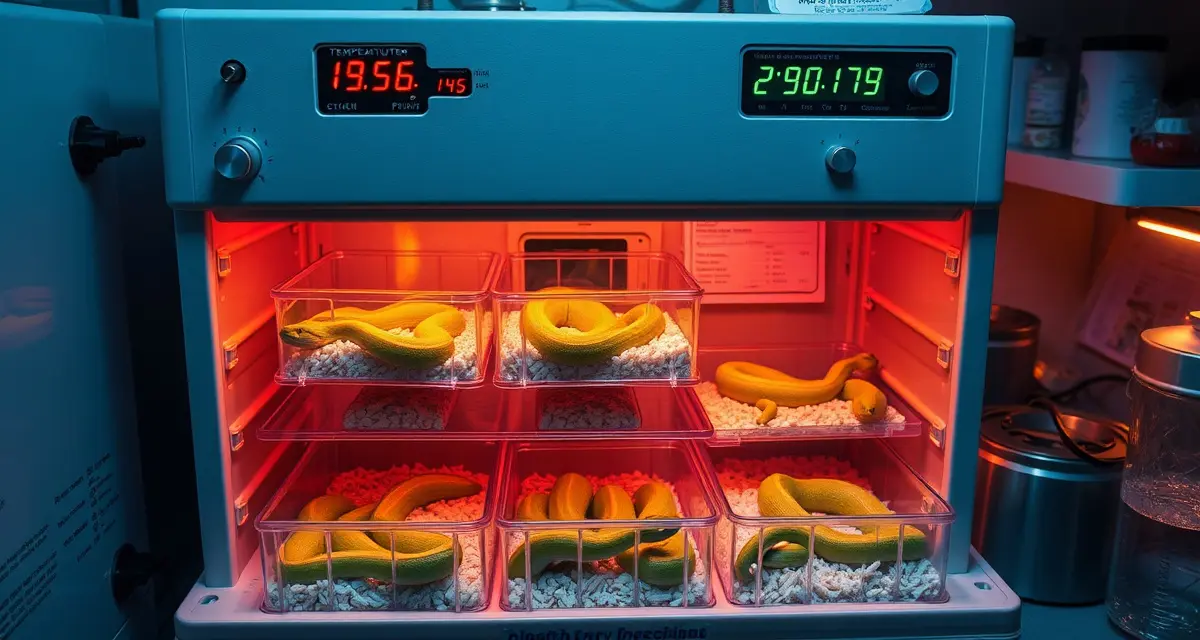
Green Tree Python Egg Incubation Setup: Complete Breeder Guide
Getting your green tree python egg incubation setup right before the first clutch of the season is significantly easier than trying to troubleshoot mid-season when eggs are already at risk. GTPs produce valuable clutches that warrant serious investment in quality incubation equipment and a consistent protocol. Breeders using integrated software report 30% less time on administrative tasks, and a well-organized incubation setup reduces the monitoring burden while improving your ability to catch problems early.
TL;DR
- Green tree pythons (Morelia viridis) are arboreal specialists requiring perch-based enclosures and husbandry quite different from terrestrial pythons.
- Breeding is triggered by a dry season simulation with reduced humidity and a modest temperature reduction over 6-8 weeks.
- Clutch sizes average 12-25 eggs, with Biak locale animals producing larger clutches than Sorong or Aru.
- Incubation runs 47-52 days at 84-86 degrees Fahrenheit, shorter than most python species at equivalent temperatures.
- Locale documentation is critical: Biak, Sorong, Aru, Kofiau, and locality blends all carry distinct market values and buyer expectations.
This guide covers everything you need to build an effective GTP incubation setup, from equipment selection to your first clutch placement.
Choosing an Incubator
Quality and Temperature Stability
Temperature stability is the most critical feature in any incubator used for GTP eggs. You want a unit that maintains your set temperature within +/- 0.5°F and recovers quickly after door openings. Temperature swings above this range are a leading cause of developmental problems and hatch failure.
Options breeders commonly use:
Purpose-built reptile incubators from manufacturers like GQF or Brinsea are reliable and offer consistent temperature control. The initial cost is higher but the reliability justifies it for high-value GTP clutches.
Converted wine coolers or mini-fridges fitted with a quality thermostat and heating element can achieve excellent stability at lower cost. This DIY approach requires more initial setup work but is widely used by experienced reptile breeders.
Dedicated herpetocultural incubators designed specifically for reptile eggs are available from specialty suppliers. These often include features like humidity trays and easy-to-read displays.
Whatever unit you use, verify its actual temperature at egg level with a secondary probe before placing eggs. Incubator displays and internal sensors often read differently from the actual temperature experienced by eggs.
Sizing
Your incubator should have enough space for multiple clutch containers with room for airflow between them. GTPs produce clutches of 10 to 25 eggs; a typical incubation container might be 6" to 12" wide. Plan for at least 2 to 3 clutch containers per incubator, with extra space for future seasons if you're planning to expand.
If you're running multiple breeding females, consider whether one incubator has enough capacity for a full season's production. Having a backup incubator for overflow or as a contingency if your primary unit fails is worth the investment.
Incubation Containers
Container Selection
Most breeders use plastic food storage containers or deli cups for individual clutches. Choose containers sized to hold the clutch with some space around the eggs. Eggs should not be stacked or crowded.
Containers can be run fully sealed with small vent holes, or with lids loosened slightly to allow gas exchange. Fully sealed containers maintain humidity most consistently but require periodic opening to refresh air. A good approach is to vent briefly (30 seconds to 1 minute) every 7 to 10 days when you're checking the clutch.
Label every container clearly with:
- Clutch ID
- Lay date
- Expected hatch window
- Parent IDs (sire and dam)
This label is the physical connection to your digital clutch record in HatchLedger's reptile breeder hub. Every incubation check should be logged against the clutch ID.
Substrate Options
Perlite at a 1:0.5 to 1:0.6 ratio (perlite to water by weight) is widely used and provides good moisture retention without waterlogging. Perlite is inert, resists mold better than vermiculite in some conditions, and allows visual inspection of moisture levels.
Vermiculite at a 1:1 ratio (vermiculite to water by weight) is another standard choice. It holds more moisture than perlite and provides more structural support for eggs.
Hatchrite and commercial incubation media are pre-mixed options that take the ratio calculation out of the process. They're more expensive per use but consistent and convenient.
Mix your substrate to the appropriate moisture level before placing eggs. The substrate should feel moist but not release water when squeezed. If water drips out when you squeeze a handful, it's too wet.
Egg Placement
Partially set eggs into the substrate without burying them. Eggs should sit in depressions that keep them stable without lateral pressure. Space eggs so they're not touching if possible; this prevents one problematic egg from contaminating an adjacent viable egg.
Do not rotate or flip eggs after initial placement. Embryos orient themselves in the first hours after lay; rotating eggs after this orientation can damage development.
Temperature and Humidity Targets
Set your incubator to maintain 86°F (30°C). This is the widely accepted target for GTP eggs, though the acceptable range is 84 to 88°F. Verify the actual temperature at the container level with your secondary probe.
Humidity within the container should be 90 to 100% when using a properly moistened substrate in a sealed or semi-sealed container. You don't need to measure humidity inside the container directly if your substrate ratio is correct; the moisture level of the substrate controls the microclimate.
Ambient humidity within the incubator itself matters less than the microclimate within each sealed container, but maintaining moderate ambient humidity in the incubator room prevents excessive moisture loss through container walls.
Your Monitoring Schedule
Set a consistent checking schedule and log every check. A basic check involves:
- Verify incubator temperature reading (compare to secondary probe)
- Open each container briefly and visually inspect eggs
- Check substrate moisture level
- Note any eggs that appear deflated, discolored, or problematic
- Weigh individual eggs if tracking weights
- Log date, observations, and any actions taken
Perform this check every 7 to 10 days. More frequent checks disturb the container humidity equilibrium unnecessarily; less frequent checks risk missing developing problems.
At 10 to 14 days after lay, candle the eggs in a dark room to assess fertility. Log your candling results in your clutch record in reptile breeder software comparison-recommended software. HatchLedger allows you to attach notes to each clutch record including candling dates and results.
Preparing for Hatch
At 47 to 52 days post-lay (at 86°F), your eggs should begin pipping. Watch for eggs beginning to slightly deflate and "sweat" as internal gas composition changes near hatch, this is normal and indicates pipping is imminent.
Prepare your hatchling setup before expected pip. Have enclosures, perches, and misting capacity ready so each hatchling can move to appropriate care immediately. Log the hatch date and hatchling count against the clutch record, completing the incubation phase of your documentation.
Frequently Asked Questions
What is the best approach to green tree python egg incubation setup?
Invest in a quality incubator with verified temperature stability, set it to 86°F, and confirm the actual temperature at egg level with a secondary probe. Use sealed or semi-sealed containers with properly moistened perlite or vermiculite substrate at the correct moisture ratio. Label every container with clutch ID, lay date, and parent information. Check containers every 7 to 10 days and log every observation. Candle at 10 to 14 days to assess fertility. A consistent, documented protocol prevents most incubation failures and gives you data to improve future seasons.
How do professional breeders handle green tree python egg incubation setup?
Professional breeders verify their incubator setup well before the first clutch of the season. They use secondary temperature probes at egg level, prepare multiple labeled incubation containers, and maintain a consistent substrate moisture ratio. They check clutches on a schedule, log every observation, and candle early to remove infertile eggs. They also track individual egg weights to monitor development progress. After each season, they review their incubation data alongside hatch rate outcomes to identify whether any adjustments to temperature, humidity, or substrate are warranted.
What software helps manage green tree python egg incubation setup?
HatchLedger is purpose-built for reptile breeders, connecting animal records, breeding history, clutch outcomes, and financial tracking in one system. Unlike generic spreadsheets, it's designed around the specific workflow of an active breeding season. Free for up to 20 animals.
Why is locale documentation so important for green tree pythons?
Buyers of green tree pythons are often very specific about locality. Biak animals are prized for large adult size and a blue ontogenetic coloration phase. Sorong and Aru animals are known for consistent solid green adult coloration. Locality blends from unknown crosses are worth significantly less than documented pure-locale animals. Recording locale information from acquisition through sale is essential.
How long does it take green tree python neonates to change color?
The ontogenetic color change from yellow or red neonate coloration to adult green takes approximately 6-12 months in most locales. Biak animals often go through a blue phase during the transition. Buyers of neonates should understand the timeline. Photographing animals at regular intervals through the color change documents the process and makes for compelling sales content.
Sources
- USARK (United States Association of Reptile Keepers)
- Association of Reptilian and Amphibian Veterinarians (ARAV)
- CITES Appendix II (international trade documentation)
- Herpetofauna (Australian Herpetological Society)
- Green Tree Python Foundation
Get Started with HatchLedger
Green tree python breeding demands locale documentation, seasonal cycling records, and clutch management that generic spreadsheets handle poorly. HatchLedger keeps your locale lineage, breeding history, and per-clutch records connected so buyers get complete documentation and you build a traceable breeding program. Try it free with up to 20 animals.