Ball Python Morph Genetics Basics: Co-Dominant, Recessive, and Dominant Mutations
By HatchLedger Editorial Team · Published 2025-04-20 · Updated Mar 13, 2026
Breeders using integrated software report 30% less time on administrative tasks, and genetics is the area where that analytical capacity matters most. Understanding how morphs pass from parent to offspring isn't optional for a serious breeder; it determines every pairing decision you make and every sale conversation you have.
TL;DR
- Ball python breeding operations require systematic record-keeping from pre-season preparation through end-of-season sales.
- Females at 1,200-1,500g or more are the target weight before introducing them to a breeding male.
- Ovulation detection is the key event that anchors pre-lay shed and lay date calculations.
- Clutch profitability guide depends on understanding actual cost basis per animal, not just gross sale revenue.
- Well-documented animals with complete feeding histories and clear genetic records consistently sell faster and at higher prices.
Ball python morph genetics follow the same fundamental principles as all diploid organism genetics, but breeders use a different vocabulary than formal genetics textbooks. Here's what you need to know to work confidently with morph outcomes.
The Three Inheritance Types
Co-dominant mutations express visually in one copy (heterozygous) and produce a different, typically more extreme form in two copies (homozygous). The terminology in the hobby refers to the single-copy form as the "base" morph and the two-copy form as the "super" form.
Classic examples: Pastel (single copy) and Super Pastel (two copies). Spider (single copy) and... there is no viable super spider due to the homozygous lethal combination. Lesser/Butter (single copy) and Blue-Eyed Lucy (two copies, or a combination with other BEL complex genes).
When you breed two co-dominant animals that carry the same mutation, the offspring possibilities are 25% normal, 50% single copy (het), and 25% super. When you breed a co-dominant to a normal, you get 50% single copy and 50% normal.
Recessive mutations only express visually when an animal carries two copies of the mutation (homozygous). One copy is invisible to the eye; that animal is called a "het" (heterozygous) for the trait. Breeding two visible recessives produces 100% visual offspring. Breeding a visual to a 100% het produces 50% visuals and 50% hets.
Classic examples: Albino, axanthic, clown, pied, genetic stripe, desert ghost.
The het status creates both opportunity and uncertainty in breeding projects. You can buy an animal that "looks normal" but carries one copy of a valuable recessive gene. Proving out het animals (breeding them to visuals or to other proven hets and confirming offspring) takes years but is foundational to working with recessive morphs.
Dominant mutations express with a single copy and, critically, the homozygous form is lethal or non-viable. This means you can never produce a "super" form of these morphs. The genetic calculation for dominant traits produces 50% expressing offspring when bred to normals.
Currently confirmed dominant with lethal homozygous combination: the spider complex mutations (spider, hidden gene woma/Hgw). Breeders working with spider still produce super spiders occasionally when pairing two spiders; those embryos are non-viable.
Working with Hets
The concept of "het" or "possible het" (ph) animals is central to recessive morph breeding projects. When you breed a het to a visual, statistically half the visually-normal offspring will be hets. But you can't tell by looking which ones carry the gene.
That's why breeders sell these animals with a "66% possible het" or "50% possible het" designation. The percentage reflects statistical probability, not certainty. Some breeders prove out possible het animals themselves before selling; others sell with the probability designation and let buyers decide whether to invest in proving.
Keeping accurate records of which offspring came from which pairing is essential for maintaining het status accuracy. Misrepresenting het status, intentionally or through poor records, damages your reputation and harms buyers who make purchasing decisions based on that information.
Punnet Squares for Breeding Projects
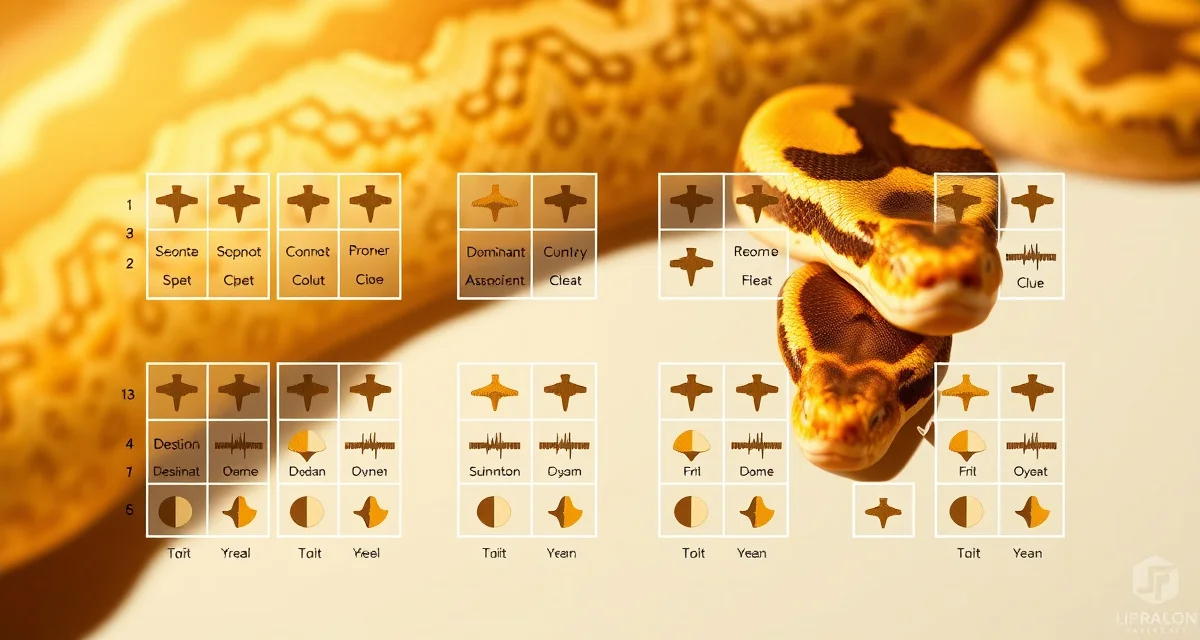
You probably learned Punnett squares in school but may not have applied them to reptile genetics. The principle is identical: list possible alleles from each parent across the top and side, fill in the grid, and count outcomes.
For co-dominant morphs:
- Use "P" for one copy of pastel, "p" for no copy
- Pastel x Normal: Pp x pp = 25% Pp (pastel), 25% Pp (pastel), 25% pp (normal), 25% pp (normal) = 50% pastel, 50% normal
For recessive morphs:
- Use "A" for the albino allele, "a" for normal (recessive alleles are often shown as lowercase)
- Het Albino x Het Albino: Aa x Aa = 25% AA (visual albino), 50% Aa (het), 25% aa (normal)
For complex multi-gene projects, work gene by gene and combine probabilities mathematically. A 50% chance of gene A and a 50% chance of gene B gives you a 25% chance of an animal carrying both.
Building Multi-Gene Animals
The most valuable ball python morphs in today's market are typically multi-gene combinations: clown pied, banana clown, black pastel albino, and so on. Building these animals requires understanding how multiple mutations interact.
Genes don't generally interact with each other visually in ball pythons with the exception of a few well-documented interactions. Most combinations are additive, meaning each gene adds its effect to the overall appearance. A pastel clown is a clown with the pastel gene's brightening effect layered on top of the clown pattern.
Some exceptions: The BEL (blue-eyed leucistic) complex, where Lesser, Butter, Russo, Mocha, and Phantom combine in various ways to produce leucistic animals. Super forms of different BEL complex members interact to produce slightly different phenotypes.
Planning a multi-gene project requires thinking several generations ahead. If you want to produce banana pied animals, you need to plan how you'll combine the banana (co-dominant, sex-linked) gene with pied (recessive). That's at minimum a two-generation project.
Recording Genetics for Every Animal
Every animal in your collection should have complete genetic information on record: the confirmed genes it visually expresses, any het or possible het status, and the parent information that underlies those designations.
HatchLedger's morph tracking tools let you record every gene for each animal and calculate expected offspring ratios for planned pairings. When you're pricing a clutch or answering a buyer's question about genetics, having this information immediately accessible saves time and prevents errors.
Sex-Linked Traits
The banana morph (also sold as coral glow) is the most notable sex-linked trait in ball pythons. The mutation is located on the sex chromosome. When a female banana is bred:
- Male banana x normal female: approximately 50% male normals, 50% female bananas
- Normal male x female banana: approximately 50% female normals, 50% male bananas
The sex-linked nature means male bananas and female bananas pass the gene differently. A female banana always passes to sons, meaning female banana offspring from normal fathers will always be banana. This is counterintuitive coming from typical co-dominant expectations and is a common source of confusion for newer breeders.
Use HatchLedger's reptile breeder software to track sex-linked trait inheritance properly, keeping your morph records accurate as you work with animals that express or carry the banana gene.
Frequently Asked Questions
What is the best approach to ball python morph genetics basics?
Start by understanding the three inheritance types: co-dominant (single copy expresses, super form exists), recessive (needs two copies to express, het animals exist), and dominant with lethal super (single copy only viable). Practice Punnett square calculations for every planned pairing, and keep accurate genetic records for every animal in your collection.
How do professional breeders handle ball python morph genetics?
Experienced breeders work several generations ahead, planning how to combine target genes most efficiently. They prove out het animals before selling with confirmed het status rather than possible het status, and they maintain detailed records of every pairing outcome to validate their genetic calculations against real-world results.
What records should every reptile breeder maintain per animal?
At minimum: acquisition date and source, morph and genetic documentation, feeding log, weight history, any veterinary treatments, and breeding history including pairing dates, clutch of origin for captive-bred animals, and offspring records. These records serve your own management, buyer documentation, regulatory compliance, and long-term genetic tracking.
How should reptile breeders document genetics for buyers?
A complete genetic record for sale includes the animal's visual morph name, confirmed het genes and their basis (parentage documentation or proven-out production), possible het genes with probability percentages, hatch date, and parent morph information. Including clutch-of-origin records lets buyers independently verify the claims.
What is Ball Python Morph Genetics Basics: Co-Dominant, Recessive, and Dominant Mutations?
Ball Python Morph Genetics Basics covers the three core inheritance types that determine how color and pattern mutations pass from parents to offspring: co-dominant mutations (visible in one copy, extreme in two), recessive mutations (require two copies to express visually), and dominant mutations (express in one copy with no known homozygous form). Mastering these principles is essential for predicting clutch outcomes and making informed pairing decisions.
How much does Ball Python Morph Genetics Basics: Co-Dominant, Recessive, and Dominant Mutations cost?
This knowledge base is freely available as an educational resource on HatchLedger. There is no cost to read or apply these genetics fundamentals. Breeders looking to put this knowledge into practice can use HatchLedger's pairing and clutch tracking tools, which help automate outcome predictions and reduce administrative overhead by up to 30%.
How does Ball Python Morph Genetics Basics: Co-Dominant, Recessive, and Dominant Mutations work?
Ball python morph genetics works by tracking how alleles — gene variants responsible for each morph — are inherited across generations. Co-dominant morphs express with one allele and intensify with two. Recessive morphs remain hidden until an animal inherits one allele from each parent. Understanding which type a morph is lets breeders calculate the statistical probability of each offspring phenotype before a pairing ever happens.
What are the benefits of Ball Python Morph Genetics Basics: Co-Dominant, Recessive, and Dominant Mutations?
Understanding morph genetics gives breeders a measurable edge: more accurate clutch predictions, fewer costly pairing mistakes, and stronger sales conversations backed by clear genetic documentation. Animals with verified, well-documented genetic records consistently sell faster and at higher prices. Systematic genetics knowledge also supports better inventory planning, helping breeders target the market segments most likely to drive profit each season.
Who needs Ball Python Morph Genetics Basics: Co-Dominant, Recessive, and Dominant Mutations?
Any ball python breeder who produces morphs needs this knowledge — from hobbyists making their first intentional pairing to professional operations running dozens of females per season. It's especially critical for breeders working with recessive traits like clown or pied, where animals can carry hidden alleles. Anyone pricing animals, marketing offspring, or planning multi-generation projects will make better decisions with a solid genetics foundation.
How long does Ball Python Morph Genetics Basics: Co-Dominant, Recessive, and Dominant Mutations take?
Learning the core concepts of co-dominant, recessive, and dominant inheritance takes most breeders an afternoon of focused study. Applying them confidently across real pairings develops over one to two breeding seasons of practice. Using tools like HatchLedger's genetics and pairing features accelerates that curve significantly by automating outcome calculations and keeping records organized so patterns become visible faster.
Related Articles
Sources
- USARK (United States Association of Reptile Keepers)
- Association of Reptilian and Amphibian Veterinarians (ARAV)
- World of Ball Pythons (WoBP genetics reference database)
- MorphMarket (reptile industry marketplace)
- Reptiles Magazine (Bowtie Inc.)
Get Started with HatchLedger
Every part of a ball python breeding operation -- from pairing records to clutch documentation to financial tracking -- works better when the data is connected rather than scattered across notebooks and spreadsheets. HatchLedger is built for exactly that. Try it free with up to 20 animals.