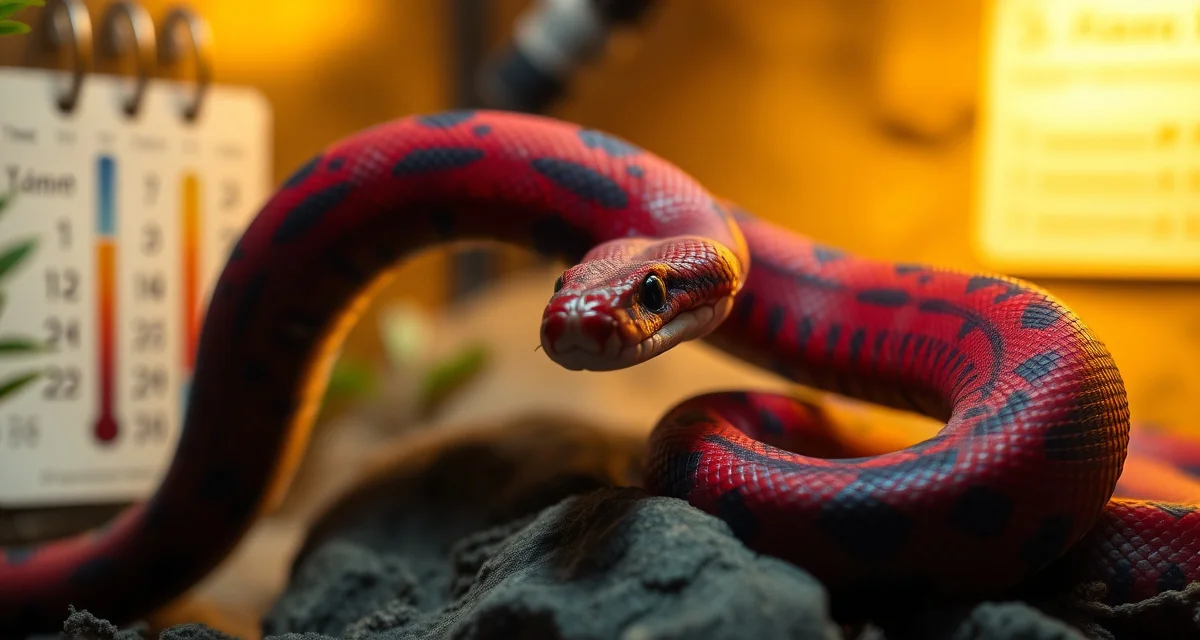
Blood Python Breeding Season Timing: Complete Breeder Guide
By HatchLedger Editorial Team · Published 2025-04-16 · Updated Mar 13, 2026
Blood pythons (Python brongersmai) are one of the most misunderstood species in captive breeding. They have a well-earned reputation for defensive temperament, but breeders who understand their specific biology -- including the timing of their breeding season -- consistently get better results than those who treat them like large ball pythons. Breeders using integrated software report 30% less time on administrative tasks, which matters when blood python breeding management requires more precise timing than many casual accounts suggest.
TL;DR
- Blood pythons require only a 5-8F temperature drop for cycling, not the dramatic drops used for temperate-climate species like carpet pythons.
- Northern Hemisphere breeders typically target October through February for pairing introductions, aligning with modest seasonal variation.
- A female blood python's reduced defensive behavior during receptive periods is a more reliable receptivity indicator than temperature cues alone.
- Ovulation occurs approximately 2-4 weeks after the final successful pairing, with egg-laying following 30-50 days post-ovulation.
- The pre-lay shed signals eggs are coming within 2-3 weeks, giving breeders a reliable window to finalize incubation setup.
- Some experienced breeders skip significant cycling entirely for animals in excellent body condition with established breeding records.
- Logging cycling start dates, pairing events, ovulation, and behavioral changes across multiple seasons helps refine protocols for each individual female.
Blood pythons come from lowland Sumatra and peninsular Malaysia, where they experience seasonal variation in rainfall and temperature rather than the dramatic seasonal swings of temperate species. This different natural environment means their cycling requirements are distinct from pythons that need significant temperature drops.
Understanding Blood Python Seasonality
Blood pythons don't need the same dramatic temperature cycling as species from temperate or subtropical regions. In the wild, they experience a relatively wet season and a drier, slightly cooler season -- but not cold winters. Captive breeding programs have adapted to this biology with cycling protocols that are more modest than those used for carpet pythons or ball pythons.
The most common approach for blood python breeding season timing in the Northern Hemisphere targets fall through early spring introductions, roughly October through February. This aligns with a modest reduction in temperature and humidity in the breeding area.
The Cycling Protocol for Blood Pythons
Drop ambient temperatures by 5-8F below maintenance temperatures rather than the more dramatic drops used for temperate-climate species. If your blood pythons are normally maintained at 82-86F ambient, cycling temperatures of 76-80F are appropriate. Maintain warm-spot access at 88-90F throughout.
Some blood python breeders skip significant cycling entirely and achieve breeding success, particularly with animals that are in excellent body condition and have established breeding records. For first-time or unpredictable breeders, modest cycling provides the environmental trigger that improves consistency.
Reduce feeding frequency during the cycling period. You don't need to eliminate feeding entirely, but blood pythons in cycling often show reduced interest in food. Don't force-feed cycling animals.
When to Begin Introductions
After two to four weeks of modest cycling, begin pairing introductions. Blood pythons can be introduced in the female's enclosure or in a neutral space -- given their defensive temperament, a neutral space sometimes produces more cooperative interactions for first-time pairings, though experienced breeders have their own preferred approaches.
Watch for male breeding behavior: tongue-flicking along the female, pelvic spur stimulation, and body alignment. Female blood pythons in breeding condition will often show significantly reduced defensive behavior compared to their normal temperament -- a female that usually strikes readily may be much more placid during receptive periods. This behavioral shift is a useful indicator of cycling success.
Ovulation and Lay Date Timing
Blood pythons ovulate approximately 2-4 weeks after the final successful pairing. Ovulation may be visible as a body swelling, though it can be subtle in these stocky animals. Some females show abdominal firmness and visible weight gain rather than the classic swelling seen in thinner pythons.
Egg-laying occurs approximately 30-50 days post-ovulation. A pre-lay shed typically occurs 2-3 weeks before laying. When the pre-lay shed completes, prepare your incubation setup -- eggs are coming within 2-3 weeks.
HatchLedger logs the full breeding season timeline for each blood python female, from cycling start through ovulation and lay date.
HatchLedger connects seasonal records to breeding outcomes and financial performance.
Frequently Asked Questions
What is the best approach to blood python breeding season timing?
Use modest temperature cycling (5-8F drop below maintenance) rather than the dramatic drops used for temperate-climate species. Begin breeding introductions after 2-4 weeks of cycling, typically in October-November for a Northern Hemisphere program. Watch for the female's reduced defensive behavior as an indicator of receptivity -- this behavioral shift is more reliable for blood pythons than temperature-dependent cycling signals. Log confirmed copulation events, watch for ovulation, and note the pre-lay shed to predict egg-laying timing.
How do professional breeders handle blood python breeding season timing?
Professional blood python breeders adapt their cycling protocols to the species' tropical origins rather than applying temperate-species cycling approaches. They document cycling start dates, temperature targets, pairing introductions, and behavioral changes for each female. Over multiple seasons, this data helps them refine their protocol for each specific animal. Blood python breeding season management requires patience and careful observation because these animals give more subtle cues than many other python species.
What software helps manage blood python breeding season timing?
HatchLedger logs each phase of the blood python breeding cycle -- cycling, introductions, ovulation, and lay events -- in chronological records linked to each breeding female. When planning subsequent seasons, the historical timeline helps you evaluate whether timing adjustments improve outcomes for your specific animals.
How many times should I pair blood pythons during a single breeding season?
Most breeders introduce pairs multiple times over several weeks rather than relying on a single pairing session. Repeated introductions every 5-10 days during the receptive window increase the likelihood of confirmed copulation and improve fertility rates. Logging each introduction date and observed behavior helps you identify which pairings were productive when you later assess clutch fertility.
Can blood pythons be bred year-round, or is seasonal timing essential?
Some blood python breeders in controlled indoor facilities do attempt year-round breeding without formal cycling, and occasional success is possible. However, consistent clutch production across multiple females in a collection is more reliably achieved with at least a modest cycling period. Animals that are bred continuously without seasonal breaks may also show reduced reproductive output over time, so most experienced breeders still incorporate a defined breeding season even in climate-controlled rooms.
How do I know if my blood python female is in good enough condition to breed?
Body condition is one of the most important factors in blood python breeding success. Females should be well-muscled and at a healthy weight, without visible spine or hip bones, but also not obese. A female that is underweight or recovering from illness or parasites is unlikely to produce a viable clutch and may be stressed further by the breeding process. Tracking weight records across multiple seasons in a reptile breeding log helps you identify each female's optimal pre-breeding weight range.
What incubation temperature and humidity work best for blood python eggs?
Blood python eggs are typically incubated at 88-90F with high humidity, often in a closed or semi-closed container to maintain moisture. Incubation periods generally run 60-75 days depending on temperature consistency. Slight temperature fluctuations within that range are tolerable, but sustained drops below 85F or spikes above 92F can affect hatch rates. Keeping incubation records linked to each clutch allows you to compare conditions against hatch success over time.
What is Blood Python Breeding Season Timing: Complete Breeder Guide?
Blood Python Breeding Season Timing: Complete Breeder Guide is a comprehensive resource covering the specific biological requirements for successfully breeding Python brongersmai in captivity. It addresses common misconceptions about this species, explains optimal timing for pairing introductions, and outlines key reproductive milestones including ovulation windows, pre-lay shed signals, and incubation preparation — helping breeders achieve more consistent results through species-specific protocols rather than generic python breeding approaches.
How much does Blood Python Breeding Season Timing: Complete Breeder Guide cost?
The Blood Python Breeding Season Timing: Complete Breeder Guide is free editorial content published on HatchLedger. There is no purchase required to access the article. HatchLedger may offer paid breeding management software separately, which breeders can use to track pairings, ovulation timing, and clutch records — tools that can reduce administrative time by around 30% according to reported user data.
How does Blood Python Breeding Season Timing: Complete Breeder Guide work?
The guide works by walking breeders through blood python reproductive biology step by step. It explains how a modest 5-8°F temperature drop triggers cycling, why October through February is the optimal pairing window in the Northern Hemisphere, and how to read behavioral receptivity cues like reduced defensive behavior. It then maps the post-pairing timeline: ovulation at 2-4 weeks, egg-laying 30-50 days later, and the pre-lay shed as a reliable 2-3 week incubation countdown.
What are the benefits of Blood Python Breeding Season Timing: Complete Breeder Guide?
The guide helps breeders avoid the most common blood python mistakes: applying the wrong cycling protocols from other species, missing receptivity windows, and being unprepared for egg deposition. By following species-accurate timing and behavioral cues, breeders can improve pairing success rates, reduce unnecessary stress on animals, and have incubation setups ready on time. The result is more predictable breeding outcomes and less wasted effort across the season.
Related Articles
Sources
- Reptile & Amphibian Ecology International, species biology and captive husbandry publications
- Association of Reptilian and Amphibian Veterinarians (ARAV), clinical and husbandry guidelines
- CITES and IUCN Species Survival Commission, Python brongersmai range and ecology data
- Reptiles Magazine, captive breeding and husbandry reference archive
- University of Florida IFAS Extension, exotic reptile care and breeding resources
Get Started with HatchLedger
Blood python breeding demands precise timing across a long seasonal window, and the details -- cycling dates, pairing observations, ovulation notes, pre-lay sheds -- add up quickly across even a small collection. HatchLedger keeps every female's breeding timeline in one place, so you can spot patterns, refine your protocol season over season, and spend less time on paperwork. Start your free trial at HatchLedger and bring the same precision to your records that you bring to your animals.