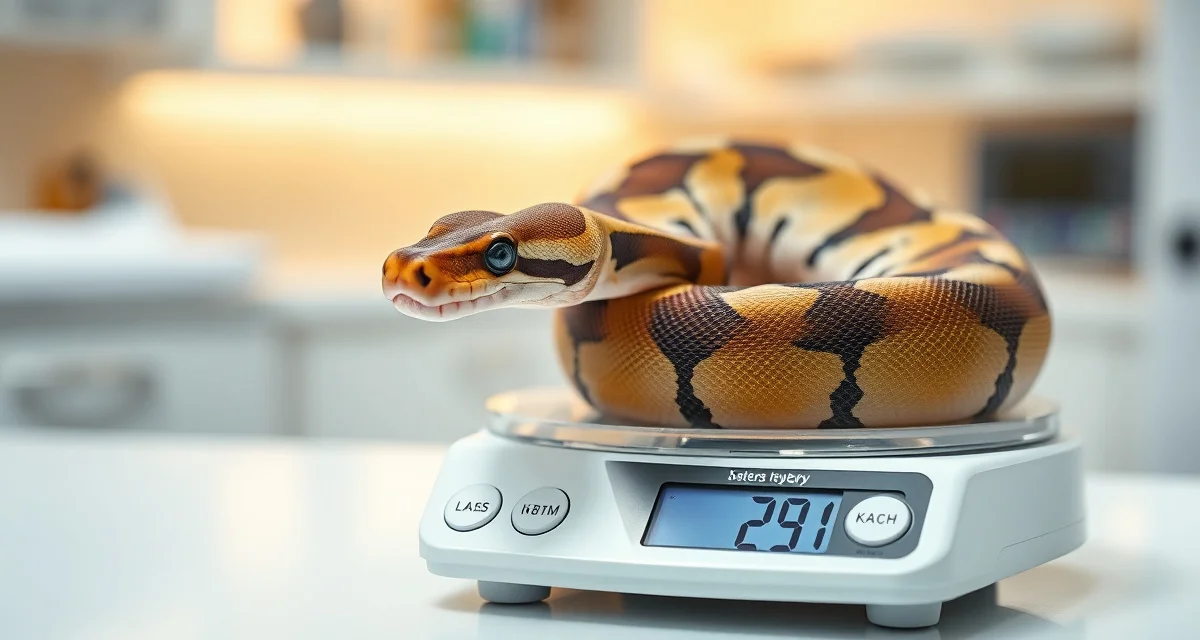
Ball Python Female Weight Tracking Through the Breeding Season
Female ball python weight is a critical management data point from October through September. It determines whether a female is ready to breed, tracks her condition through gravidity, documents the cost of clutch production to her body, and monitors her recovery. Without consistent weight data, you're making husbandry and breeding decisions blind.
Pre-Breeding Weight Assessment (September-October)
Weigh every breeding female candidate before making pairing decisions. This is non-negotiable.
Minimum weight: 1,200g. Below this, the risks to the female increase and first clutches from underweight females are often smaller or problem-prone.
Preferred weight: 1,500g or above for experienced breeders. Many serious breeders will not introduce a female until she's at 1,500-1,600g. Larger, heavier females produce larger clutches and recover more easily.
Year-over-year comparison: If you have last year's pre-breeding weight on file, compare. A female who was 1,700g in October last year and is 1,450g this October never fully recovered from the previous season. She may need a year off.
Document this weight precisely and date it. It becomes the anchor for tracking the season ahead.
During the Pairing Period (October-February)
Female weight during active pairing typically stays relatively stable, though some females eat less during the pairing period and may lose 50-100g. This is normal.
Weigh monthly during the pairing period. You're not looking for rapid changes, but you want to flag any female losing significant weight before showing signs of ovulation. A female dropping weight rapidly while not yet gravid may have a health issue.
Post-Ovulation Through Pre-Lay (February-April)
After ovulation, the female becomes gravid as follicles develop into eggs. During this period she will gain weight noticeably. A female who ovulated at 1,650g may weigh 1,850-2,000g or more immediately before laying, depending on clutch size.
Track this weight gain. It correlates with clutch size: more egg mass means more weight. A female who barely gained weight in gravidity and then lays a clutch of 3 eggs is consistent data. One who gained 400g and laid only 2 eggs should prompt you to check whether additional eggs were retained.
Many females stop eating entirely during gravidity, which is normal. Do not force-feed a gravid female who is refusing. Continue to offer food but do not be concerned about refusals in a clearly gravid animal.
Post-Clutch Weight (May-June)
Weigh the female immediately after the clutch is laid, before she has her first post-lay feeding. This post-clutch weight is the key recovery baseline.
A female who laid at 1,900g (gravid weight) and weighs 1,350g post-clutch has produced approximately 550g of eggs. This is a significant metabolic cost. Her weight recovery through the summer will determine whether she's ready for the following season.
Typical post-clutch weight loss from gravid weight to post-lay weight ranges from 350g-600g for average clutch sizes. Larger clutches cost more.
Recovery Period (June-September)
After laying, a female needs to eat aggressively and recover condition. Most healthy females will return to near their pre-breeding weight within 8-12 weeks with consistent feeding.
Track weight monthly during recovery. A female who is still 300g below her pre-breeding weight at the start of September did not recover fully. Options:
- Give her a year off from breeding, focus on weight gain through the off-season and into the following year
- Use her more conservatively the following season with fewer or shorter pairing periods
- Investigate health factors if she's eating well but not gaining
HatchLedger graphs weight history per animal, making the breeding season weight curve visible at a glance. When you pull up a female's record in September, you can see whether her recovery curve looks like previous healthy seasons or whether it's lagging.
Body Condition Scoring Alongside Weight
Weight alone can be misleading if an animal's frame size is unusual. A 1,600g female who is heavily obese is in worse condition than a lean 1,500g female. Use body condition scoring alongside weight: feel along the spine and ribs, assess fat deposits, and note whether the animal is at a healthy muscle to fat ratio.
Related content: Animal Weight Tracking | Female Weight Tracking | Ball Python Breeding Records
Sources
- Ball Python Breeders Association breeding condition guidelines
- Association of Reptilian and Amphibian Veterinarians (ARAV)
- World of Ball Pythons husbandry resources