Female Weight Tracking for Reptile Breeders
By HatchLedger Editorial Team · Published 2025-03-03 · Updated Mar 13, 2026
Weight is the most objective measure of a breeding female's condition. It tells you whether she's gaining, maintaining, or losing mass, and when combined with feeding records, it reveals whether she's converting prey into body condition effectively. For breeders managing multiple females across breeding seasons, systematic weight tracking is foundational.
Why Weight Matters More Than Visual Assessment
Experienced breeders develop an eye for condition over time, but visual assessment is subjective and inconsistent across observers. Body condition scoring works as a quick check, but it doesn't catch gradual changes the way a weight trend does.
A female who looks fine visually but has dropped 200 grams over three months is losing condition. That loss may not be obvious in a large animal until it's substantial. A scale catches it early.
Weight trends also predict breeding success. Ball python females below 1,500 grams produce smaller clutches on average. Females who enter the breeding season having lost significant mass since the previous season have worse reproductive outcomes than those who've maintained or gained.
How to Weigh Reptiles Consistently
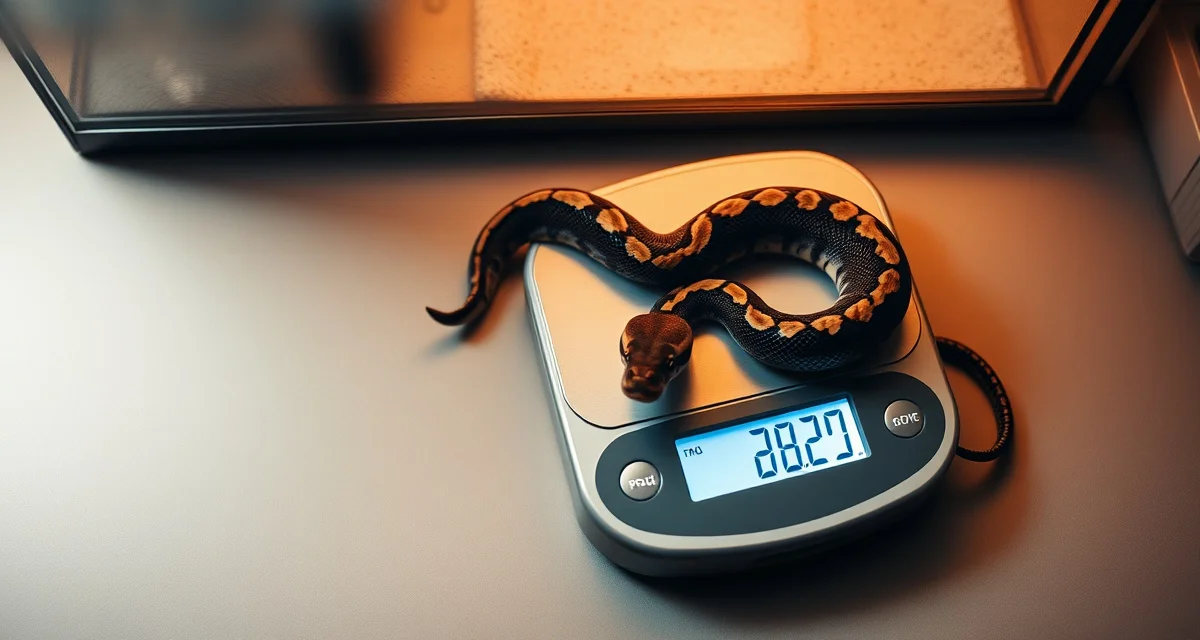
Use the same scale: If you use two different scales, you introduce measurement inconsistency. Stick with one calibrated scale for all weight records.
Weigh at consistent times: Weigh before feeding, not after. A ball python who just ate a large rat weighs significantly more than before the meal. Pre-feeding weight reflects true body condition. Some breeders weigh 24-48 hours post-meal to allow digestion.
Use a consistent container: Tare the scale with whatever container you're using. A pillowcase, deli cup, or small tub all work. Use the same container for the same animal to minimize handling stress.
Frequency: Monthly for adult non-breeding animals. Every 2-4 weeks during the breeding season. More frequently if you're managing a female with health concerns.
Interpreting Weight Trends
A single weight is a data point. Weight over time is a trend. Look for:
Steady gain: Normal in juveniles and young adults, expected in females being conditioned for breeding season. Good sign.
Stable weight: Normal for healthy adults not in active breeding. Expected in males who are otherwise doing well.
Gradual decline: Concerning. A female who loses 3-5% of body weight per month consistently has a problem, insufficient feeding, health issue, or over-breeding.
Rapid loss: Urgent. More than 10% body weight loss in a short period requires immediate investigation.
Post-lay recovery: After laying, females typically lose weight equivalent to the clutch mass plus some additional reserves. Document the post-lay weight and track recovery. A female who recovers to pre-lay weight within 3-4 months is recovering well.
Weight and the Breeding Season
Connect weight records to your breeding season records to build a picture of how each female's weight moves through the reproductive cycle.
A typical ball python breeding female might follow this pattern:
- September (pre-breeding): 2,100g
- November (active breeding): 1,950g (normal; many females eat less during active pairing)
- January (post-ovulation): 1,850g (follicle development adds mass internally)
- February (post-lay): 1,400g (clutch mass removed)
- May (recovery): 1,900g (4 months of steady feeding)
Documenting this pattern over multiple seasons for each female tells you what's normal for her specifically. Deviations from her individual pattern are more meaningful than comparisons to population averages.
Minimum Weights for Breeding
Before introducing a female to a male, verify she meets minimum weight criteria. This protects her health and increases the probability of a successful clutch.
Ball python minimums by most breeder standards: 1,200g absolute minimum, 1,500g recommended for first-time breeders, 1,800g+ preferred. Larger females consistently produce larger, healthier clutches.
Document the female's weight at the time of first breeding introduction for each season. This creates a record of the condition she was in when breeding decisions were made, which is useful if you're evaluating clutch outcomes later.
HatchLedger keeps complete weight logs alongside female health tracking records so you always have the context you need to evaluate a female's current status against her historical baseline.
FAQ
What is Female Weight Tracking for Reptile Breeders?
Female weight tracking for reptile breeders is the practice of regularly recording each breeding female's body weight over time to monitor her condition, feeding response, and reproductive readiness. Rather than relying on visual assessment alone, breeders use a calibrated scale and a log—digital or paper—to build a weight history for each animal. This data reveals trends like gradual mass loss, poor feed conversion, or condition changes heading into breeding season that would otherwise go unnoticed until the animal's health was already compromised.
How much does Female Weight Tracking for Reptile Breeders cost?
Female weight tracking itself costs nothing beyond a reliable digital scale, which typically runs $20–$60 for a kitchen or postal scale accurate to one gram. Software tools like HatchLedger that log weights alongside feeding records and breeding data are available at low monthly subscription rates. The real cost of not tracking is higher—missed condition declines, reduced clutch sizes, and poorer reproductive outcomes across seasons represent losses that far exceed any tool investment.
How does Female Weight Tracking for Reptile Breeders work?
Breeders weigh each female on a consistent schedule—typically weekly or bi-weekly—using the same calibrated scale each time. The weight is recorded alongside the date and any relevant notes such as recent feeding or shed status. Over time, these data points form a trend line that shows whether the animal is gaining, maintaining, or losing mass. When combined with feeding records, weight data reveals whether the female is converting prey efficiently and whether her condition is appropriate for the upcoming breeding season.
What are the benefits of Female Weight Tracking for Reptile Breeders?
Systematic weight tracking catches gradual condition loss before it becomes visually obvious, allows early intervention with feeding adjustments, and helps predict reproductive outcomes. Females entering breeding season below target weight or having lost significant mass since the prior season tend to produce smaller clutches with worse hatch rates. Tracking also creates accountability across a breeding collection—when managing multiple females, memory alone is unreliable. A documented weight history supports better decisions about pairing timing, feeding frequency, and whether a female should be rested from breeding.
Who needs Female Weight Tracking for Reptile Breeders?
Any reptile keeper managing breeding females benefits from weight tracking, but it becomes essential once you're working with multiple animals or aiming for consistent reproductive results. Ball python breeders in particular rely on it because females below 1,500 grams tend to produce smaller clutches. Hobbyists breeding one or two animals can use it to build confidence in their husbandry. Professional breeders managing dozens of females across multiple species use it as a core record-keeping practice to maintain collection health and breeding performance season over season.
How long does Female Weight Tracking for Reptile Breeders take?
Weighing an individual female takes under two minutes. The time investment comes from doing it consistently—most breeders build it into a weekly or bi-weekly husbandry routine alongside feeding and enclosure checks. Recording the weight in a log or app adds seconds per animal. The larger time commitment is reviewing trends periodically, which might mean a few minutes per month per female. Over a full breeding season, this accumulates into a valuable dataset that informs pairing decisions, feeding schedules, and long-term collection management.
What should I look for when choosing Female Weight Tracking for Reptile Breeders?
Choose a scale accurate to one gram with a capacity that covers your heaviest animals—kitchen scales in the 0–5kg range work well for most colubrids and ball pythons. Look for consistent readings and easy taring with a container. For record-keeping, prioritize a system that links weight to individual animal records and feeding history rather than tracking them separately. HatchLedger connects weight logs to each female's full breeding profile. Avoid switching scales mid-season, as different instruments introduce measurement inconsistency that distorts trend data.
Is Female Weight Tracking for Reptile Breeders worth it?
Yes. Weight tracking is one of the highest-signal, lowest-effort practices in reptile breeding. A single early catch of unexpected mass loss—before it becomes a health crisis—justifies the entire habit. Breeders who track weights consistently report better awareness of each female's condition, fewer surprises at pairing time, and more confidence in feeding decisions. The data compounds in value across seasons, giving you a baseline that makes each new year's breeding cycle more informed than the last. For anyone serious about reproductive outcomes, it's foundational.