What Causes Infertile Ball Python Eggs FAQ
Pulling open an incubation bin to find a clutch of slugs is one of the more discouraging moments in ball python breeding. Understanding why it happens helps you prevent it from recurring.
TL;DR
- Slug eggs are infertile ball python eggs with no developing embryo, identifiable by their smaller size, yellowish color, and firmer texture compared to fertile eggs.
- The most common cause of all-slug clutches is failed fertilization, where copulation was observed but no viable sperm transfer actually occurred.
- Timing relative to ovulation is critical: pairing too early or too late in the female's cycle frequently results in slugs even when the male is fertile.
- Candling within one to two weeks of laying is the most reliable way to distinguish fertile eggs from slugs before investing weeks of incubation time.
- Tracking slug rate per pairing across multiple seasons helps identify whether the problem is the male, the female, or the timing of introductions.
- Introducing males multiple times throughout the breeding season, rather than relying on a single pairing, meaningfully reduces slug risk.
- Stored sperm from a previous season can decline in viability, so females relying solely on stored sperm may still produce all-slug clutches.
What Are Slug Eggs?
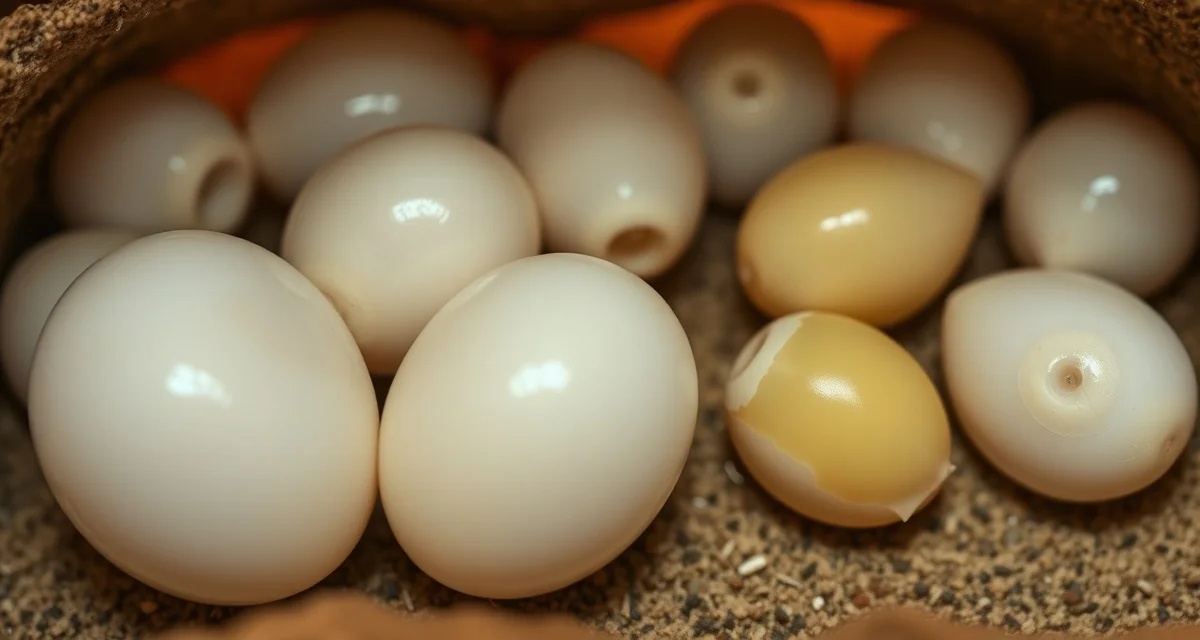
Slug eggs, or slugs, are infertile ball python eggs. They're typically smaller than fertile eggs, yellowish, and firmer in texture. Some slugs are completely solid with no fluid inside. Others may have a small amount of fluid but no developing embryo.
A clutch of all slugs means fertilization didn't occur. A mixed clutch with some slugs and some fertile eggs is more common and still produces hatchlings from the viable eggs.
What Causes Infertile Ball Python Eggs?
Failed fertilization: The most common cause. The female was not successfully mated despite observed breeding behavior. Copulation was observed but no viable sperm transfer occurred.
Infertile male: Some males are simply not producing viable sperm. This can be age-related (very young or very old males), related to health issues, or just individual variation. A male who has never produced a successful clutch despite multiple pairings should be considered potentially infertile.
Timing issues: Breeding too early before the female was ready to ovulate, or too late after she already ovulated, can result in all slugs. This is why tracking ovulation is so important.
Female health problems: Nutritional deficiencies, parasite load, infections, and other health issues can interfere with follicle development and fertilization.
Stored sperm failure: Ball pythons can store sperm and fertilize eggs from a previous season's pairing. When a female produces slugs in a season where the previous male's stored sperm was the only sperm available, it may indicate that stored sperm viability declined.
How Can You Tell If Eggs Are Fertile Before Incubation?
Candling is the most reliable method. Shine a bright light through the egg in a darkened room. Fertile eggs, within a week or two of laying, will show pink or red vascularization (blood vessels) inside. Slugs show no vascularization and often appear uniformly yellowish or solid.
Candling takes some experience to read accurately. Eggs early in incubation can be harder to candle than eggs a week or two in.
Does Slug Rate Vary by Pairing?
Yes. Some pairings consistently produce high slug rates while others rarely produce any. Tracking slug rate per pairing over multiple seasons is useful data.
If a specific pairing consistently produces 30 to 40 percent slugs, something about that combination may be off. You might try introducing a different male to the same female, or have the male's health evaluated.
Can You Prevent Slug Clutches?
You can reduce risk but not eliminate it entirely. Key preventive practices:
- Ensure the male is healthy, experienced, and has demonstrated fertility with other females
- Confirm the female has ovulated before expecting fertile eggs
- Introduce males multiple times throughout the breeding season rather than relying on a single pairing
- Maintain female health year-round, not just during breeding season
- Track your ovulation observations carefully so you know the timing window
How Does Tracking Help Reduce Slug Rates?
If you're logging every breeding introduction, noting when the female showed ovulation swelling, and documenting the time gap between last pairing and lay date, you can identify timing problems. A female who ovulated three weeks after the last male introduction may have been poorly timed, and that tells you something for next season.
The ball python breeding hub connects to your clutch records in HatchLedger. The ball python morph calculator helps you plan what you're trying to produce, but your breeding season logs show you whether your process is set up to produce it successfully.
Frequently Asked Questions
What causes infertile ball python eggs?
The most common causes are failed fertilization (breeding happened but no viable sperm transfer), male infertility, timing mismatches where pairing occurred too early or too late relative to ovulation, and female health issues that interfere with reproductive function.
How do professional breeders handle infertile ball python egg rates?
They track slug rates per pairing and per female, monitor ovulation carefully to ensure timing is correct, verify male fertility across multiple females, and adjust their breeding protocols when a specific pairing consistently underperforms.
What software helps manage ball python clutch fertility tracking?
HatchLedger logs egg count, slug count, and hatch rate for every clutch, and connects those records to the breeding introductions and female health logs that led to that clutch, helping you identify patterns in your slug rates.
How many slugs in a clutch is considered normal?
A mixed clutch with one or two slugs alongside several fertile eggs is common and not necessarily a sign of a problem. Breeders generally become concerned when slug rates exceed 30 to 40 percent of a clutch consistently across multiple seasons or multiple pairings with the same male. A single all-slug clutch from an otherwise productive female is worth noting but not always cause for alarm.
Can a female ball python produce slugs even if she was successfully mated?
Yes. Observed copulation does not guarantee viable sperm transfer. A female can go through the full breeding process, develop follicles, ovulate, and still lay all slugs if sperm transfer was incomplete or if the male's sperm was not viable. This is why confirming male fertility across multiple females is an important part of evaluating breeding males.
Does incubation temperature affect whether eggs develop or become slugs?
No. Whether an egg is fertile or infertile is determined at the time of fertilization, before the egg is laid. Incubation temperature affects development speed and hatchling sex ratios in some species, but it cannot cause a fertile egg to become a slug or rescue an already-infertile egg.
At what age are male ball pythons most reliably fertile?
Males are generally considered most reliably fertile between two and eight years of age, though many males remain productive well beyond that. Very young males under 18 months may show breeding behavior but produce low-viability sperm. Very old males can also see declining fertility, which is worth tracking if a previously productive male begins contributing to higher slug rates.
Sources
- Ball Python Husbandry and Reproduction Guidelines, Association of Reptilian and Amphibian Veterinarians (ARAV)
- Reptile Breeding and Genetics, University of Florida IFAS Extension
- Journal of Herpetological Medicine and Surgery, Society for the Study of Amphibians and Reptiles
- Python Regius Reproductive Biology, Smithsonian National Zoological Park Herpetology Department
Get Started with HatchLedger
If slug rates, timing gaps, and male fertility questions are things you're trying to sort out across multiple females and multiple seasons, HatchLedger gives you a single place to log every breeding introduction, ovulation observation, clutch outcome, and hatch rate so the patterns become visible over time. You can start tracking your current season's clutches right away with a free trial and see how your records connect across animals and pairings.