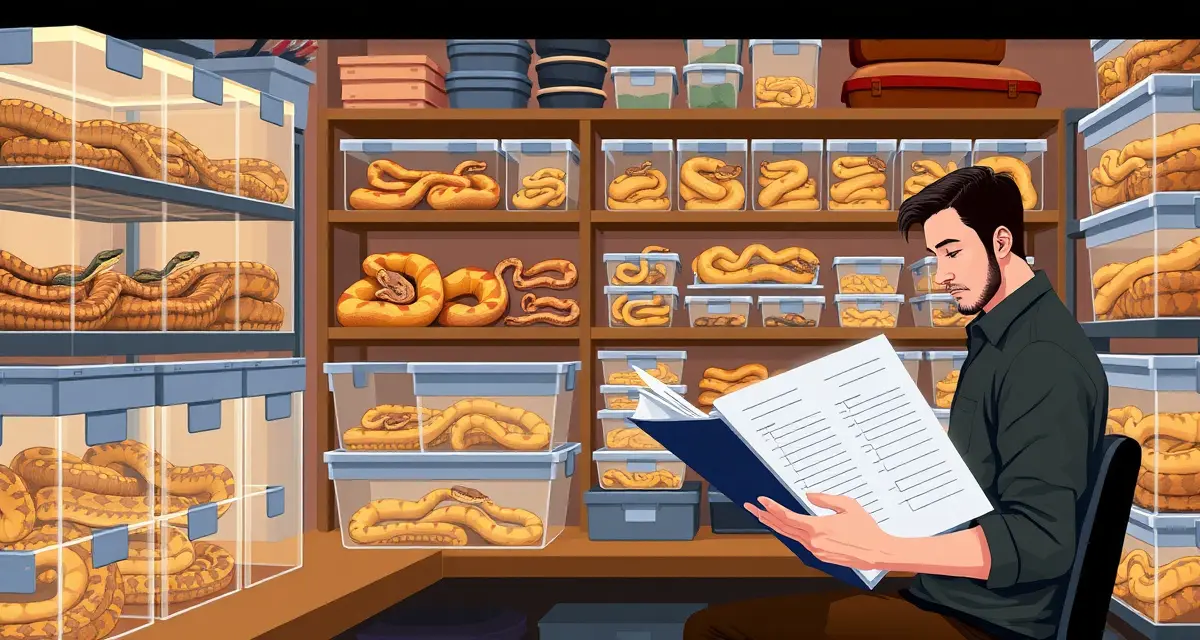
The Risk of Overproduction in Ball Python Breeding
There's a version of success in ball python breeding that quietly becomes a liability. You've built a solid collection. Your females are healthy. Your genetics guide are good. You run 20 pairings. You get 20 clutches. You hatch 160 animals. And then you realize you have no idea how you're going to sell 160 ball pythons in a competitive market before the cost of feeding them for another year erodes your margins to zero.
TL;DR
- Ball python breeding operations require systematic record-keeping from pre-season preparation through end-of-season sales.
- Females at 1,200-1,500g or more are the target weight before introducing them to a breeding male.
- Ovulation detection is the key event that anchors pre-lay shed and lay date calculations.
- Clutch profitability guide depends on understanding actual cost basis per animal, not just gross sale revenue.
- Well-documented animals with complete feeding histories and clear genetic records consistently sell faster and at higher prices.
Overproduction is real, it's common, and it's one of the primary reasons small and mid-size breeding operations fail. This guide explains the risk, how to avoid it, and how to structure a more sustainable breeding operation.
What Overproduction Means in Practice
Overproduction is simple: you produce more animals than you can sell at profitable prices within a reasonable timeframe. The consequence isn't just slow sales. It's a cascade of problems:
Carrying costs compound. Every unsold animal costs you money every week in food, electricity, and space. A ball python eating a rat every week for 52 weeks while you wait for a buyer consumes $50-100 in prey alone over a year, plus the cost of substrate changes, electricity, and your time.
Sale prices drop. When you're holding inventory that's not moving, the pressure to discount increases. Selling animals at below-market prices to clear space has become a race to the bottom. MorphMarket is full of breeders in this position posting increasingly discounted animals.
Attention divides. Managing 160 hatchlings takes far more of your time than managing 80. That time has to come from somewhere, and it often comes from quality of care, quality of documentation, and quality of the breeding program itself.
Cash flow stalls. If revenue is tied up in unsold animals, you can't reinvest in better genetics for the next season. The operation stagnates at exactly the point where you need to be improving.
The Primary Causes of Overproduction
Pairing More Animals Than Your Sales Can Absorb
The most obvious cause. Breeders who run 20+ pairings in a season without a clear sales plan for the projected hatchling count are setting themselves up for this problem. The math is straightforward: if you average 6 viable hatchlings per clutch and run 20 pairings, you're projecting 120 hatchlings. How many ball pythons do you realistically sell in a season at what average price? If the answer is "probably 60-80," you shouldn't be running 20 pairings.
Producing Animals Below Market Demand
You can produce 160 beautiful animals and still have an overproduction problem if what you're producing isn't what buyers are actively seeking. High volumes of commodity morphs, basic Pastels, single-gene Spiders, plain Cinnamons, in a market where those morphs are already saturated creates a difficult sales environment regardless of your production quality.
Building Inventory Without Building a Buyer Base
Some breeders spend years developing genetics but almost no time building a customer base. A fantastic Instagram photo of a new morph doesn't automatically translate into buyers. Established sellers have email lists, waitlists, repeat customers, and network connections that new sellers don't. Without that infrastructure, even genuinely special animals can sit unsold.
Failing to Track Production Against Sales History
If you don't know what you sold last year, at what price, and how long it took, you have no data to inform this year's pairing decisions. Most breeders operate from memory and intuition. Memory is notoriously unreliable for unflattering facts, like how many animals you sold at a discount in November because you couldn't move them in September.
How to Calibrate Production to Demand
Start with Your Realistic Sales Capacity
Before the pairing season, answer these questions honestly:
- How many animals did you sell last year?
- What was your average sale price?
- How long did animals sit on average before selling?
- What did you do with animals that didn't sell?
These numbers are your baseline. Don't plan for production that exceeds your demonstrated sales capacity by more than 20-30%.
Match Production to Specific Buyer Demand
If you have a waitlist of 40 buyers for specific animals, produce to fill that list. If you don't have a waitlist, build one before you breed. Getting buyers interested in what you're planning to produce before the season starts is the most direct way to align production with demand.
This requires marketing effort (building an email list, consistent social media presence, attending shows) that many breeders neglect. The breeding itself is fun; the sales infrastructure is work. Both are necessary for a sustainable operation.
Prioritize Fewer, Higher-Value Pairings
Twenty pairings of commodity morphs may produce more animals but generate less revenue than eight pairings of high-value combinations. Quality and value per animal is almost always a better strategy than volume. Buyers willing to pay $1,000 for a complex combo are generally easier to find than buyers willing to pay $100 for a basic single-gene animal in a crowded market.
Set a Firm Breeding Cap
Decide how many clutches you're going to run before the season starts and don't go above that number regardless of which females are ready. A firm cap forces prioritization: you have to decide which pairings are worth running, which forces better pairing decisions overall.
Financial Modeling Before the Breeding Season
Knowing whether a planned production level is financially sustainable requires modeling before you commit. If you're planning 15 clutches at an average of 7 hatchlings with a projected average sale price of $400, you're modeling $42,000 in revenue. Does that cover your costs and provide adequate margin? If your carrying costs for 105 animals over 6 months before they sell are $25,000 and your animal acquisition, overhead, and labor costs add another $10,000, your margin is thinner than it looks.
The HatchLedger platform connects your clutch production records to your sales and cost data so you can run this analysis on real historical numbers, not estimates. Breeders using integrated software report 30% less time on administrative tasks because data that would otherwise require piecing together from multiple sources is already connected. Knowing your actual cost per animal and actual revenue per clutch from last season makes this year's production planning dramatically more grounded.
The reptile breeder software comparison covers how different tools approach financial tracking for breeding operations and is worth reviewing if you're building out this capability.
Managing Surplus When It Happens
Even well-planned operations sometimes have surplus. How you manage it matters.
Don't race to discount publicly. Heavily discounting on MorphMarket signals to all future buyers that your prices are negotiable and that you're under pressure. Use private discounts or bundle offers selectively rather than posting public price cuts.
Consider long-term holdbacks. Animals that don't move as hatchlings or juveniles sometimes become more interesting as they color up in adulthood. A female you can't sell at $300 as a hatchling might be worth $800 at adult size and weight with a proven breeding history attached.
Build relationships with other breeders. Wholesale trades with other breeders can move surplus quickly at below-retail prices without publicly discounting. The breeder network is often a better channel for surplus than open market listings.
Evaluate what didn't sell and why. Is it the morph, the price, your listing quality, or the sales platform? Surplus is information if you're willing to analyze it honestly.
Thinking Long-Term About Breeding Scale
The most sustainable ball python breeding operations are rarely the largest ones. A mid-sized operation with 30-50 pairings, focused on high-value genetics, with a waitlist that pre-sells most hatchlings before they're born, is often more profitable and more manageable than a 200-pairing operation competing on volume.
Building to that position takes years and requires simultaneous investment in genetics, husbandry quality, and sales infrastructure. But the breeders who get there tend to be the ones who treated overproduction as a planning problem rather than an unavoidable cost of doing business.
Frequently Asked Questions
What is the best approach to ball python overproduction risk?
Set a firm pairing cap before the season based on your demonstrated sales capacity from previous years. Focus on fewer, higher-value pairings rather than maximum volume. Build a waitlist before the season to pre-sell animals at target prices, and model your expected production revenue against your carrying costs before committing to pairings.
How do professional breeders handle ball python overproduction risk?
Professional breeders treat production planning as a financial exercise, not just a genetics exercise. They know their cost per animal, their historical average sale price by morph category, and their realistic sell-through volume. They set their pairing count to match their sales capacity plus a modest buffer, prioritize high-value combinations over volume, and build buyer relationships year-round rather than only during selling season.
What records should every reptile breeder maintain per animal?
At minimum: acquisition date and source, morph and genetic documentation, feeding log, weight history, any veterinary treatments, and breeding history including pairing dates, clutch of origin for captive-bred animals, and offspring records. These records serve your own management, buyer documentation, regulatory compliance, and long-term genetic tracking.
How should reptile breeders document genetics for buyers?
A complete genetic record for sale includes the animal's visual morph name, confirmed het genes and their basis (parentage documentation or proven-out production), possible het genes with probability percentages, hatch date, and parent morph information. Including clutch-of-origin records lets buyers independently verify the claims.
Sources
- USARK (United States Association of Reptile Keepers)
- Association of Reptilian and Amphibian Veterinarians (ARAV)
- World of Ball Pythons (WoBP genetics reference database)
- MorphMarket (reptile industry marketplace)
- Reptiles Magazine (Bowtie Inc.)
Get Started with HatchLedger
Every part of a ball python breeding operation -- from pairing records to clutch documentation to financial tracking -- works better when the data is connected rather than scattered across notebooks and spreadsheets. HatchLedger is built for exactly that. Try it free with up to 20 animals.