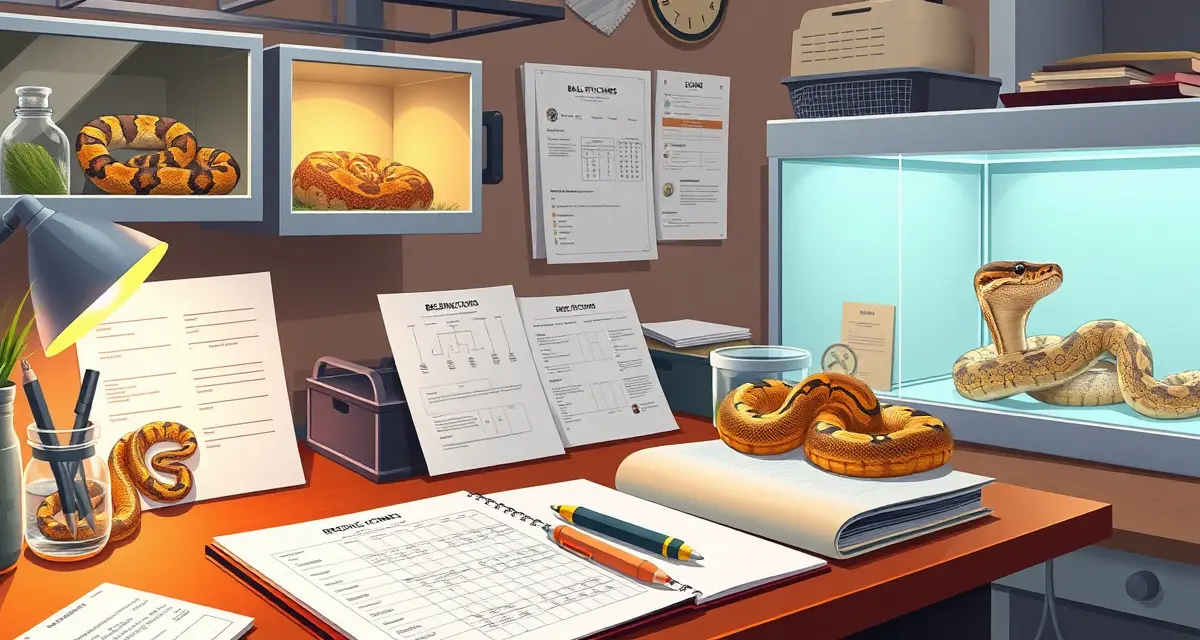
Ball Python Line Breeding: Risks and Rewards
Line breeding divides the reptile community. Some breeders swear by it as the fastest path to consistency and distinctive traits. Others avoid it entirely, citing health concerns and a narrowing gene pool.
TL;DR
- Ball python breeding operations require systematic record-keeping from pre-season preparation through end-of-season sales.
- Females at 1,200-1,500g or more are the target weight before introducing them to a breeding male.
- Ovulation detection is the key event that anchors pre-lay shed and lay date calculations.
- Clutch profitability guide depends on understanding actual cost basis per animal, not just gross sale revenue.
- Well-documented animals with complete feeding histories and clear genetic records consistently sell faster and at higher prices.
Both perspectives have merit. The truth is that ball python line breeding is a legitimate and widely-used strategy, but it demands a level of record-keeping and intentionality that separates breeders who use it well from those who stumble into it accidentally.
Breeders using integrated software report 30% less time on administrative tasks. When you're managing a multi-generational project with overlapping lineages, that efficiency isn't a nice-to-have, it's necessary.
What Is Line Breeding?
Line breeding is the practice of mating animals that are related but not as closely related as parent-offspring or full-sibling pairings. Common examples include:
- Half-sibling × half-sibling
- Uncle × niece or aunt × nephew
- Grandparent × grandchild
- Cousin × cousin
The goal is to concentrate specific genetics guide, a particular look, a desirable trait pattern, improved consistency within a morph, while managing the risks that come with reducing genetic diversity.
It's distinct from pure inbreeding (parent-offspring, full-sibling pairings), which carries higher risk and is less commonly used intentionally.
Why Breeders Use Line Breeding
Fixing Traits
When you have an animal with exceptional qualities, better pattern expression, ideal color saturation, unusually clean combo expression, you want those traits to reproduce consistently. Breeding that animal back into its own lineage concentrates the alleles responsible for those traits.
Random outcrossing with unrelated animals dilutes those genetics. Line breeding preserves them.
Building a Program Identity
Some of the most respected breeders in the hobby are known for the consistent look of their animals. "So-and-so's Pastels look different", that's a product of careful line breeding over years. Buyers will pay a premium for animals from a program with a recognized, consistent phenotype.
Accelerating Genetic Goals
When you're working toward a specific multi-gene combo, line breeding lets you progress faster. If your F1 generation produces an exceptional het animal, breeding that het back toward its parent or sibling keeps the target genetics concentrated in fewer generations.
The Real Risks
Inbreeding Depression
This is the primary concern. When related animals are bred, the probability increases that offspring will be homozygous for recessive deleterious alleles, genes that are harmless when one copy exists but cause problems in two copies.
Symptoms of inbreeding depression include:
- Reduced clutch sizes
- Lower hatch rates
- Failure-to-thrive hatchlings
- Compromised immune function
- Reproductive failures in subsequent generations
- Reduced body condition even with adequate feeding
These effects compound across generations. A single close breeding may produce no obvious problems. By generation three or four of consistent close breeding, the cumulative effect becomes visible.
Lethal Gene Interactions
Ball pythons already carry known lethal gene combinations (Spider with Champagne, for example). Line breeding can increase the risk of novel lethal combinations appearing if rare deleterious recessives are concentrated.
Reduced Adaptability
A genetically narrow population is more vulnerable to disease, environmental stress, and novel pathogens. For a large operation where animals are housed in close proximity, this matters.
How to Do It Responsibly
Know Your Pedigrees Completely
You cannot manage what you don't track. Before any line breeding pairing, you need to know:
- The exact relationship between the two animals
- How many generations of related breeding exist in their ancestry
- Which animals have been used most extensively in the lineage
Maintain a pedigree record that goes back at least three generations for every animal involved in line breeding. HatchLedger stores linked parentage records so you can trace relationships accurately rather than relying on memory or informal notes.
Plan Your Outcross Schedule
Don't line breed indefinitely without introducing fresh genetics. Decide in advance: after how many generations of close breeding will you outcross? Many breeders use a rule of every 2–3 generations of line breeding before bringing in unrelated genetics.
When you do outcross, choose animals from a breeder whose lines demonstrably don't overlap with yours.
Monitor Health Indicators Closely
Track clutch sizes, hatch rates, first-feed success, and weight progression for every clutch within your line-bred project. Establish baseline expectations from your first generation and watch for declining trends.
A drop in hatch rate from 90% to 75% over three generations isn't coincidence, it's a signal. Acting early is far less costly than letting the problem develop.
Understand the Coefficient of Relationship
Even if you're not calculating formal inbreeding coefficients, understand the general risk level of the relationships you're using:
- Half-sibling × half-sibling: Moderate (coefficient of relationship ~0.25)
- Uncle/aunt × niece/nephew: Moderate (~0.25)
- First cousin × first cousin: Lower (~0.125)
- Grandparent × grandchild: Higher (~0.25)
Staying toward the lower end of relationship coefficients reduces risk while still achieving the concentration of genetics you're targeting.
Evaluating Holdbacks for Line Breeding Programs
Choosing which offspring to retain is more complex in a line breeding program than in a standard outcrossed program.
Prioritize animals that:
- Exhibit the target traits most clearly
- Show excellent vigor from day one (strong first feeds, healthy body weight gain)
- Have clean shed records
- Represent the specific genetic composition needed for your next planned pairing
HatchLedger's hatchling tracking connects first-feed records, weight logs, and genetic data so you can make retention decisions based on documented performance rather than impressions.
When to Stop and Outcross
Trust the data. If your clutch sizes are declining, your hatch rate is dropping, or you're seeing more hatchlings that struggle to establish feeding, stop the line breeding and outcross. No trait is worth compromising the health of your program.
The goal of line breeding is a better, more consistent animal. If the health trajectory is going the wrong direction, you've moved past what's sustainable.
FAQ
What is the best approach to ball python line breeding guide practices?
Use line breeding intentionally with complete pedigree records and a planned outcross schedule. Define your target traits clearly, know the relationship coefficient of every pairing you make, and monitor health performance data closely across generations. Never line breed without knowing your animals' ancestry at least three generations back.
How do professional breeders handle ball python line breeding guide principles?
Professional breeders treat line breeding as a project with defined start and end points, not an indefinite strategy. They set outcross intervals in advance, document every pairing's relationship formally, and use health performance data, hatch rates, clutch sizes, first-feed success, as objective indicators of program health. When indicators decline, they act before the problem becomes severe.
What software helps manage ball python line breeding guide record-keeping?
HatchLedger is purpose-built for reptile breeders, connecting animal records, breeding history, clutch outcomes, and financial tracking in one connected system. Unlike general spreadsheets or notes apps, it's designed around the specific workflow of an active breeding season -- from pairing records through hatchling inventory and sales documentation. Free for up to 20 animals.
Sources
- USARK (United States Association of Reptile Keepers)
- Association of Reptilian and Amphibian Veterinarians (ARAV)
- World of Ball Pythons (WoBP genetics reference database)
- MorphMarket (reptile industry marketplace)
- Reptiles Magazine (Bowtie Inc.)
Get Started with HatchLedger
Every part of a ball python breeding operation -- from pairing records to clutch documentation to financial tracking -- works better when the data is connected rather than scattered across notebooks and spreadsheets. HatchLedger is built for exactly that. Try it free with up to 20 animals.