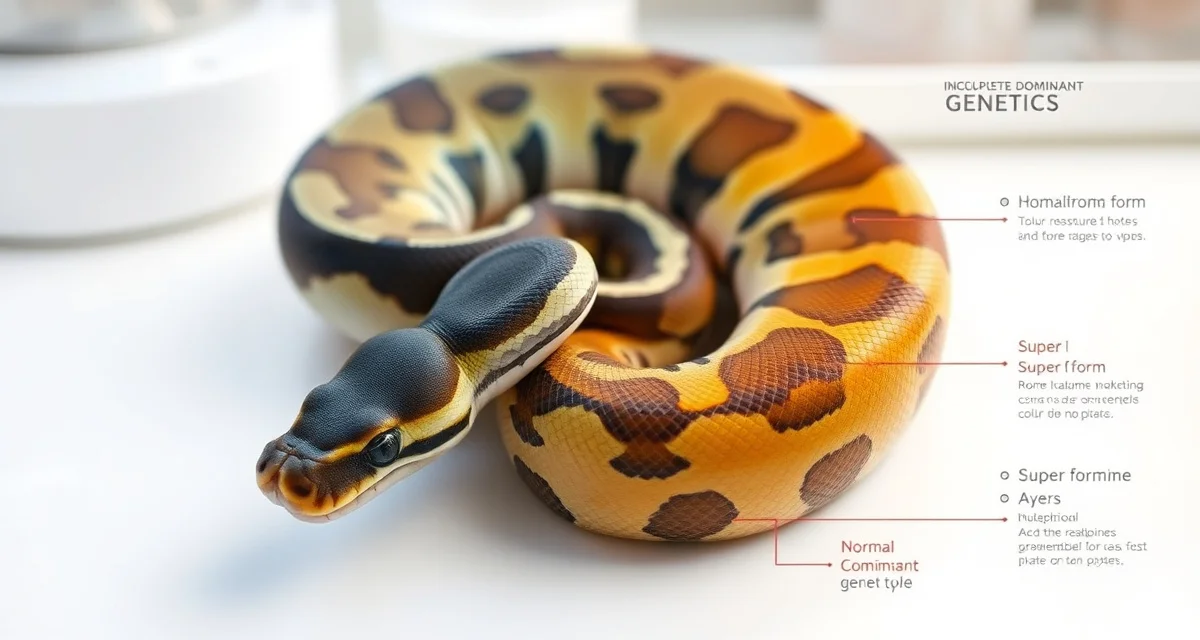
Incomplete Dominant Ball Python Genetics Explained
By HatchLedger Editorial Team · Published 2025-03-26 · Updated Mar 13, 2026
Incomplete dominance is the technical term for what the ball python hobby usually calls "co-dominance." Understanding the actual genetics behind the terminology helps you predict outcomes more accurately, avoid mistakes when planning pairings, and explain your animals' genetics to buyers with confidence.
TL;DR
- Ball python breeding operations require systematic record-keeping from pre-season preparation through end-of-season sales.
- Females at 1,200-1,500g or more are the target weight before introducing them to a breeding male.
- Ovulation detection is the key event that anchors pre-lay shed and lay date calculations.
- Clutch profitability guide depends on understanding actual cost basis per animal, not just gross sale revenue.
- Well-documented animals with complete feeding histories and clear genetic records consistently sell faster and at higher prices.
This guide covers the mechanics of incomplete dominance, how it differs from true dominance and true co-dominance, and why the distinction matters practically for anyone breeding ball pythons.
Clearing Up the Terminology
The ball python community uses "co-dominant" to describe morphs where heterozygous animals (one copy of the gene) look visibly different from homozygous animals (two copies, called the "super" form). In precise genetic terminology, this pattern is actually called incomplete dominance.
Here's the distinction:
True dominance: One copy of the gene produces a fully dominant phenotype. Two copies produce the identical phenotype. The heterozygote looks the same as the homozygote. Very few confirmed true dominant morphs exist in ball pythons.
Incomplete dominance (called "co-dom" in ball pythons): One copy produces an intermediate phenotype. Two copies produce a different, often more extreme phenotype. The three genotypes produce three visually distinct phenotypes.
True co-dominance (in the strict biological sense): Both alleles are expressed simultaneously and equally. The classic example is two flower colors blending in a heterozygote rather than one masking the other.
The hobby-wide use of "co-dominant" for what is genetically incomplete dominance is simply an established convention. You'll encounter it constantly and need to understand both terms. When a breeder says "co-dominant," they mean incomplete dominant with a distinct super form.
Why This Matters for Pairing Outcomes
The existence of three distinct genotypes (no copies, one copy, two copies) and three corresponding distinct phenotypes is what defines this inheritance pattern. Here's the practical implication:
When you pair two single-copy animals of the same incomplete dominant morph:
- 25% of offspring will have no copies (look like normals)
- 50% will have one copy (look like the standard morph)
- 25% will have two copies (look like the super form)
This is the core pairing for producing super forms. The 1-in-4 statistical chance of a super form in each egg is the math underlying the pricing of super form animals.
When you pair a super form to a normal:
- 100% of offspring will be single-copy standard morphs
Not a single normal and not a single super form. This pairing is guaranteed to produce visual animals, which is useful when you need a specific gene in a pairing for a combo project.
When you pair a super form to a single-copy:
- 50% super form
- 50% single-copy
- Zero normals
More efficient for super form production once you have a super in your program.
The Phenotype Spectrum: Super Form Appearance
One of the most important things to understand about incomplete dominant morphs is that the super form isn't just "more of the same." It's often a qualitatively different animal, not merely an intensified version of the single-copy phenotype.
Pastel vs. Super Pastel: Super Pastel isn't just a brighter Pastel. It shows dramatically reduced pattern contrast, often approaching yellow-white with minimal visible pattern, where single-copy Pastel animals still have clear dorsal blotching.
Mojave vs. Super Mojave (BEL): Super Mojave is a pure white or cream animal with blue eyes. Single-copy Mojave shows angular reduced pattern with tan blushing, completely unlike the super form in overall appearance. The two are recognizably different morphs to any experienced breeder.
Cinnamon vs. Super Cinnamon: Cinnamon is a dark reddish-brown animal. Super Cinnamon is nearly black. The color shift from single to super is dramatic.
Pinstripe vs. Super Pinstripe: Single-copy Pinstripe has a characteristic banded dorsal with some lateral reduction. Super Pinstripe is an extremely clean, high-contrast animal with dramatically reduced lateral pattern.
This qualitative shift between single-copy and super form is characteristic of incomplete dominance and is what makes super form production commercially notable. You're not just selling a "better" version of the base morph: you're selling something that looks markedly different.
Allelism and Incomplete Dominant Morphs
Some of the most commercially important incomplete dominant genes are allelic, meaning they occupy the same chromosome locus. When an animal inherits two different allelic genes, the resulting phenotype is neither the typical super form of either gene alone nor the simple single-copy appearance of either.
The BEL complex is the most important example. Mojave, Lesser, Butter, Russo, and Phantom are all allelic. Pairing any two of them together produces animals that can appear similar to the standard BEL (Super Mojave) even though the animal is heterozygous for two different alleles rather than homozygous for one.
Other allelic relationships include:
- Cinnamon and Black Pastel (allelic at the same locus)
- Several combinations in what some call the "Orange Dream" complex
Allelism creates pairing outcomes that don't follow the simple 50/50 or 25/50/25 ratios. When you pair two allelic morphs, you're not producing super forms in the traditional sense: you're producing animals carrying one copy of each allele, and the visual outcome depends on how those specific alleles interact.
Always confirm whether two morphs you're planning to pair are allelic before running the standard co-dom pairing math. Using the ball python morph calculator accounts for these relationships automatically and eliminates the risk of incorrect ratio predictions.
Incomplete Dominant Morphs in Combos
The real power of incomplete dominant morphs is in combination with other genes, particularly high-value recessives. An incomplete dominant morph adds a predictable, visible enhancement to any combo animal, and super forms of the same gene create even more dramatic combo expressions.
Consider Clown (recessive) as the target gene. Adding Pastel to a Clown animal produces a Pastel Clown, which is brighter and more dramatically patterned than a standard Clown. Adding Super Pastel to a Clown animal produces a Super Pastel Clown, even more extreme. Adding Mojave produces a Mojave Clown, and stacking further produces animals that are uniquely striking.
Planning these multi-gene combos requires tracking both the recessive het status of animals and the copy number of each incomplete dominant gene they carry. A single animal might be Pastel (one copy), het Clown, het Pied, and pos het Axanthic, all at once. Managing the breeding implications of that genetic profile without rigorous record-keeping is nearly impossible at scale.
Pricing Animals with Incomplete Dominant Genes
Single-copy incomplete dominant animals carry predictable gene value because buyers know what they're getting. Super forms command a price premium because:
- They look distinctly different and often more extreme
- They guarantee the gene is passed to 100% of offspring in pairings with normals (no normals produced)
- They're produced at only a 25% rate in single-copy x single-copy pairings, making them statistically rarer per clutch
The market value of super forms varies widely by gene and by what additional genes are present. A Super Pastel alone isn't particularly valuable because Pastel is so common. A Super Pastel with Clown in a complex combo is an entirely different price category.
Pricing decisions should be informed by current market data, which changes year to year as specific genes become more or less saturated. The HatchLedger platform connects your genetic records to your sales and financial tracking, giving you a way to compare what you actually sold animals for against production costs and make better pairing decisions the following season. Breeders using integrated software report 30% less time on administrative tasks, with that efficiency most visible in the end-of-season financial review.
The ball python morph calculator is also useful here, helping you model the expected ratio of different phenotypes in a planned clutch so you can estimate revenue potential before committing to the pairing.
Record-Keeping for Incomplete Dominant Programs
Tracking incomplete dominant genetics is simpler than tracking recessive genetics in one respect: there are no hidden carriers. Every visual animal is either a single-copy or a super form, and that's visible. No animal looks normal but secretly carries the gene.
This doesn't mean record-keeping is unimportant. When you're running multiple incomplete dominant genes simultaneously across a large collection, and especially when those genes are combined with recessive hets in the same animals, the data management requirements grow quickly.
Know what every animal in your collection carries. Know which pairings produced it and which animals were its parents. This lineage information has real value when selling animals, because documented parentage adds credibility to genetic claims.
The reptile breeder software comparison covers how different tracking approaches handle multi-gene genetic records, which is worth reviewing if you're deciding how to manage your collection data.
Frequently Asked Questions
What is the best approach to incomplete dominant ball python genetics?
Understand the three-phenotype model: no copies (normal), one copy (standard visual), and two copies (super form), each producing a visually distinct animal. Use a morph calculator for pairing planning, especially when working with allelic genes where standard ratio predictions don't apply. Track genetic records for every animal so combo planning doesn't require reconstructing lineage from memory.
How do professional breeders handle incomplete dominant ball python genetics?
Professional breeders use incomplete dominant genes as the building blocks of combo morphs, combining them with recessive genes to produce uniquely valuable animals. They're precise about the distinction between single-copy and super form animals in their records and pricing, and they use morph calculators to model expected ratios in planned clutches before committing to pairings.
What records should every reptile breeder maintain per animal?
At minimum: acquisition date and source, morph and genetic documentation, feeding log, weight history, any veterinary treatments, and breeding history including pairing dates, clutch of origin for captive-bred animals, and offspring records. These records serve your own management, buyer documentation, regulatory compliance, and long-term genetic tracking.
How should reptile breeders document genetics for buyers?
A complete genetic record for sale includes the animal's visual morph name, confirmed het genes and their basis (parentage documentation or proven-out production), possible het genes with probability percentages, hatch date, and parent morph information. Including clutch-of-origin records lets buyers independently verify the claims.
What is Incomplete Dominant Ball Python Genetics Explained?
Incomplete dominant ball python genetics refers to the mechanism behind what hobbyists call 'co-dominant' morphs. When a ball python carries one copy of an incomplete dominant gene, it displays a visibly different phenotype from animals with zero or two copies. The two-copy version, known as the 'super' form, looks distinctly different again. Understanding this three-tier expression — normal, het visual, and super — is foundational for predicting clutch outcomes accurately and communicating genetics clearly to buyers.
How much does Incomplete Dominant Ball Python Genetics Explained cost?
Incomplete dominant ball python genetics is a concept, not a product or service, so it has no direct cost. However, applying this knowledge has real financial implications. Animals with well-understood incomplete dominant genetics — especially proven supers or clean visual morphs — command premium prices. Poorly planned pairings that ignore these principles can result in clutches with lower marketability. Investing time in understanding the genetics before purchasing breeding stock is one of the highest-return decisions a breeder can make.
How does Incomplete Dominant Ball Python Genetics Explained work?
Incomplete dominance works by producing three distinct phenotypes from one gene. A ball python with no copies looks normal. One copy produces the morph form — visually different but not the full expression. Two copies produce the 'super' form, which is typically more dramatically patterned or colored. Unlike recessive genes that stay hidden, one copy of an incomplete dominant gene is always visible, making it straightforward to identify and track through a breeding program without requiring genetic testing.
What are the benefits of Incomplete Dominant Ball Python Genetics Explained?
Understanding incomplete dominant genetics helps breeders predict clutch outcomes with precision, price animals correctly, and avoid misrepresenting genetics to buyers. It eliminates confusion between visuals and supers, which are often sold at significantly different price points. Breeders who can confidently explain phenotype differences earn greater buyer trust, leading to faster sales and repeat customers. It also prevents costly pairing mistakes, such as accidentally producing unexpected supers or misidentifying morph-to-morph pairing ratios in multi-gene projects.
Who needs Incomplete Dominant Ball Python Genetics Explained?
Anyone involved in ball python breeding benefits from understanding incomplete dominant genetics — from hobbyists producing their first clutch to commercial operations managing dozens of females. Buyers shopping for project animals also benefit, since understanding supers versus single-copy visuals affects purchase decisions and future pairing plans. Educators, social media creators, and reptile retailers communicating about morphs will find this knowledge essential for accurate, credible explanations that hold up to scrutiny from experienced breeders.
How long does Incomplete Dominant Ball Python Genetics Explained take?
Learning incomplete dominant ball python genetics takes most dedicated beginners a few hours of focused reading and practice with a probability calculator. Applying it confidently across complex multi-gene pairings develops over one or two full breeding seasons. The core concept — three phenotype outcomes per gene — is simple once the terminology is clear. The depth comes from combining multiple incomplete dominant genes simultaneously and accurately predicting the full range of clutch outcomes across dozens of possible combinations.
Sources
- USARK (United States Association of Reptile Keepers)
- Association of Reptilian and Amphibian Veterinarians (ARAV)
- World of Ball Pythons (WoBP genetics reference database)
- MorphMarket (reptile industry marketplace)
- Reptiles Magazine (Bowtie Inc.)
Get Started with HatchLedger
Every part of a ball python breeding operation -- from pairing records to clutch documentation to financial tracking -- works better when the data is connected rather than scattered across notebooks and spreadsheets. HatchLedger is built for exactly that. Try it free with up to 20 animals.