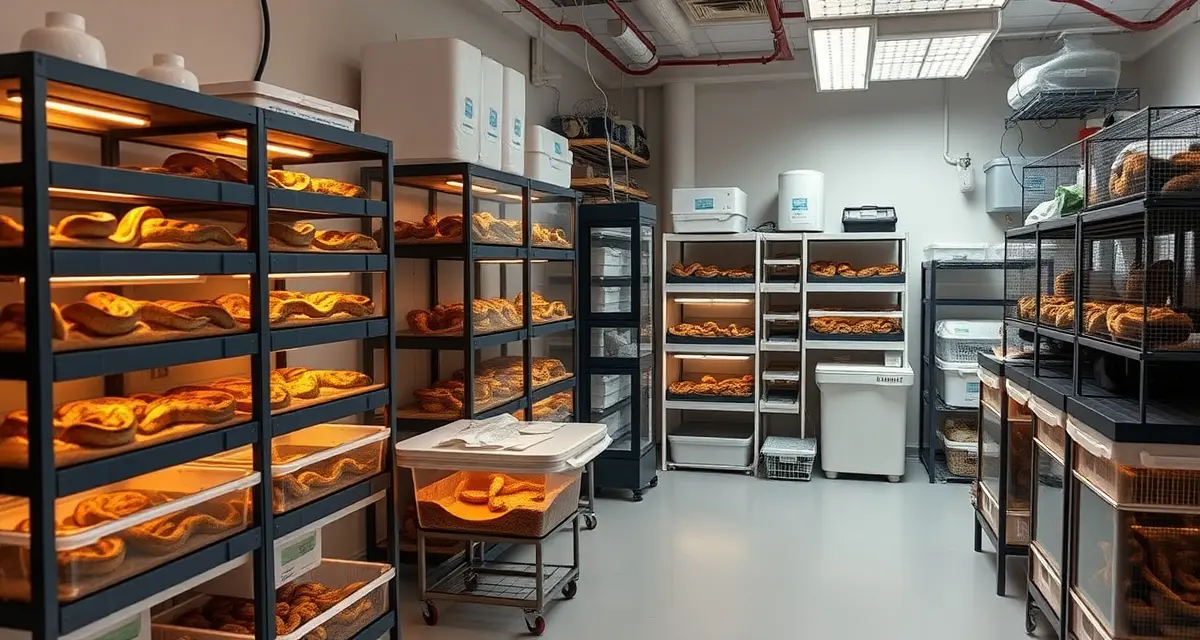
Ball Python Breeding Program Scaling: From Hobbyist to Professional Operation
Breeders using integrated software report 30% less time on administrative tasks, and that administrative efficiency is what makes scaling possible. Going from 5 breeding pairs to 30 breeding pairs isn't just a matter of buying more animals; it requires systems that scale.
TL;DR
- Ball python breeding operations require systematic record-keeping from pre-season preparation through end-of-season sales.
- Females at 1,200-1,500g or more are the target weight before introducing them to a breeding male.
- Ovulation detection is the key event that anchors pre-lay shed and lay date calculations.
- Clutch profitability guide depends on understanding actual cost basis per animal, not just gross sale revenue.
- Well-documented animals with complete feeding histories and clear genetic records consistently sell faster and at higher prices.
Most professional ball python breeders started as hobbyists. The transition from "I have a few animals I love" to "I'm running a viable business" involves changes in how you think, what you track, and how you organize your operation. The breeders who make this transition successfully have a few things in common.
What Changes When You Scale
Volume: More animals means more feeding, more health checks, more breeding introductions, more clutches, more hatchlings. Every management task that took 30 minutes with 10 animals takes 3+ hours with 100.
Complexity: More breeding projects, more morphs, more genetic calculations, more pairing schedules. The cognitive load of managing a large collection manually is unsustainable.
Financial stakes: A mistake with one animal costs you one animal. A mistake across a disease-compromised collection of 100 animals is a financial and emotional disaster.
Market requirements: A professional operation needs to produce consistently, sell efficiently, and meet the standards buyers of notable animals expect.
Staging the Growth
Don't scale faster than your systems can support. Common scaling mistakes:
Scaling animals before scaling systems: Adding 40 hatchlings before you have adequate housing, feeding capacity, and record-keeping infrastructure. The hatchlings suffer, sales fall behind, and you burn out.
Scaling breadth before depth: Running 12 breeding projects with 2 pairs each is less efficient and less profitable than running 4 focused projects with 6 pairs each.
Scaling without market validation: Producing more of something that isn't selling yet doesn't fix the sales problem; it compounds it.
A reasonable scaling framework:
- Year 1: 3-5 breeding pairs, one or two focused projects, establish your systems and processes
- Year 2: Double to 6-10 breeding pairs if Year 1 was successful. Expand proven projects, don't add new ones yet.
- Year 3+: Scale based on market response, available capital, and operational capacity
Housing Capacity Planning
Before breeding season, model your expected hatchling production:
(Number of breeding pairs) x (Average eggs per clutch) x (Expected hatch rate) = Projected hatchlings
Compare this to your available hatchling housing. If you're projecting 80 hatchlings and have housing for 50, you either need more housing or a plan to sell hatchlings faster.
For every 10 breeding pairs you run, expect to need capacity for 50-70 hatchlings at some point during the season.
Establishing Business Infrastructure
As you scale beyond hobby:
Separate business bank account: Keep business finances separate from personal from day one.
Business name and structure: A clear business identity helps with marketing, taxes, and professional credibility.
Inventory management: Animals are inventory. Track acquisition cost, current market value, and projected selling price for every animal.
Customer database: Maintaining buyer contact information lets you build a customer base rather than starting fresh with every sale.
The Role of genetics guide in Scaling Strategy
At scale, the genetics decisions you made in year one are now being amplified. A genetic direction that wasn't well-planned produces inventory that's hard to sell. A well-planned genetic program produces consistent, desirable animals.
Review your genetic portfolio annually:
- Which morphs in your program are selling well?
- Which are sitting?
- Are there market trends that suggest building toward or away from specific morphs?
- Are any of your breeding animals approaching the end of their productive years?
Financial Requirements for Scaling
Scaling requires capital. Calculate your per-season break-even before expanding:
- Animal acquisition costs for new breeding stock
- Rack/enclosure purchases
- Increased feeder costs
- Increased veterinary costs
- Increased utility costs
Capital comes from retained earnings from previous seasons, outside income, or financing (with caution). Don't fund scaling with debt that requires the business to generate specific revenue before it's proven the market supports it.
When to Hire Help
Managing 150+ animals solo while working full-time is the breaking point for most breeders. Help options:
Part-time family or household member: For basic daily feeding and checks, this is often the first help hired.
Reptile-knowledgeable assistant: Someone who can execute care protocols independently. Requires training and trust.
Outsourcing: Some tasks (photography, social media, accounting) can be outsourced to specialists without requiring reptile knowledge.
HatchLedger at Scale
The operational and financial tracking that's optional when you have 15 animals becomes essential when you have 100. At 100 animals:
- Feeding logs prevent animals from being missed in 50-tub rack sections
- Weight tracking at scale catches health declines before they become emergencies
- P&L per clutch tells you which projects are carrying their weight and which aren't
- Genetic records that update automatically (connecting clutch outcomes to parent records) save hours of manual cross-referencing
Purpose-built software scales with your operation in ways that spreadsheets fundamentally cannot.
The HatchLedger reptile breeder software supports operations from 10 animals to 500+ with the same interface and feature set, growing with you rather than requiring a system change when you scale.
Frequently Asked Questions
What is the best approach to ball python breeding program scaling?
Scale systems before animals. Establish record-keeping, financial tracking, and operational protocols at small scale, then expand animals into that infrastructure. Stage growth in 2-3 year cycles, validate market demand before scaling production, and maintain focused genetic projects rather than sprawling in many directions simultaneously.
How do professional breeders handle ball python program scaling?
Successful breeders at scale operate with documented protocols, purpose-built management software, separate business finances, and annual genetic and financial reviews that guide expansion decisions. They scale animals only when housing capacity, feeding capacity, and management systems can support the additional animals without degrading care quality.
What records should every reptile breeder maintain per animal?
At minimum: acquisition date and source, morph and genetic documentation, feeding log, weight history, any veterinary treatments, and breeding history including pairing dates, clutch of origin for captive-bred animals, and offspring records. These records serve your own management, buyer documentation, regulatory compliance, and long-term genetic tracking.
How should reptile breeders document genetics for buyers?
A complete genetic record for sale includes the animal's visual morph name, confirmed het genes and their basis (parentage documentation or proven-out production), possible het genes with probability percentages, hatch date, and parent morph information. Including clutch-of-origin records lets buyers independently verify the claims.
Sources
- USARK (United States Association of Reptile Keepers)
- Association of Reptilian and Amphibian Veterinarians (ARAV)
- World of Ball Pythons (WoBP genetics reference database)
- MorphMarket (reptile industry marketplace)
- Reptiles Magazine (Bowtie Inc.)
Get Started with HatchLedger
Every part of a ball python breeding operation -- from pairing records to clutch documentation to financial tracking -- works better when the data is connected rather than scattered across notebooks and spreadsheets. HatchLedger is built for exactly that. Try it free with up to 20 animals.