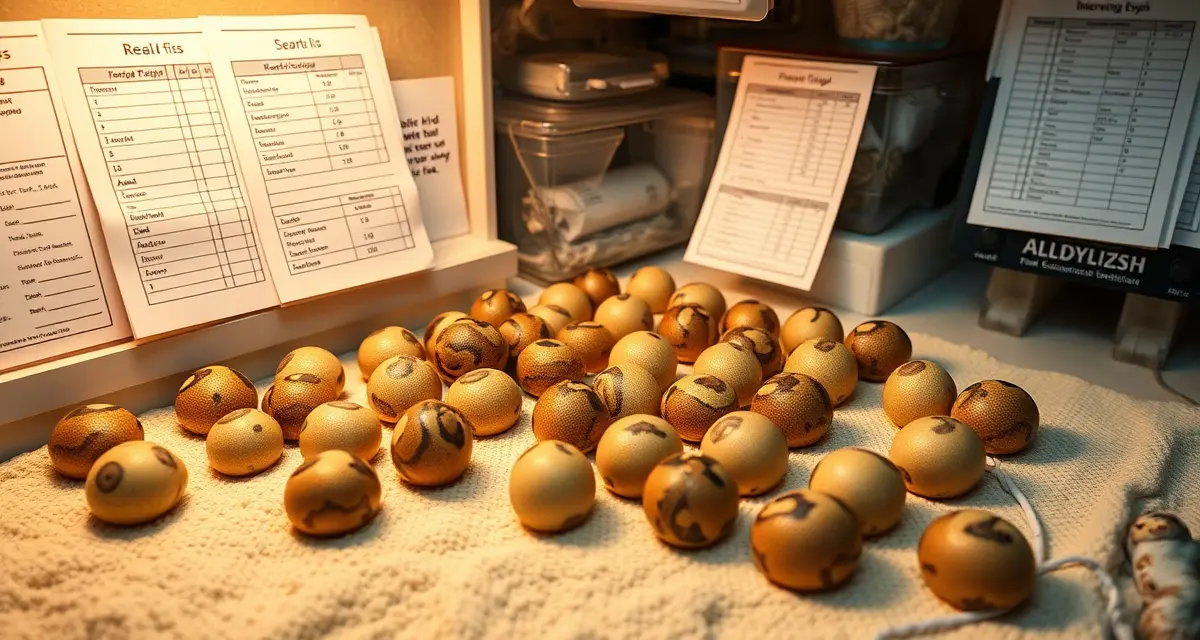
Ball Python Egg Laying and Clutch Management: Advanced Breeder Guide
Breeders using integrated software report 30% less time on administrative tasks, and clutch management is one of the most record-intensive phases of the entire breeding season. From the moment eggs hit the nest box floor, every decision you make affects hatch rates and hatchling quality. Good records make sure you don't forget when eggs went in, what the pairing was, or how many slugs were in the clutch.
TL;DR
- Ball python breeding operations require systematic record-keeping from pre-season preparation through end-of-season sales.
- Females at 1,200-1,500g or more are the target weight before introducing them to a breeding male.
- Ovulation detection is the key event that anchors pre-lay shed and lay date calculations.
- Clutch profitability guide depends on understanding actual cost basis per animal, not just gross sale revenue.
- Well-documented animals with complete feeding histories and clear genetic records consistently sell faster and at higher prices.
A ball python clutch typically contains 3-11 eggs, with 6-8 being the average for a healthy, well-conditioned adult female. Your job from lay to transfer is to handle the eggs correctly, document everything, and get the clutch into proper incubation conditions as quickly as possible.
The Lay Event
Most females lay at night or in the early morning hours. Don't be surprised to check your female at 10pm, find nothing, and then discover a complete clutch at 6am. The actual laying process usually takes 1-4 hours.
The female will typically coil around the eggs immediately after laying. This brumation instinct is strong, even in captive-raised animals. You can leave her with the eggs for a few hours without issue, but don't leave her long-term. Her coiling can damage eggs if she's disturbed while brooding, and she needs to eat and rehydrate.
Counting and Recording the Clutch
When you remove the female, do a careful clutch inventory:
- Total egg count
- Number of viable eggs (firm, white, properly formed)
- Number of slugs (infertile eggs, typically smaller, yellow, soft)
- Any eggs that appear conjoined
- Any eggs with unusual appearance (dimpled, discolored, oddly shaped)
Write this down immediately. Your record should include the female's ID or name, the male's ID or name, the lay date, and the full clutch inventory. This is the foundation of your P&L calculation for the clutch.
Slugs are worth noting separately. A normal slug rate for a healthy clutch from a well-paired female is 0-2 slugs. A clutch that's more than 30-40% slugs may indicate a failed breeding, a health issue with the female, or genetic incompatibility.
Marking Eggs Before Moving
Before you move a single egg from the nest box to the incubator, mark the top of each egg with a soft permanent marker or a small piece of medical tape. A simple dot or line is enough. This is critical because egg orientation matters: once an embryo attaches to the shell (which happens within hours of laying), rotating the egg 180 degrees can drown the developing embryo.
Keep the marked side up throughout incubation. This is non-negotiable.
Handling Eggs During Transfer
Eggs should be moved with gentle but firm support. They're slightly pliable when fresh, which is normal. Avoid:
- Squeezing eggs
- Rolling or rotating them
- Stacking them against each other under pressure
- Exposing them to temperature extremes during transfer
Move eggs individually, supporting the full surface area with your palm or fingers. If eggs are stuck together (normal in ball pythons, often called "sweating"), do not force them apart. Stuck eggs can be incubated together in the position they were laid. Forcing separation often tears the shell membrane and kills both eggs.
Separating Stuck Eggs
If you want to separate stuck eggs, warm, slightly humid air from a hair dryer on low (pointed away from the eggs, using ambient warm air rather than direct heat) can soften the adhesion enough to gently work eggs apart over several minutes. This requires patience and practice. Most experienced breeders simply incubate stuck eggs together and let them separate naturally during development.
Setting Up the Incubation Container
Inside the incubator, each clutch should have its own container. This keeps different clutches with different lay dates organized and prevents cross-contamination if one egg develops issues.
Common incubation containers include large plastic deli cups, sandwich containers, or takeout containers with ventilation holes. Nest the eggs in whatever substrate you're using for incubation (details covered in the substrate article), with the eggs nestled into slight depressions so they don't roll.
Label the outside of the container with the lay date, female ID, male ID, and clutch number if you're running multiple clutches.
The Role of HatchLedger in Clutch Management
The pairing data you've been tracking all season, male introductions, ovulation date, pre-lay shed, now connects to your clutch record. HatchLedger's clutch management features let you link the clutch to the parent animals, enter the egg count and slug count, and set the expected hatch date based on incubation parameters.
This is also where your P&L calculation begins. The projected value of the clutch (based on the genetics guide of the parent pair) goes in here, as do incubation costs. By the time hatchlings sell, you have a complete financial picture for each clutch without digging through spreadsheets.
Caring for the Female Post-Lay
Once the eggs are in the incubator, your attention returns to the female. She's depleted after the breeding season, gestation, and laying. Your goals now are:
- Rehydrate her (ensure constant access to clean water, consider a brief soak if she seems dehydrated)
- Begin refeeding within 48-72 hours of laying
- Monitor for post-lay infection or retained eggs
Retained eggs (slugs or viable eggs that didn't get laid) are a potential issue. If your female seems to still have mass in her mid-body after laying, palpate carefully or get an X-ray from a reptile vet. A retained egg can become a serious infection if not addressed.
Feeding Post-Lay
Offer food at your normal feeding schedule. Most females are ravenous within 48 hours of laying. Start with a smaller prey item to ease her digestive system back into operation, then resume normal prey size after the first successful feeding.
Don't be alarmed if she refuses the first offering. Some females take 1-2 weeks before they're ready to eat again. As long as she looks healthy and is drinking, a week or two of food refusal post-lay is not concerning.
Clutch Labeling Systems
If you're running a multi-female operation, develop a consistent clutch labeling system and stick with it. Common formats include:
- Year-Female ID-Clutch Number (e.g., 2025-F07-C1)
- Female Name-Year (e.g., Pearl-2025)
- Sequential numbering (e.g., Clutch 47)
Whatever you choose, it needs to be on the incubation container, in your records, and on the hatchling tubs when babies emerge. Losing track of which hatchling came from which clutch is a beginner mistake that can have real financial consequences when you're selling animals with specific genetics.
The HatchLedger platform keeps all of this organized automatically once you enter the clutch data correctly at the lay event.
Frequently Asked Questions
What is the best approach to ball python egg laying and clutch management?
Mark eggs before moving them, never rotate after marking, keep stuck eggs together rather than forcing separation, and document the complete clutch inventory including slug count immediately at laying. Move eggs to the incubator promptly, label containers clearly, and begin refeeding the female within 48-72 hours.
How do professional breeders handle ball python egg laying and clutch management?
Professional breeders check nest boxes every 4-6 hours during the expected lay window to minimize the time eggs spend at sub-optimal nest box temperatures before transfer to the incubator. They maintain a consistent labeling system from clutch to hatchling, and they log each clutch's egg count and projected morph outcomes immediately to keep P&L projections current.
What records should every reptile breeder maintain per animal?
At minimum: acquisition date and source, morph and genetic documentation, feeding log, weight history, any veterinary treatments, and breeding history including pairing dates, clutch of origin for captive-bred animals, and offspring records. These records serve your own management, buyer documentation, regulatory compliance, and long-term genetic tracking.
How should reptile breeders document genetics for buyers?
A complete genetic record for sale includes the animal's visual morph name, confirmed het genes and their basis (parentage documentation or proven-out production), possible het genes with probability percentages, hatch date, and parent morph information. Including clutch-of-origin records lets buyers independently verify the claims.
Sources
- USARK (United States Association of Reptile Keepers)
- Association of Reptilian and Amphibian Veterinarians (ARAV)
- World of Ball Pythons (WoBP genetics reference database)
- MorphMarket (reptile industry marketplace)
- Reptiles Magazine (Bowtie Inc.)
Get Started with HatchLedger
Every part of a ball python breeding operation -- from pairing records to clutch documentation to financial tracking -- works better when the data is connected rather than scattered across notebooks and spreadsheets. HatchLedger is built for exactly that. Try it free with up to 20 animals.