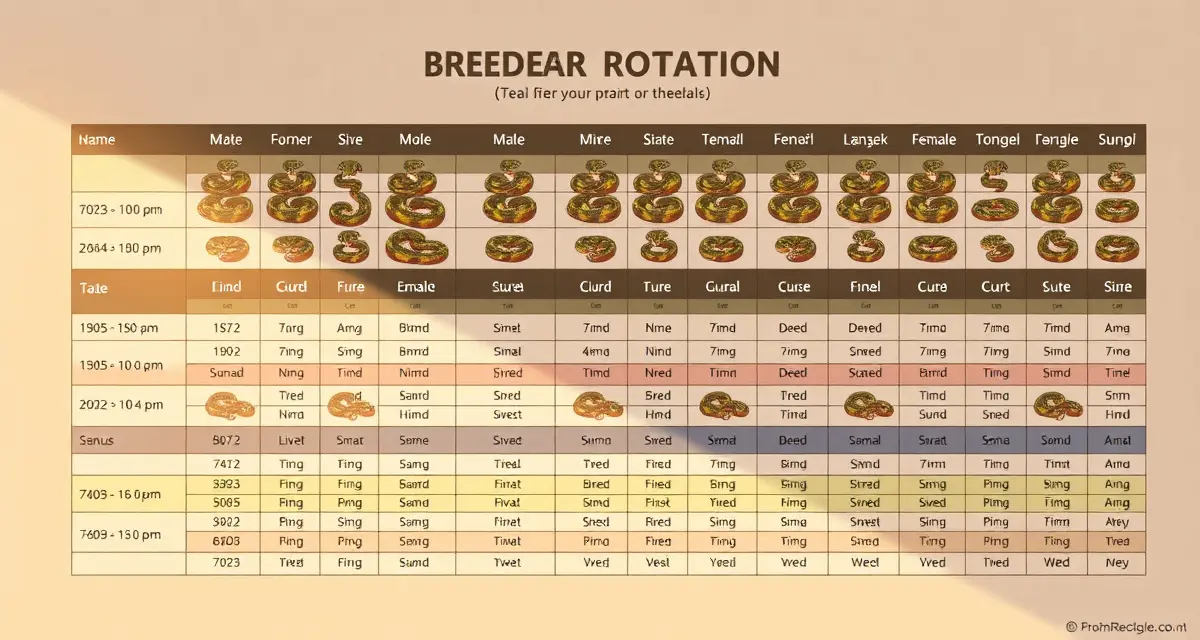
Managing a Multi-Male Ball Python Breeding Rotation
Running multiple males in a breeding program sounds straightforward until you're juggling six females, three males, and trying to remember which pairs have locked, which haven't, and who needs rest. Breeders using integrated software report 30% less time on administrative tasks, and nowhere is that time savings more felt than in rotation management where a missed entry can mean an unverified sire on a high-value clutch.
TL;DR
- Ball python breeding operations require systematic record-keeping from pre-season preparation through end-of-season sales.
- Females at 1,200-1,500g or more are the target weight before introducing them to a breeding male.
- Ovulation detection is the key event that anchors pre-lay shed and lay date calculations.
- Clutch profitability guide depends on understanding actual cost basis per animal, not just gross sale revenue.
- Well-documented animals with complete feeding histories and clear genetic records consistently sell faster and at higher prices.
A multi-male rotation is used for two main reasons: genetic diversity across your female lineup, and increased pairing frequency when one male can't cover all your females alone. Both are legitimate approaches, but they require different record-keeping discipline.
Why a Rotation System Matters
If you're using more than one male on the same female at different times, sire verification becomes a real concern. Ball python sperm can remain viable in a female's reproductive tract for weeks. If you introduced Male A in November and Male B in December, and your female lays in March, you may not know with certainty who fathered the clutch - unless you have a documented rotation schedule and pairing log.
This matters most when:
- The two males produce different possible outcomes (e.g., one is het for recessive, one isn't)
- You're selling animals with specific genetic claims
- You're tracking which male produces the most fertile locks
A rotation log where you record every introduction, lock observation, and separation date gives you the paper trail to make defensible claims about sire identity.
Setting Up a Rotation Schedule
The simplest approach is to assign each female to one primary male per season, with documented "guest pairings" only if you have a specific genetic reason. This keeps your records cleaner and your sire verification simpler.
If you do need to rotate multiple males through one female:
Give each male a rest period. Males introduced too frequently stop performing. Most breeders rotate males every 3-7 days, giving each male 3-5 days off before reintroduction. Males that are working hard and feeding poorly need longer recovery windows.
Document every introduction and removal. Log the date and time each male is placed with a female and when he's removed. Note whether you observed a lock.
Track male condition separately. Log each male's weight through breeding season. A male dropping more than 10-15% of his body weight is being worked too hard and needs time to recover. Continuing to breed an underweight male reduces lock quality and can lead to a male that won't perform for the rest of the season.
Use a rotation chart. A simple grid showing which male is with which female on which dates helps prevent confusion when you have more than four or five pairs active at once.
Assigning Breeding Groups
Many experienced breeders pre-plan their breeding season by assigning each male a group of 2-4 compatible females before the season begins. This prevents ad-hoc decisions that are harder to document consistently.
When building groups, consider:
- Morph compatibility: Are you trying to produce specific combos? Assign the male whose genetics guide are required.
- Body size: Males noticeably smaller than their females can struggle to achieve locks. Match sizes reasonably.
- Proven vs. unproven: Pair your proven males with your most important females. Put unproven males with animals where a missed season is less costly.
Handling Males During Breeding Season
Males often go off food completely during breeding season. This is normal and not a health concern unless the male is losing condition rapidly. Log every feeding attempt and refusal in your records so you have a baseline to return to after breeding season ends.
Keep males in their own enclosures between pairings. Cohabitation of males is not recommended and doesn't increase breeding success.
If a male consistently refuses to breed with a specific female, try a different male, or try reintroducing the same male after a longer rest. Some pairs simply don't click, and spending weeks on an incompatible pairing wastes time that could be used productively.
Verifying Sire When Using Multiple Males
When paternity is uncertain, you have a few options:
- Sequential exclusive pairings: Give Male A exclusive access for 3-4 weeks, confirm ovulation, then exclude all males. This is the cleanest approach.
- DNA testing: Labs that work with reptile genetics can determine paternity from hatchling samples, though this adds cost.
- Conservative marketing: If you can't verify sire, sell the animals as "possible het" or with disclosed uncertainty rather than making a definitive genetic claim you can't support.
Transparent record-keeping connected to your pairing log via a tool like HatchLedger's breeding management system is the foundation of honest genetic claims.
Logging Rotation Records Over Multiple Seasons
After one or two seasons of detailed rotation logs, you'll start to see patterns. Which male locks most reliably? Which females are receptive earliest? Which pairings produce the best fertility rates? These insights are only available if your records are structured consistently enough to compare.
Spreadsheets can handle this, but they require discipline to maintain formatting across seasons. Purpose-built breeding software as reviewed in the reptile breeder software comparison keeps the structure automatic, so your data is always comparable.
Frequently Asked Questions
What is the best approach to managing a multi-male ball python breeding rotation?
The best approach is to assign each female to a primary male at the start of the season and document every introduction, lock, and removal with dates. If you're rotating more than one male through a female, keep the pairings sequential rather than overlapping so you can make reasonable sire claims. Track each male's weight through the season to catch condition decline before it affects performance. A simple rotation schedule posted near your racks prevents the "did I already put him in?" confusion that's common when managing six or more pairs.
How do professional breeders handle multi-male rotation records?
Professional breeders typically maintain a pairing journal or digital log with an entry for every introduction and removal. Many use color-coded charts or spreadsheets during active breeding season, then transfer records to a central system post-season. The most important data points are the introduction date, whether a lock was observed, the removal date, and the male's current weight. Some breeders photograph their rotation schedule board daily as a backup record.
What software helps manage ball python multi-male breeding rotations?
HatchLedger is purpose-built for reptile breeders, connecting animal records, breeding history, clutch outcomes, and financial tracking in one system. Unlike generic spreadsheets, it's designed around the specific workflow of an active breeding season. Free for up to 20 animals.
What records should every reptile breeder maintain per animal?
At minimum: acquisition date and source, morph and genetic documentation, feeding log, weight history, any veterinary treatments, and breeding history including pairing dates, clutch of origin for captive-bred animals, and offspring records. These records serve your own management, buyer documentation, regulatory compliance, and long-term genetic tracking.
How should reptile breeders document genetics for buyers?
A complete genetic record for sale includes the animal's visual morph name, confirmed het genes and their basis (parentage documentation or proven-out production), possible het genes with probability percentages, hatch date, and parent morph information. Including clutch-of-origin records lets buyers independently verify the claims.
Sources
- USARK (United States Association of Reptile Keepers)
- Association of Reptilian and Amphibian Veterinarians (ARAV)
- World of Ball Pythons (WoBP genetics reference database)
- MorphMarket (reptile industry marketplace)
- Reptiles Magazine (Bowtie Inc.)
Get Started with HatchLedger
Every part of a ball python breeding operation -- from pairing records to clutch documentation to financial tracking -- works better when the data is connected rather than scattered across notebooks and spreadsheets. HatchLedger is built for exactly that. Try it free with up to 20 animals.