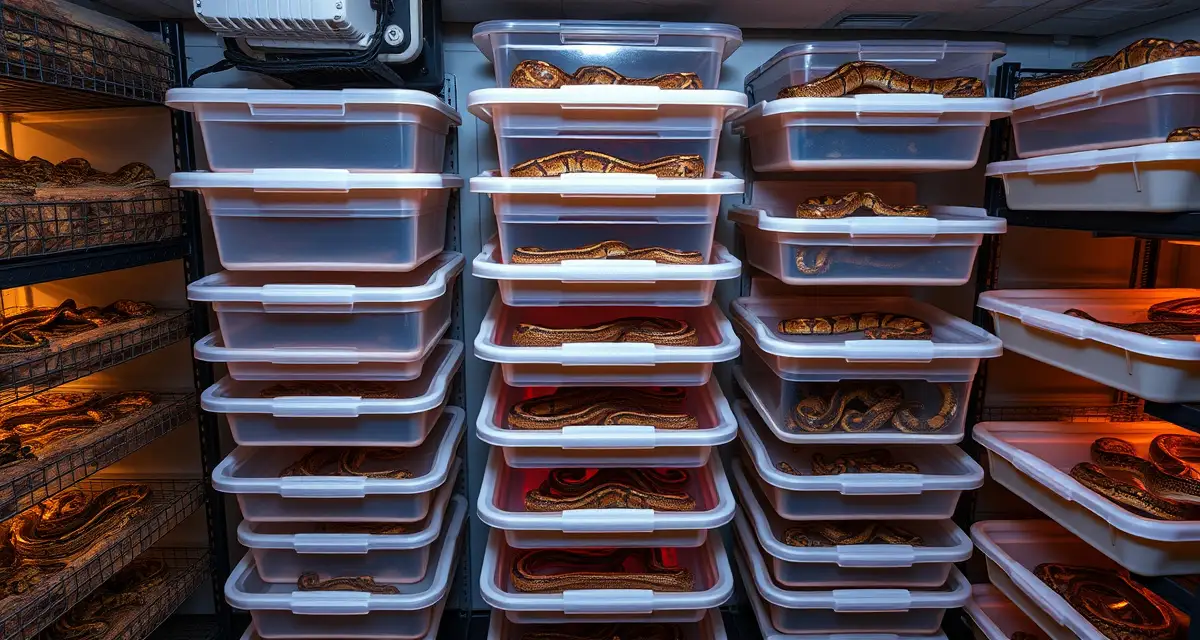
Ball Python Rack System Setup: Choosing, Building, and Scaling Your Breeder Racks
Rack systems are the backbone of any serious ball python breeding operation. Once you move beyond 10-15 animals, individual enclosures become space-inefficient and expensive. A well-configured rack keeps your animals in snug, secure, thermoregulation-friendly tubs, gives you fast daily access for checks and feeding, and lets you scale without redesigning your whole setup. Breeders using integrated software report 30% less time on administrative tasks, and a smart rack layout is part of what makes that efficiency possible.
TL;DR
- Ball python breeding operations require systematic record-keeping from pre-season preparation through end-of-season sales.
- Females at 1,200-1,500g or more are the target weight before introducing them to a breeding male.
- Ovulation detection is the key event that anchors pre-lay shed and lay date calculations.
- Clutch profitability guide depends on understanding actual cost basis per animal, not just gross sale revenue.
- Well-documented animals with complete feeding histories and clear genetic records consistently sell faster and at higher prices.
This guide covers everything from selecting the right rack size for your needs to heating configurations, tub choices, and how to organize a growing collection.
Why Rack Systems Work for Ball Pythons
Ball pythons are naturally denning animals. They prefer tight, dark spaces where they can feel contact on multiple body surfaces. A snug-fitting tub in a rack mimics this far better than an open terrarium with a large footprint. Most experienced breeders observe that ball pythons in well-fitted rack tubs are calmer, feed more consistently, and shed more reliably than animals in oversized glass enclosures.
Racks also make daily management practical at scale. You can check 30 animals in 15 minutes when they're in pull-out tubs rather than lifting lid after lid on individual tanks.
Choosing the Right Rack System
Commercial racks vs. DIY builds:
Commercial racks (Animal Plastics, Boamaster, Vision, ARS, etc.) are built to spec, come with appropriate tub sizing, and often include heat tape channels. They're the right choice for most breeders who want reliability without fabrication headaches. DIY racks using melamine, PVC board, or wood can be cost-effective for breeders with construction skills, but poor builds lead to heat retention problems, bowing shelves, and tub fit issues.
Size categories:
- Hatchling/juvenile racks: Typically hold 6-quart or 15-quart tubs. These are appropriate for animals from hatch to roughly 300-400 grams.
- Sub-adult racks: 28-32 quart tubs. Appropriate from 300g to approximately 800-1000g.
- Adult female racks: 41-56 quart tubs. Adult females need more space, especially breeding females at 1,500+ grams.
- Adult male racks: Males are smaller and can often stay in 28-32 quart tubs as adults.
If you're setting up for the first time and plan to breed, buy more hatchling rack capacity than you think you need. A productive season can produce 60-100+ hatchlings, and you don't want to scramble for tub space.
Tub Selection
The tub must fit the rack shelf snugly. A tub with too much side clearance allows air circulation that undermines your heat gradient. A tub that doesn't slide smoothly becomes a daily frustration.
Common tub brands: Sterilite, Iris, and Hefty are the most common in ball python racking. Animal Plastics racks come designed around specific Sterilite models. Check the rack manufacturer's tub recommendations before buying in bulk.
Ventilation: Tubs need ventilation holes, but not too many. Ball pythons need higher humidity than many reptiles (60-80% ambient), and over-ventilated tubs dry out quickly. The standard approach is a row of small holes (1/16" to 3/32") along the top sides or beneath the lip. A soldering iron or drill with a small bit works well. Avoid large cutouts covered with screen, which drop humidity too aggressively.
Visual opacity: Opaque tubs reduce stress by limiting visual access. Clear or semi-clear tubs can work, but animals in open-view positions may show more defensive behavior and feed less consistently.
Heating Options
Heat tape: The most common and cost-effective heating method for rack systems. A strip of heat tape (Flexwatt is the industry standard) runs along the back of each shelf, heating the rear section of the tub to provide a warm side. The front of the tub stays at ambient room temperature.
Proper heat tape installation requires a thermostat. Never run heat tape without one. A good thermostat (Herpstat, Spyder Robotics, Ranco) sets your surface temperature and prevents thermal burns. Set your probe on the warm side of the tub floor with the thermostat targeting 88-90°F on the warm surface.
Heat cable: Functionally similar to heat tape but flexible and easier to route in custom configurations. Useful for DIY builds.
Radiant heat panels (RHP): Mounted above the tub inside an enclosure or attached to the rack shelf above. RHPs heat the air and surfaces through radiant emission rather than contact. They're popular in custom builds and naturalistic setups but less common in traditional rack systems.
Under-tank heaters (UTH): Fine for individual tubs but impractical at rack scale. Heating individual tubs through contact pads under each one creates thermostat management complexity and is less economical than heat tape.
Room heat: Some large breeders heat entire rack rooms to 80-82°F ambient and use minimal supplemental heat within tubs. This works but requires dedicated climate control for the room and isn't practical for most home operations.
Humidity Management
Ball pythons need 60-80% humidity for healthy sheds. Rack tubs tend to retain humidity naturally when ventilation is appropriate, but you may need to add:
- A small hide or cork piece that the snake can press against
- Moist substrate in one half of the tub (coco coir, cypress mulch, or paper towel layered under dry substrate)
- A humid hide: a small container with a damp moss or paper towel inside
Check humidity during shed cycles. Pre-shed animals need higher humidity (75-80%+) for clean sheds. If you see retained eye caps or patchy sheds across your rack, increase tub humidity before the next shed cycle.
Labeling and Organization
With 30, 50, or 100+ animals in a rack system, clear labeling is non-negotiable.
A minimum label includes:
- Animal ID or name
- Sex
- Morph/genetics guide summary
- Date of last feeding
Many breeders use a color-coding system: colored tape or label backgrounds by sex, breeding status, or age class. Others use QR codes linking to digital animal profiles.
The label on a tub is your first-line reference. HatchLedger's animal management system creates printable ID cards and animal profiles that you can link to physical rack labels, so pulling a tub and scanning immediately surfaces that animal's full record: feeding history, weight logs, breeding notes, and genetic profile. For breeders evaluating management tools for a growing rack operation, the reptile breeder software comparison is a useful starting point.
Scaling Your Rack System
When you're ready to add capacity, think in modules:
- Add a new rack rather than reconfiguring existing ones
- Keep morph projects or breeding groups together on the same rack for visual reference
- Separate hatchlings, sub-adults, and adults onto dedicated racks for feeding schedule consistency
- Document your rack layout (which tub slot holds which animal) in your management software
Frequently Asked Questions
What is the best approach to setting up a ball python rack system?
Start with a commercial rack from a reputable manufacturer sized for your current collection, then plan one size up to account for growth. Use heat tape with a quality thermostat, appropriate tub ventilation (not excessive), and a clear labeling system from day one. Keeping hatchlings, sub-adults, and adults on separate racks lets you manage feeding schedules and temperature gradients more precisely for each life stage.
How do professional breeders configure large-scale rack systems?
Most high-volume breeders standardize on 2-3 tub sizes that cover hatchling through adult, use a single thermostat model across all racks for consistency, and keep dedicated racks for breeding females that are set slightly warmer during breeding season. They label every tub with at least the animal ID, sex, and last feeding date, and link physical labels to digital records in their management software so any tub can be cross-referenced immediately.
What software helps manage a ball python rack system and animal inventory?
HatchLedger is purpose-built for reptile breeders, connecting animal records, breeding history, clutch outcomes, and financial tracking in one system. Unlike generic spreadsheets, it's designed around the specific workflow of an active breeding season. Free for up to 20 animals.
What records should every reptile breeder maintain per animal?
At minimum: acquisition date and source, morph and genetic documentation, feeding log, weight history, any veterinary treatments, and breeding history including pairing dates, clutch of origin for captive-bred animals, and offspring records. These records serve your own management, buyer documentation, regulatory compliance, and long-term genetic tracking.
How should reptile breeders document genetics for buyers?
A complete genetic record for sale includes the animal's visual morph name, confirmed het genes and their basis (parentage documentation or proven-out production), possible het genes with probability percentages, hatch date, and parent morph information. Including clutch-of-origin records lets buyers independently verify the claims.
Sources
- USARK (United States Association of Reptile Keepers)
- Association of Reptilian and Amphibian Veterinarians (ARAV)
- World of Ball Pythons (WoBP genetics reference database)
- MorphMarket (reptile industry marketplace)
- Reptiles Magazine (Bowtie Inc.)
Get Started with HatchLedger
Every part of a ball python breeding operation -- from pairing records to clutch documentation to financial tracking -- works better when the data is connected rather than scattered across notebooks and spreadsheets. HatchLedger is built for exactly that. Try it free with up to 20 animals.