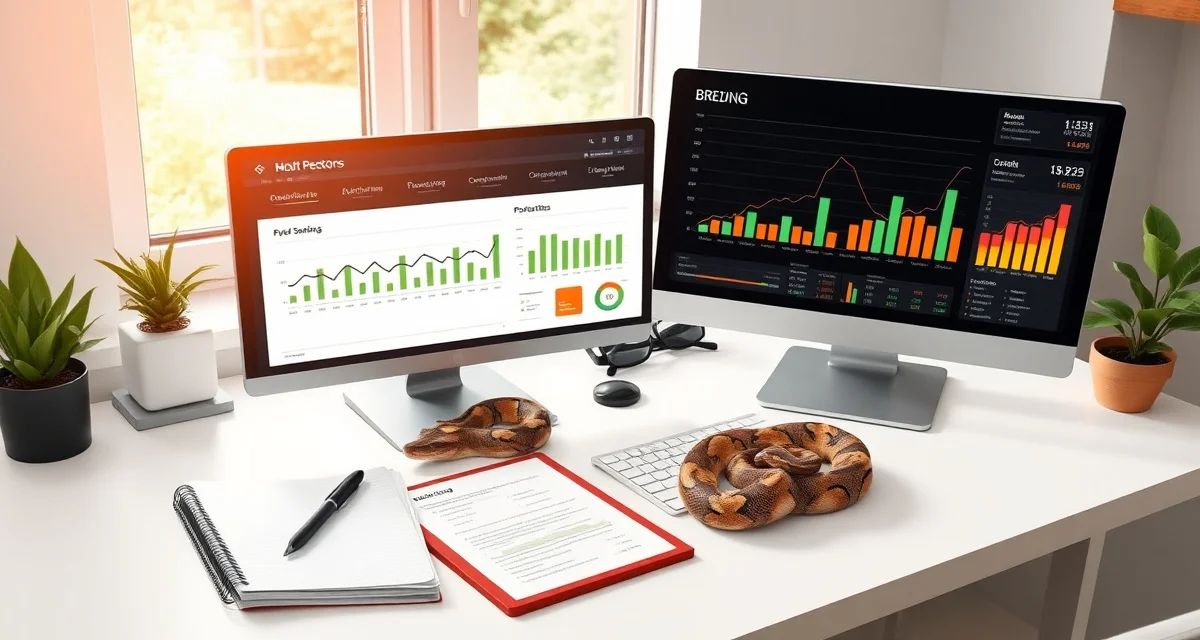
Ball Python Breeding Business Plan: Building a Sustainable Operation from the Ground Up
Breeders using integrated software report 30% less time on administrative tasks, and a business plan is the document that ensures those savings compound rather than disappear into an operation that grows without direction. The difference between a ball python breeding operation that sustains itself financially and one that's a persistent drain on its owner usually comes down to whether anyone ever thought through the fundamentals before spending money.
TL;DR
- Ball python breeding operations require systematic record-keeping from pre-season preparation through end-of-season sales.
- Females at 1,200-1,500g or more are the target weight before introducing them to a breeding male.
- Ovulation detection is the key event that anchors pre-lay shed and lay date calculations.
- Clutch profitability guide depends on understanding actual cost basis per animal, not just gross sale revenue.
- Well-documented animals with complete feeding histories and clear genetic records consistently sell faster and at higher prices.
A business plan for a ball python breeding operation doesn't need to be a formal 30-page document. It needs to answer the key questions that determine whether the operation makes sense.
The Core Questions a Business Plan Answers
What are you producing? Specific morph targets, production scale (number of animals per year), and quality positioning (budget feeders, mid-market morphs, high-end combinations).
Who are you selling to? Direct consumers through Morph Market and social media? Wholesale to pet stores? Show buyers? A combination? Different channels require different marketing and have different margin profiles.
What does it cost? Annual operating costs: feeding, substrate, utilities, veterinary, software, show fees, shipping supplies. Plus annual fixed costs: rack depreciation, equipment maintenance. Plus annual capital costs if you're still building the operation.
What does it generate? Expected annual revenue at realistic production scale and realistic per-animal pricing. Not the best-case pricing from a good year; median expected pricing for the mix of animals you'll actually produce.
What's the margin? Revenue minus costs. Is it positive? How many years until the initial capital investment is recovered?
What are the risks? Market price declines (morphs that are popular today may be cheaper in 3 years), health events that wipe out breeding animals, regulatory changes, personal life changes that affect your ability to maintain the operation.
Defining Your Production Model
There are several viable production models for ball python breeding operations:
Hobbyist model: 5-15 breeding females, 1-3 breeding projects, primarily selling to other hobbyists and pet owners. Annual revenue $5,000-20,000. Usually not enough to generate a living income but can be self-sustaining or better.
Semi-professional model: 15-40 breeding females, multiple concurrent projects, dedicated breeding room, Morph Market presence plus shows, potentially some wholesale. Annual revenue $20,000-60,000. Can approach a notable secondary income or full-time income.
Production model: 40-100+ breeding females, dedicated facility (often a separate outbuilding or commercial space), systematic genetics guide program, mixed wholesale and retail channels. Annual revenue $60,000+. Full-time operation.
Most operations start at the hobbyist level and grow. Understanding which model you're targeting informs the investment decisions you make.
The Revenue Model
Revenue forecast construction:
- How many females do you expect to breed this season?
- What's the expected average clutch size (be conservative; use your actual history or industry average 5-6 eggs)?
- What percentage of eggs produce viable hatchlings (accounting for slugs and losses, typically 60-80% of total eggs)?
- What's the expected average sale price for your mix of morphs (research current Morph Market pricing, be conservative)?
- Multiply: females x clutch size x viability rate x average sale price = gross revenue
Example:
- 10 breeding females
- 6 eggs per clutch average
- 70% viability (4.2 viable hatchlings per clutch)
- $150 average sale price (for a mid-market morph mix)
- Gross revenue: 10 x 4.2 x $150 = $6,300
Is that enough? That depends on your costs and your goals for the operation.
The Cost Model
Annual operating costs for a 10-female operation:
- Feeding: 10 adults + holdbacks + males + hatchlings. Estimate $100-200/month. Annual: $1,200-2,400.
- Substrate and supplies: $300-500/year
- Utilities: Additional electricity for reptile room heating. $300-600/year.
- Veterinary: $300-500/year for routine and contingency.
- Software and marketing: $150-400/year.
- Show fees (if attending shows): $200-500/year per show.
- Shipping supplies: $200-400/year.
Total annual operating costs: $2,650-5,300 for a modest 10-female operation.
Net from the example above: $6,300 revenue - $4,000 operating costs = $2,300. Before capital cost recovery. The capital (animals, rack, thermostats) might have cost $4,000-6,000 to build, recovering in 2-3 years.
Adjusting the Model for Your Goals
If $2,300 net annually doesn't meet your goals, you have levers:
- Scale up: more females, more pairings
- Trade up: higher-value morphs with better per-animal margins
- Reduce costs: feeder colony, DIY housing
- Add channels: shows, social media to increase buyer reach
The business plan is the document where you work through these levers before committing money.
HatchLedger's financial tracking records actual revenue and expenses against your plan, showing you whether your projections were accurate and where the gaps are.
The HatchLedger reptile breeder software connects your operational data to financial outcomes, giving you the real numbers to refine your business model each season.
Frequently Asked Questions
What is the best approach to writing a ball python breeding business plan?
Answer the core questions: what you're producing, who you're selling to, what it costs, what it generates, and what the risks are. Build a realistic revenue forecast using conservative pricing and actual clutch size expectations. Compare projected revenue to realistic cost projections to determine whether the operation makes financial sense at your target scale.
How do professional breeders approach ball python breeding business planning?
Operations that sustain themselves financially plan annually: what are we producing this season, at what cost, and what should we expect to generate? They track actual results against projections, identify which morphs are generating the best margins, and make collection and project decisions based on financial performance data rather than instinct.
What records should every reptile breeder maintain per animal?
At minimum: acquisition date and source, morph and genetic documentation, feeding log, weight history, any veterinary treatments, and breeding history including pairing dates, clutch of origin for captive-bred animals, and offspring records. These records serve your own management, buyer documentation, regulatory compliance, and long-term genetic tracking.
How should reptile breeders document genetics for buyers?
A complete genetic record for sale includes the animal's visual morph name, confirmed het genes and their basis (parentage documentation or proven-out production), possible het genes with probability percentages, hatch date, and parent morph information. Including clutch-of-origin records lets buyers independently verify the claims.
Sources
- USARK (United States Association of Reptile Keepers)
- Association of Reptilian and Amphibian Veterinarians (ARAV)
- World of Ball Pythons (WoBP genetics reference database)
- MorphMarket (reptile industry marketplace)
- Reptiles Magazine (Bowtie Inc.)
Get Started with HatchLedger
Every part of a ball python breeding operation -- from pairing records to clutch documentation to financial tracking -- works better when the data is connected rather than scattered across notebooks and spreadsheets. HatchLedger is built for exactly that. Try it free with up to 20 animals.