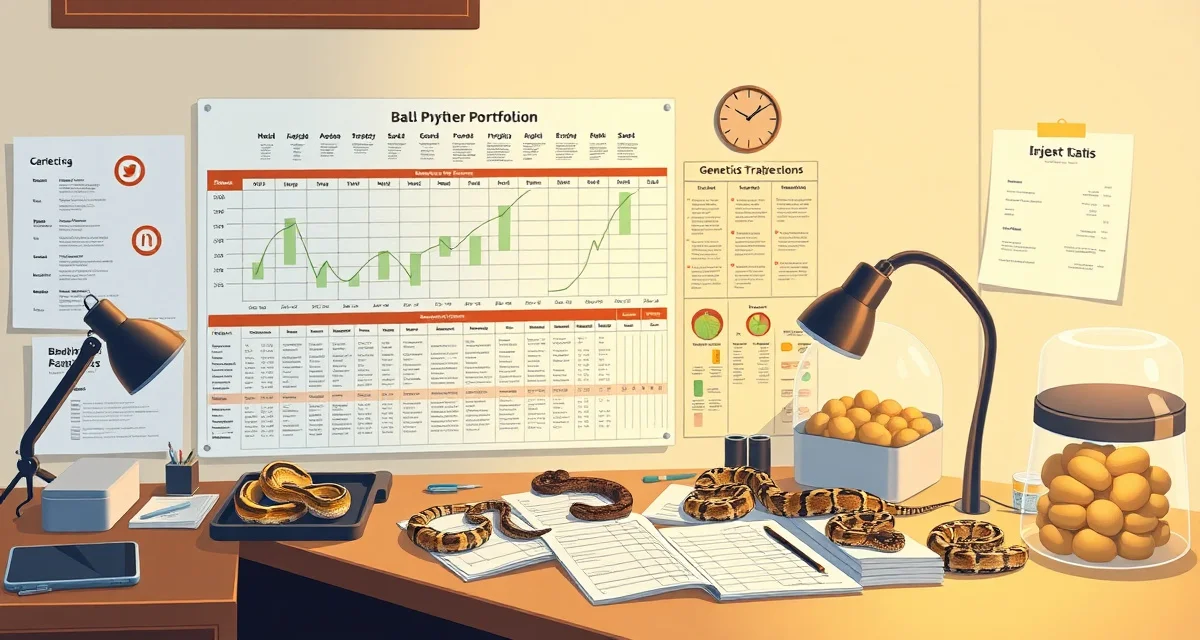
Advanced Ball Python Breeding: How to Build a Multi-Year Project Portfolio
Most ball python breeding guides cover the basics: breed your female, incubate your eggs, sell your hatchlings. But experienced breeders know the real money, and the real satisfaction, comes from multi-year project work. Building a recessive project that pays off three seasons in feels fundamentally different from selling single-gene hatchlings. This guide covers how to think about project portfolio management as an advanced breeder.
TL;DR
- Ball python breeding operations require systematic record-keeping from pre-season preparation through end-of-season sales.
- Females at 1,200-1,500g or more are the target weight before introducing them to a breeding male.
- Ovulation detection is the key event that anchors pre-lay shed and lay date calculations.
- Clutch profitability guide depends on understanding actual cost basis per animal, not just gross sale revenue.
- Well-documented animals with complete feeding histories and clear genetic records consistently sell faster and at higher prices.
What Makes a Project a "Project"
A project, in breeder terms, is a multi-season genetic goal that you're systematically working toward. You're not just pairing two animals that happen to be available. You're building toward a specific outcome, often a multi-recessive combination or a high-value super form, over multiple breeding seasons.
The most common advanced projects involve:
- Building multi-recessive combinations (Pied Clown, Albino Pied, Scaleless Pied, etc.)
- Stacking high-value co-dominant genes into recessive backgrounds
- Developing new combination morphs as new genes emerge in the hobby
- Breeding for high expression within a morph (high-white Pieds, for example)
Each of these requires intentional multi-season planning rather than seasonal opportunism.
Structuring Your Project Portfolio
An advanced breeder typically runs several projects simultaneously. The key is balancing projects at different stages:
Current revenue generators: Projects that are paying off now. Visual Pieds, visual Clowns, GHI Mojaves. Animals that produce sellable hatchlings this season.
Mid-stage projects: Animals in the "het building" phase. You have your visual recessives paired with the complementary genes, and you're producing het combination animals that will fuel the next stage.
Long-term high-value projects: Early-stage multi-recessive builds where you're still in the first generation of het production. These won't pay off for two to four seasons, but the eventual return justifies the patience.
This portfolio structure means your cash flow from current-revenue projects funds the patience required for your long-term projects. You're never entirely dependent on this season's premium animals to cover your costs.
Calculating Project ROI Before You Start
Before committing to a multi-year project, model the expected return. Specifically:
What will the target animal sell for? Research current and projected pricing for the combination you're building toward. Multi-recessive combination females have real market values you can estimate.
How long to reach production? Count the seasons from acquisition of starting stock to first production of your target animal. For many multi-recessive projects, this is 3 to 4 years from purchasing het animals.
What does the stock cost? Calculate the acquisition cost of every animal in the project, plus annual feeding and care costs across all seasons until production.
What is your expected yield? Based on expected clutch sizes and genetics guide ratios, how many of your target animals do you expect to produce per season once you're in production? What does that mean for annual revenue from the project?
Run this math honestly. Some projects look great on paper but take 5 years and $8,000 in costs to produce animals worth $3,000 each at a rate of one per season. That might still be worth it for the right project, but you should know before you start.
Managing Genetics Across a Multi-Year Portfolio
Advanced projects require meticulous genetics tracking. When you're working with three or four genes across 20 to 30 animals over five seasons, the records become complex. Every animal's genetics need to be current, accurate, and easily referenced when planning next season's pairings.
The difference between a breeder who runs projects profitably and one who wastes seasons on wrong pairings is often just the quality of their records. Knowing exactly what each animal is carrying, what was confirmed by production versus parentage, and which pairings have already been run is the information that guides every decision.
HatchLedger connects all of this. Your animal genetics, parentage records, breeding introductions, and clutch outcomes all live in one system. When you're planning next season's pairings, you pull up each female's complete genetic profile alongside her production history and make data-driven decisions rather than trying to reconstruct information from memory or scattered notes.
When to Retire a Project
Not every project deserves to run indefinitely. Signals that a project should be retired or restructured:
Market conditions changed notably: The target combination that was worth $3,000 three years ago is now worth $800 because everyone is producing it. The economics of continuing no longer justify the cost.
The animals aren't producing: A female who has had multiple all-slug seasons from a recessive het pairing may not be the right female for that project. Redirect productive females to better pairings.
You've achieved the goal: You've produced the combination animal you were building toward. Now you need to decide whether to continue producing them (is there market demand?), build toward a further combination, or repurpose those genetics.
Better opportunity emerged: A new morph or combination is generating more excitement and higher prices than your current project. Portfolio management means being willing to redirect resources toward better opportunities.
The Genetics Planning Cycle
Advanced breeders approach each season with explicit project planning:
- Review production history: Which pairings produced well? Which females underperformed?
- Assess current project status: Where is each project in its development arc?
- Model next season's pairings: For each female, what pairing best advances your project goals?
- Financial projection: What does the expected clutch production from next season look like in revenue terms?
- Adjust for market conditions: Are prices for your target animals tracking where you expected?
This cycle, done deliberately before each breeding season, is what separates reactive breeding from intentional project management.
Using Data to Drive Better Pairings
The most valuable aspect of multi-year records is the patterns they reveal. After three seasons, your data shows:
- Which of your females consistently produce larger clutches
- Which pairings have historically hit above their expected genetic ratios
- Which animals are your highest-revenue producers relative to their cost of care
- Which projects are tracking toward their projected ROI and which are running behind
This is the data that advanced breeders use to make the next round of decisions better than the last round. It's also data that's genuinely difficult to reconstruct if you haven't been tracking it systematically.
Breeders using integrated software report spending roughly 30% less time on administration. For an advanced breeder managing a complex multi-project portfolio, that saved time goes back into the strategic work of project planning and the care work that keeps animals healthy and productive.
The reptile breeder software comparison covers what tracking tools handle the complexity of multi-project advanced operations and how to evaluate which fits your specific needs.
Frequently Asked Questions
What is the best approach to advanced ball python breeding project management?
Build a portfolio of projects at different stages: current revenue generators, mid-stage projects building toward premium combinations, and long-term high-value builds. Model ROI before committing to a project, maintain meticulous genetics records, and regularly evaluate which projects deserve continued investment and which should be restructured or retired.
How do professional breeders manage multi-year ball python genetics projects?
They maintain detailed records of every animal's genetics and production history, plan each season's pairings against project development goals, run financial projections before the season, and make data-driven decisions about which projects to continue, scale up, or retire based on actual performance data.
What software helps advanced ball python breeders manage complex multi-year projects?
HatchLedger is purpose-built for reptile breeders, connecting animal records, breeding history, clutch outcomes, and financial tracking in one connected system. Unlike general spreadsheets or notes apps, it's designed around the specific workflow of an active breeding season -- from pairing records through hatchling inventory and sales documentation. Free for up to 20 animals.
What records should every reptile breeder maintain per animal?
At minimum: acquisition date and source, morph and genetic documentation, feeding log, weight history, any veterinary treatments, and breeding history including pairing dates, clutch of origin for captive-bred animals, and offspring records. These records serve your own management, buyer documentation, regulatory compliance, and long-term genetic tracking.
How should reptile breeders document genetics for buyers?
A complete genetic record for sale includes the animal's visual morph name, confirmed het genes and their basis (parentage documentation or proven-out production), possible het genes with probability percentages, hatch date, and parent morph information. Including clutch-of-origin records lets buyers independently verify the claims.
Sources
- USARK (United States Association of Reptile Keepers)
- Association of Reptilian and Amphibian Veterinarians (ARAV)
- World of Ball Pythons (WoBP genetics reference database)
- MorphMarket (reptile industry marketplace)
- Reptiles Magazine (Bowtie Inc.)
Get Started with HatchLedger
Every part of a ball python breeding operation -- from pairing records to clutch documentation to financial tracking -- works better when the data is connected rather than scattered across notebooks and spreadsheets. HatchLedger is built for exactly that. Try it free with up to 20 animals.