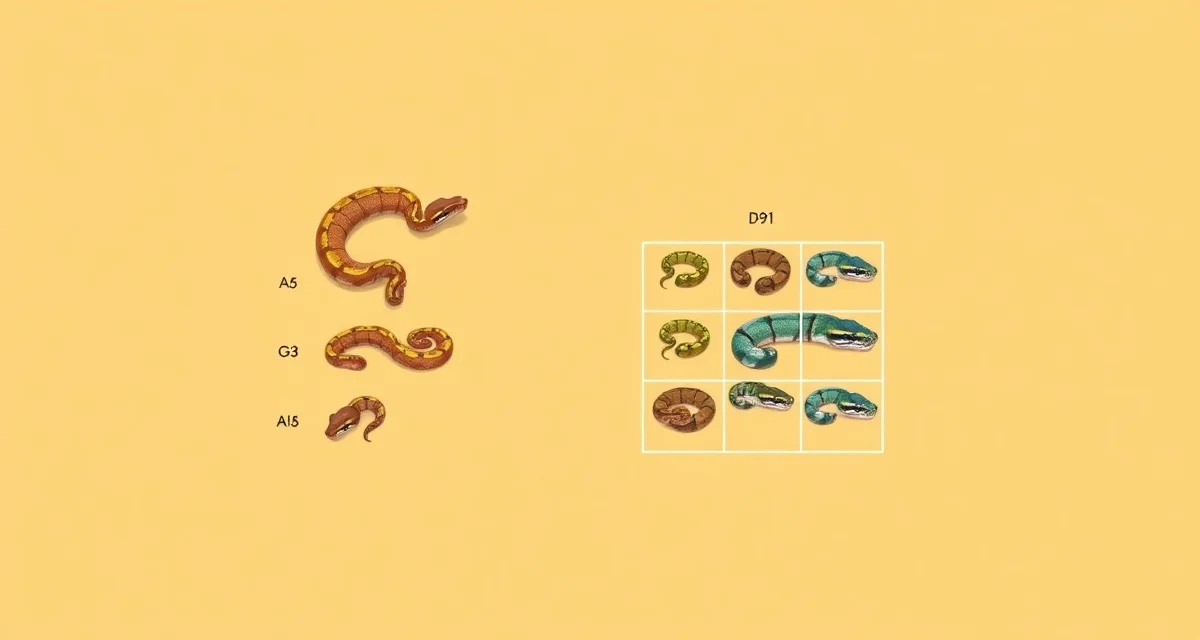
Dominant Genetics in Ball Pythons Explained
Genetics is the engine of ball python breeding. Understanding how different inheritance patterns work determines what pairings you plan, what outcomes you can expect, and how you price and market the animals you produce. Dominant genetics are a great place to start because the logic is clean and the results show up quickly, often in the very first clutch you produce.
TL;DR
- Ball python breeding operations require systematic record-keeping from pre-season preparation through end-of-season sales.
- Females at 1,200-1,500g or more are the target weight before introducing them to a breeding male.
- Ovulation detection is the key event that anchors pre-lay shed and lay date calculations.
- Clutch profitability guide depends on understanding actual cost basis per animal, not just gross sale revenue.
- Well-documented animals with complete feeding histories and clear genetic records consistently sell faster and at higher prices.
This guide explains dominant inheritance in ball pythons, covers which morphs behave as dominant traits, and explains how to plan pairings and predict outcomes reliably.
The Basics: What Does "Dominant" Mean?
In genetics, a trait is called dominant when one copy of the mutant gene is sufficient to produce a visible phenotype. You don't need two copies. One parent carries the gene, passes it to 50% of offspring statistically, and those offspring that inherit it will be visual for the trait.
This is the fundamental difference between dominant and recessive traits. A recessive gene requires two copies, one from each parent, to express visibly. With a dominant gene, a single copy does the job.
In ball python breeding, the term "dominant" is often used loosely to describe morphs where one copy produces the visual animal and two copies either produce the same visual (true dominant) or produce a distinctly different "super" form (which is technically co-dominant, also called incomplete dominant). We'll address the distinction between those categories in separate guides. For now, let's focus on the mechanics and examples of morphs that behave dominantly.
True Dominant vs. Co-Dominant: The Key Distinction
True dominant morphs are those where homozygous animals (two copies of the gene, also called "super" forms) are visually identical or indistinguishable from heterozygous animals (one copy). There are relatively few confirmed true dominant morphs in ball pythons.
More common are co-dominant morphs, where the super form has a distinct appearance from the single-copy form. Pastel and Super Pastel look visibly different. Mojave and Super Mojave (Blue-Eyed Lucy) are dramatically different. These are technically co-dominant or incomplete dominant, but many breeders and sellers group them together under the broader "dominant" umbrella.
For practical breeding purposes, what matters is:
- Does one copy produce a visible animal? (Yes, for all dominant/co-dom morphs)
- Does the super form look different from the single-copy form?
- Is the super form viable and healthy?
How Dominant Traits Work in Pairings
When you pair a single-copy dominant morph to a wild-type normal, the expected outcome is:
- 50% animals carrying one copy (visual for the trait)
- 50% animals with no copies (normal wild-type animals)
There's no such thing as a "het" for a dominant morph, at least not in the way that term applies to recessives. If an animal doesn't display the dominant trait visually, it doesn't carry it silently. You either see it or it's not there.
When you pair two single-copy animals to each other:
- 25% will be two-copy (super form, if distinguishable)
- 50% will be one-copy (standard visual)
- 25% will be normal
When you pair a super form to a normal:
- 100% of offspring will carry one copy and be visual for the trait
- None will be normal
This last pairing, super to normal, is particularly useful when you need a specific morph in a pairing but want to guarantee that all offspring carry the gene.
Common Dominant and Co-Dominant Ball Python Morphs
Pastel
One of the most widely distributed genes in the ball python world. Pastel brightens yellows, reduces pattern contrast, and adds a white belly. The Super Pastel is distinctly brighter with more reduced pattern. Pastel is the foundational "brightener" gene that improves the appearance of nearly every combo morph it's added to.
Pairing Pastel x Pastel is a commonly debated topic. It does produce Super Pastels, but it also produces normals that have no gene value. Most breeders find it more productive to pair Pastels to animals carrying high-value genes (like recessive morphs) rather than producing simple Pastel x Pastel clutches.
Cinnamon and Black Pastel
These are allelic co-dominant genes that sit at the same gene locus. Both individually produce darkened animals with reduced pattern. Their super forms are Super Cinnamon and Super Black Pastel respectively, which are black or very dark brown animals. Cinnamon x Black Pastel produces a Super Cinnamon/Super Black Pastel-type animal through their allelic relationship.
The super forms of Cinnamon and Black Pastel are notable because some animals can have neurological issues similar to the Spider wobble, making breeding ethics around super forms relevant here as well.
Spider
Spider is a dominant morph that produces dramatically reduced pattern and a distinctive geometric dorsal stripe. The Super Spider is a stark white or near-white animal. Spider is one of the most controversial morphs in the hobby because both single-copy and super-form Spiders exhibit a neurological "wobble", a head tremor and balance issue that ranges from mild to severe.
The wobble is hereditary and linked to the Spider gene itself, not just to super form animals. This has led to notable ethical debate in the breeding community about producing and selling Spider morphs, particularly wobble-affected individuals. If you plan to work with Spider, understand this issue fully before proceeding.
Pinstripe
Pinstripe produces a distinctly banded dorsal pattern with reduced side pattern. The Super Pinstripe is a very clean, pattern-reduced animal. Pinstripe is a popular gene in combos because it adds clean dorsal patterning that pairs well with both recessive and other dominant genes.
Enchi
Enchi enhances orange and yellow tones while muting some pattern elements. It's often described as a "painter's gene" because its primary role is intensifying colors of other morphs it's combined with. Super Enchi is visibly different from single-copy Enchi but the full expression depends heavily on what other genes are in the animal.
Orange Dream
OD (Orange Dream) is a co-dominant that brightens orange tones and has a characteristic head pattern. Super OD is a white or near-white animal. Like Enchi, OD is often more valuable in combos than alone, though it does produce attractive single-gene animals.
Spotnose
Spotnose produces subtle pattern changes and a characteristic "spotted" nose pattern. The Super Spotnose is a dramatically different, light-colored animal with highly reduced pattern. Spotnose is sometimes considered in the same category as Pastel as a "stack-well" gene that improves combo morph appearance.
Mojave
Mojave is one of the most important co-dominant genes in ball python genetics. Single-copy Mojave animals have a distinctive reduced pattern with angular blotches. The Super Mojave is a Blue-Eyed Lucy (BEL), a pure white or near-white animal with blue eyes, one of the most recognizable and marketable ball python visuals.
BEL animals can also be produced through other co-dom genes at the same locus, including Lesser, Butter, Russo, and Phantom, which are all allelic to Mojave. Pairing any two of these allelic genes together produces a BEL.
Planning Dominant Pairings
The advantage of dominant genetics from a planning perspective is speed. You don't need to prove out hets over multiple generations before seeing visual results. Pair a dominant morph to any animal and you'll see results in the first clutch.
This makes dominant morphs accessible for beginning breeders and valuable for breeders who want to accelerate their project development. Adding a dominant gene to a recessive project animal produces visual dominant-plus-possible-het offspring in generation one, versus waiting for het-to-het pairings.
Use a morph calculator to model expected outcomes before committing to a pairing. Tools like the ball python morph calculator let you enter the genetics of both parents and see expected offspring ratios. This is particularly useful when working with multiple genes in the same pairing.
Genetic Record-Keeping for Dominant Morphs
Even though dominant morphs don't require the multi-generation proving process of recessive genes, good record-keeping still matters. When you're tracking the genetics of every animal across a large collection and planning combos involving multiple genes, the complexity adds up fast.
The HatchLedger platform stores genetic profiles for every animal in your collection and links them to their parents and offspring records. When you're trying to identify which animals from a previous season are carrying specific combinations of dominant and recessive genes, that connected record structure saves enormous time compared to manually cross-referencing spreadsheets. Breeders using integrated software report 30% less time on administrative tasks, which compounds across a full season of pairings and hatchling records.
The Financial Side of Dominant Morphs
Dominant morphs are generally accessible in price relative to high-value recessive morphs, because any breeder with one visual animal can produce more visual offspring in the first season. Market saturation happens faster with dominant genes.
Where the real value is captured is in combinations: a dominant gene paired to a high-value recessive, or stacked with multiple other dominant genes to produce a uniquely colored combo. Single-gene dominant animals in popular morphs (basic Pastel, basic Cinnamon) are inexpensive and plentiful. The same gene in a complex combo with Clown or Pied is a different commercial proposition entirely.
Plan your dominant morph pairings with the combo potential in mind, not just the immediate clutch outcome.
Frequently Asked Questions
What is the best approach to dominant ball python genetics explained?
Understand that dominant and co-dominant morphs don't require two copies to express visibly, which means you see results immediately in the first clutch. Model pairings with a morph calculator before making decisions, track all genetic profiles in your records, and think about combo potential rather than breeding single-gene dominant animals in isolation.
How do professional breeders handle dominant ball python genetics explained?
Professional breeders use dominant and co-dominant genes as building blocks for complex combo morphs rather than as end products in themselves. They track genetic lineages meticulously to manage what genes are stacked in each animal, use morph calculators to plan pairings, and price animals based on the combination of genes present rather than individual gene value alone.
What records should every reptile breeder maintain per animal?
At minimum: acquisition date and source, morph and genetic documentation, feeding log, weight history, any veterinary treatments, and breeding history including pairing dates, clutch of origin for captive-bred animals, and offspring records. These records serve your own management, buyer documentation, regulatory compliance, and long-term genetic tracking.
How should reptile breeders document genetics for buyers?
A complete genetic record for sale includes the animal's visual morph name, confirmed het genes and their basis (parentage documentation or proven-out production), possible het genes with probability percentages, hatch date, and parent morph information. Including clutch-of-origin records lets buyers independently verify the claims.
Sources
- World of Ball Pythons (WoBP genetics reference database)
- USARK (United States Association of Reptile Keepers)
- Association of Reptilian and Amphibian Veterinarians (ARAV)
- Ball Python genetics community resources
- MorphMarket (morph identification and pricing data)
Get Started with HatchLedger
Every part of a ball python breeding operation -- from pairing records to clutch documentation to financial tracking -- works better when the data is connected rather than scattered across notebooks and spreadsheets. HatchLedger is built for exactly that. Try it free with up to 20 animals.