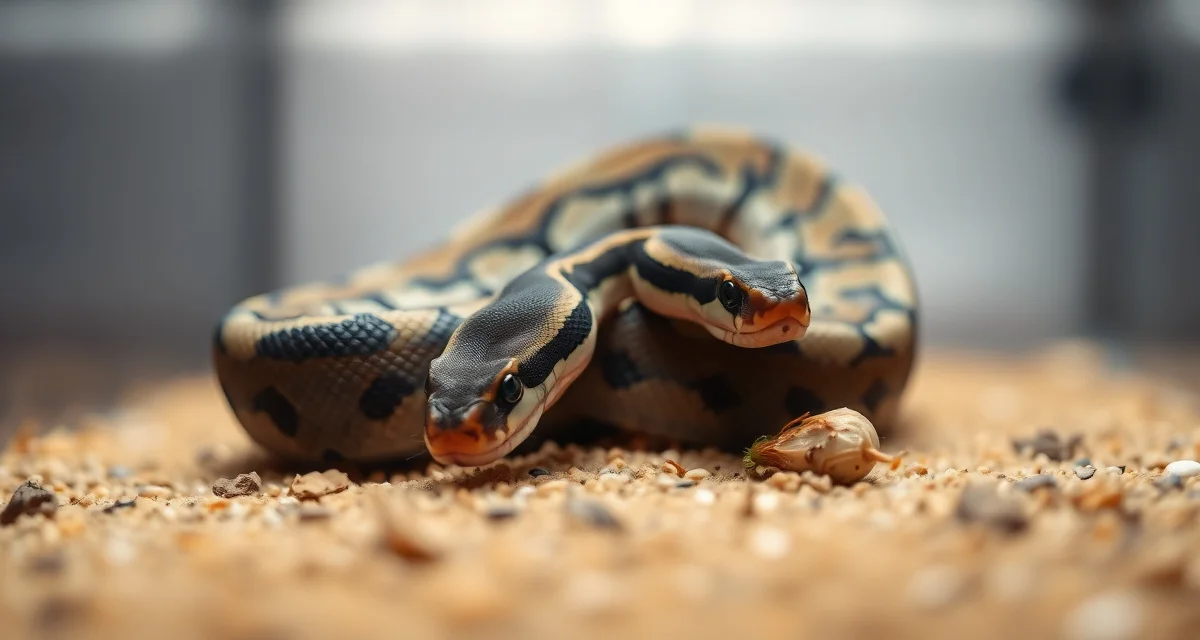
When Do Ball Python Hatchlings Start Eating FAQ
Getting hatchlings to eat is one of the first real challenges you'll face after a clutch comes out. It's also one of the most stressful parts of breeding for anyone who's watched a stubborn hatchling refuse meal after meal. Here's what's normal and what to do.
TL;DR
- Most ball python hatchlings take their first meal 7 to 14 days after hatching, typically after their first shed completes around day 10 to 14 post-hatch.
- Hatchlings have enough yolk reserves to survive 2 to 4 weeks without food, so a first-week refusal is not an emergency.
- Scenting, brain feeding, and offering prey in a dark deli cup overnight are the most commonly used techniques for stubborn feeders.
- Appropriately sized prey means roughly matching the snake's widest point, usually a pinky mouse or small fuzzy for most hatchlings.
- A hatchling that hasn't eaten by day 30 needs extra attention; refusal past 60 to 90 days is a more serious concern.
- Reputable breeders wait for 3 to 5 consistent meals before selling, regardless of hatch weight or genetics.
- Logging every feeding attempt per individual hatchling, including prey type, size, and outcome, helps identify husbandry problems before they become health problems.
When Should Ball Python Hatchlings Start Eating?
Most ball python hatchlings will take their first meal 7 to 14 days after hatching, typically after their first shed. Waiting until after the first shed is important. The first shed usually happens 10 to 14 days post-hatch, and many hatchlings simply won't eat until that process is complete.
Don't panic if a hatchling doesn't eat immediately after hatching. That's completely normal.
How Long Can a Ball Python Hatchling Go Without Eating?
A healthy hatchling has enough yolk reserves to survive 2 to 4 weeks after hatching without any food. After the first shed, if a hatchling still isn't eating, you should begin working through a troubleshooting protocol, but a first refusal at week one isn't necessarily a problem.
Most hatchlings that don't eat within the first 30 days will eventually eat. True long-term fasting refusal past 60 to 90 days in a hatchling is more concerning.
What Should You Feed Ball Python Hatchlings?
Appropriately sized frozen/thawed or live mice or small rats. "Appropriately sized" means roughly the same width as the snake's widest point. For most hatchlings, that's a pinky mouse or small fuzzy.
Frozen/thawed is the safer option and should be the default. Live prey can injure a snake. If you're using live prey, never leave it unattended with the snake.
How Do You Get a Stubborn Hatchling to Eat?
Several techniques breeders use:
Scenting: Rub the feeder item against a lizard, frog, or another prey item's skin. Ball pythons in the wild eat a wide variety of prey, and a different scent can trigger a response in picky eaters.
Brain feeding: Make a small incision in the skull of the prey item to expose the brain tissue. The scent is often enough to trigger feeding in reluctant hatchlings.
Assist feeding: Gently hold the prey item near the snake's nose without forcing anything. Sometimes a hatchling needs a little encouragement to strike.
Dark, quiet environment: Put the snake in a dark deli cup with air holes and a thawed feeder item overnight. Some hatchlings prefer to eat without feeling observed.
Live prey as a last resort: If all else fails and the snake is losing weight, a live pinky mouse may trigger a strike when frozen/thawed hasn't. Once established on live, begin transitioning from live to frozen/thawed prey as soon as possible.
What Tracking Should You Do for Hatchling Feeding?
Every feeding attempt and outcome should be documented. Hatchlings that consistently refuse have either a husbandry issue you need to identify or a health problem that needs attention.
The ball python breeding hub covers hatchling management in more detail. In HatchLedger, you can log feeding records per individual hatchling, including date, prey type, prey size, and whether the animal took the meal. Over time, that record tells you which animals in a clutch are thriving and which need extra attention before you can move them to a new home.
Your ball python morph calculator may tell you what genetics you produced. Your feeding records tell you which of those animals are actually ready to sell.
At What Weight Can You Sell a Ball Python Hatchling?
Most buyers and reputable breeders consider an animal ready for sale after it has eaten a minimum of 3 to 5 meals consistently. Weight at hatch is typically 60 to 100 grams. By the time an animal has eaten 3 to 5 meals, it should be gaining steadily and showing normal feeding response.
Selling animals that haven't established eating is risky for your reputation and the buyer's experience. Keeping detailed hatchling weight and growth records alongside feeding logs gives you the documentation to back up your sale-ready claims with confidence.
Frequently Asked Questions
When do ball python hatchlings start eating?
Most begin eating within 7 to 14 days after their first shed, which typically occurs 10 to 14 days post-hatch. A hatchling that hasn't eaten by day 30 should be given extra attention, but many will still start eating on their own before the 60-day mark.
How do professional breeders handle ball python hatchling feeding?
They wait until after the first shed, offer appropriate prey in an appropriately stressful-free environment, document every feeding attempt, and work through a structured troubleshooting protocol before resorting to more aggressive interventions.
What software helps manage ball python hatchling feeding records?
HatchLedger tracks individual feeding records per animal, including dates, prey size, and meal acceptance, giving you a clear history of each hatchling's feeding progress before sale.
What temperature and humidity should I maintain to encourage hatchlings to eat?
Hot side temperatures of 88 to 92 degrees Fahrenheit with a cool side around 76 to 80 degrees are the standard range for ball python hatchlings. Humidity should stay between 60 and 80 percent. Hatchlings kept outside these ranges are more likely to refuse food, so confirming your enclosure parameters before troubleshooting feeding technique is always the right first step.
Should I handle a hatchling that isn't eating yet?
Minimize handling until a hatchling has eaten at least 3 consecutive meals. Frequent handling adds stress that can suppress feeding response, particularly in the first few weeks post-hatch. Once a hatchling is eating reliably, short, calm handling sessions can begin without disrupting its feeding schedule.
Is it normal for some hatchlings in the same clutch to eat while others refuse?
Yes, this is common. Individual variation within a clutch is normal, and a sibling eating readily does not mean a refusing hatchling has a serious problem. Document each animal separately and work through your troubleshooting protocol on a per-animal basis rather than treating the clutch as a single unit.
Can incorrect prey size cause a hatchling to refuse food?
Yes. Prey that is too large can intimidate a hatchling into refusing, and prey that is too small may not trigger a strong feeding response. Matching prey width to the snake's widest body point as closely as possible gives you the best chance of a successful feeding, especially with first-time feeders.
Sources
- Ball Python Care and Husbandry Guidelines, Association of Reptilian and Amphibian Veterinarians (ARAV)
- Reptile Feeding and Nutrition, Merck Veterinary Manual
- Ball Python Natural History and Captive Management, Smithsonian's National Zoo and Conservation Biology Institute
- Reptile and Amphibian Ecology and Husbandry, University of Florida IFAS Extension
- Captive Reptile Welfare and Best Practices, British Veterinary Zoological Society (BVZS)
Get Started with HatchLedger
If you're tracking hatchling feeding attempts on paper or in a spreadsheet, you're making it harder than it needs to be to spot which animals are ready to sell and which need more time. HatchLedger lets you log every feeding attempt per individual hatchling, including prey type, size, and outcome, so your clutch records are always complete and easy to review. Try HatchLedger free and see how much clearer your hatchling season looks when every data point is in one place.