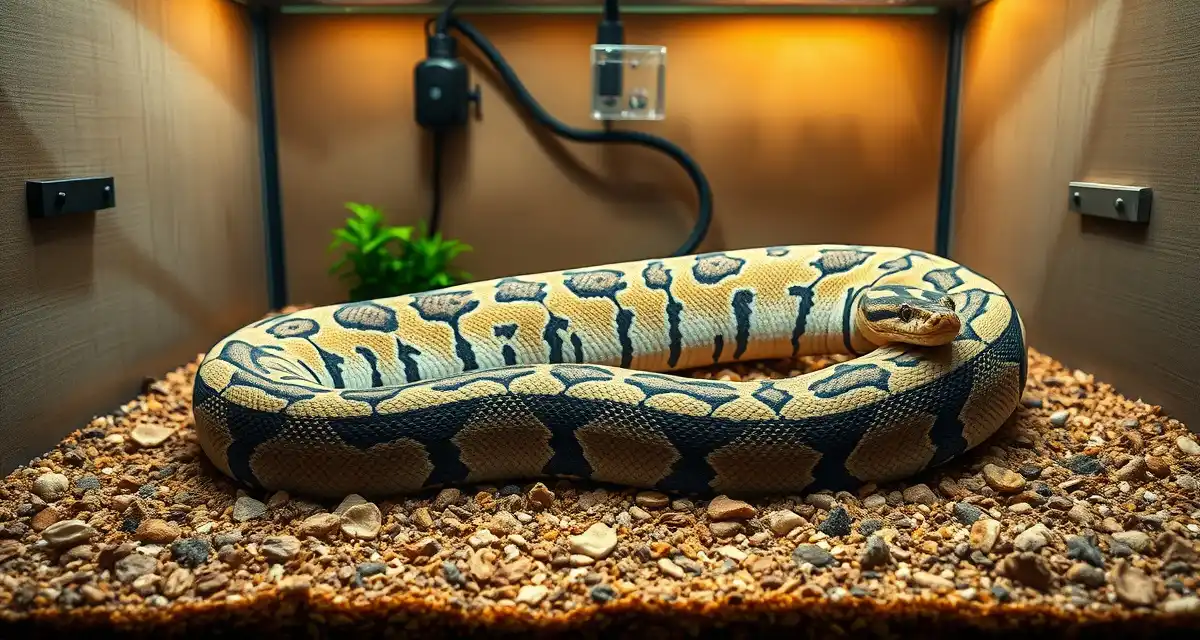
Reticulated Python Husbandry for Breeders: Complete Breeder Guide
Retic husbandry for breeding programs requires addressing everything a general keeper needs to get right, plus the additional complexity of maintaining reproductive condition in animals that can reach 16-20 feet and weigh over 100 pounds. The husbandry decisions you make -- enclosure design, feeding protocol, temperature management, handling approach -- have direct effects on breeding performance and on your ability to safely manage these animals year after year. Breeders using integrated software report 30% less time on administrative tasks, leaving more time for the hands-on work that large retics demand.
TL;DR
- Reticulated pythons (Malayopython reticulatus) are the world's longest snake species, with breeding females commonly exceeding 10-14 feet.
- Clutch sizes average 30-60 eggs, making retics one of the most productive large constrictors in captive breeding.
- Temperature drops of 5-8 degrees Fahrenheit over 6-8 weeks typically trigger breeding behavior without the longer cooling required by temperate species.
- Incubation runs 80-90 days at 88-90 degrees Fahrenheit, longer than most python species due to egg size.
- Super dwarf and dwarf locality animals are bred specifically for smaller adult size and command significant premiums over standard retics.
Enclosure Requirements for Breeding Adults
Adult retics need large enclosures. Full-size females in prime breeding condition can be 12-16+ feet long; their enclosure needs to accommodate that length while providing adequate thermal gradients and security.
Custom enclosures are the standard for large adult retics. Commercial enclosures rarely come in sizes appropriate for full-grown retics, and the weight-bearing and structural requirements of housing a 100+ pound snake mean DIY or custom builds are necessary for most breeders.
Minimum footprint for a full-size adult female is typically 8x4 feet (floor dimensions). Larger is better. Enclosures need secure locking mechanisms -- retics are powerful animals that can push through inadequately latched doors or lids.
Supermorph dwarfs and regular dwarf lines allow smaller enclosures that are more practical for breeders with limited space. A 6x2 enclosure handles many adult supermorph dwarf females. This is a significant practical advantage of working with smaller retic lines.
Temperature Management
Retics need a thermal gradient: warm basking area at 88-92F, ambient temperature at 78-82F, cooler area at the opposite end of the enclosure at 75-78F. The gradient allows thermoregulation. A single temperature throughout the enclosure prevents the animal from moving between zones as its metabolic needs change.
Heat sources for large retics can be overhead heat (CHE, radiant heat panels, T5 basking tubes) or under-enclosure heat tape or radiant heat panels beneath a raised enclosure floor. Large animals don't thermoregulate well from purely belly heat -- overhead heat sources that warm the animal from above are generally preferred for large pythons.
Verify temperatures with a digital thermometer with a probe placed at the basking spot, not just an IR gun aimed at the hot spot from across the room. Temperature readings can vary significantly based on measurement method.
Feeding Adult Breeding Retics
Adult retics are large animals with corresponding prey requirements. A 14-foot female may eat large rabbits, large pigs, or large rats. Prey item size should match the animal's girth -- large enough to create a visible lump after consumption but not so large that the animal struggles to consume it or shows signs of stress.
Feeding frequency for adult breeders varies by season and by individual. Outside of breeding season, feeding every 2-4 weeks is typical for well-conditioned adults. Going into breeding season, you want females to be in excellent body condition without being obese -- well-muscled and in the upper end of healthy weight range.
During breeding season, females focused on reproduction often reduce feeding voluntarily. Don't force-feed a female that's showing normal breeding behavior and maintaining weight. A brooding female will fast for the entire 60-80 day incubation period if she's maternally incubating; this is normal and expected for well-conditioned animals.
Hygiene and Disease Prevention
Large enclosures housing large animals require a systematic approach to cleaning. Retic defecations are substantial; spot cleaning daily or every other day is more practical than waiting for full clean-outs.
Full enclosure cleaning should happen when needed based on contamination, not on a fixed weekly schedule. Deep cleaning involves removing the animal, removing substrate, disinfecting the enclosure interior, and refreshing substrate. This is a two-person task for large adult retics -- having an assistant when working with an adult full-size retic is a safety practice, not just a convenience.
HatchLedger logs husbandry records including weight entries, feeding history, and veterinary visits that together provide a complete individual care history.
Handling and Safety Protocols
A 14-foot, 80-pound retic is not a solo-handling animal for most people. The standard safety rule is one handler per four feet of snake. A 16-foot retic needs four people for safe handling. This isn't an arbitrary rule -- it reflects the actual physical control requirements for animals of this size and strength.
Hook training from hatching through the juvenile stages pays dividends throughout the animal's life. A well-hook-trained adult retic that understands the difference between the hook signal and a feeding response is a fundamentally safer animal than one that wasn't trained. Always hook before every handling interaction, regardless of the animal's apparent temperament on that day.
HatchLedger connects husbandry records to financial performance, providing complete program visibility.
Frequently Asked Questions
What is the best approach to reticulated python husbandry for breeders?
Provide large enclosures with proper thermal gradients (88-92F warm, 75-78F cool). Use overhead heat sources for large adults. Feed large prey every 2-4 weeks outside breeding season; allow females to self-regulate during breeding season. Spot clean daily and deep clean as needed. Follow the one-handler-per-four-feet rule for safe handling. Maintain hook training throughout the animal's life. Log feeding, weight, and husbandry observations consistently so you have objective data for veterinary consultations and reproductive management.
How do professional breeders handle reticulated python husbandry?
Professional retic breeders design their facilities around the animals' actual size requirements -- they don't try to keep large retics in undersized enclosures and don't manage them without appropriate staffing for safe handling. They maintain consistent feeding and temperature records for every animal. They establish safety protocols before problems arise and have veterinary relationships with practitioners who can handle large constrictors. They also track husbandry data over time to identify animals whose condition is declining or whose feeding is changing in ways that might indicate health issues.
What software helps manage reticulated python husbandry records?
HatchLedger tracks cycling records, pairing introductions, clutch documentation, locality lineage, and sale records for reticulated python breeders. With large animals, large clutches, and locality documentation all requiring careful records, having everything in one system reduces the risk of documentation errors at sale. Free for up to 20 animals.
What is the difference between standard, dwarf, and super dwarf reticulated pythons?
Standard reticulated pythons are the full-size animals from mainland Asian populations. Dwarf retics originate from island populations (Kalatoa, Kayuadi) and typically reach 8-12 feet. Super dwarf retics from Madu and Selayer islands often cap below 8 feet. These size differences are locality-based, and crossing localities produces intermediates. Locality documentation in your records is essential for accurate representation to buyers.
What are the legal considerations for keeping and breeding reticulated pythons?
Regulations vary significantly by state and municipality. Several US states restrict or ban large constrictors, and federal regulations under the Lacey Act apply to some populations. USARK maintains current regulatory information. Before breeding retics at scale, confirm that selling and shipping animals is permitted in your jurisdiction and target markets.
Sources
- USARK (United States Association of Reptile Keepers)
- Association of Reptilian and Amphibian Veterinarians (ARAV)
- Journal of Herpetology (Society for the Study of Amphibians and Reptiles)
- CITES Appendix II (international trade documentation)
- Southeast Asian Biodiversity Society
Get Started with HatchLedger
Reticulated python breeding at any scale involves large animals, large clutches, morph and locality genetics overview, and compliance and shipping records that require an organized system to manage well. HatchLedger tracks every animal, pairing, clutch, and sale record in one place. Try it free with up to 20 animals.