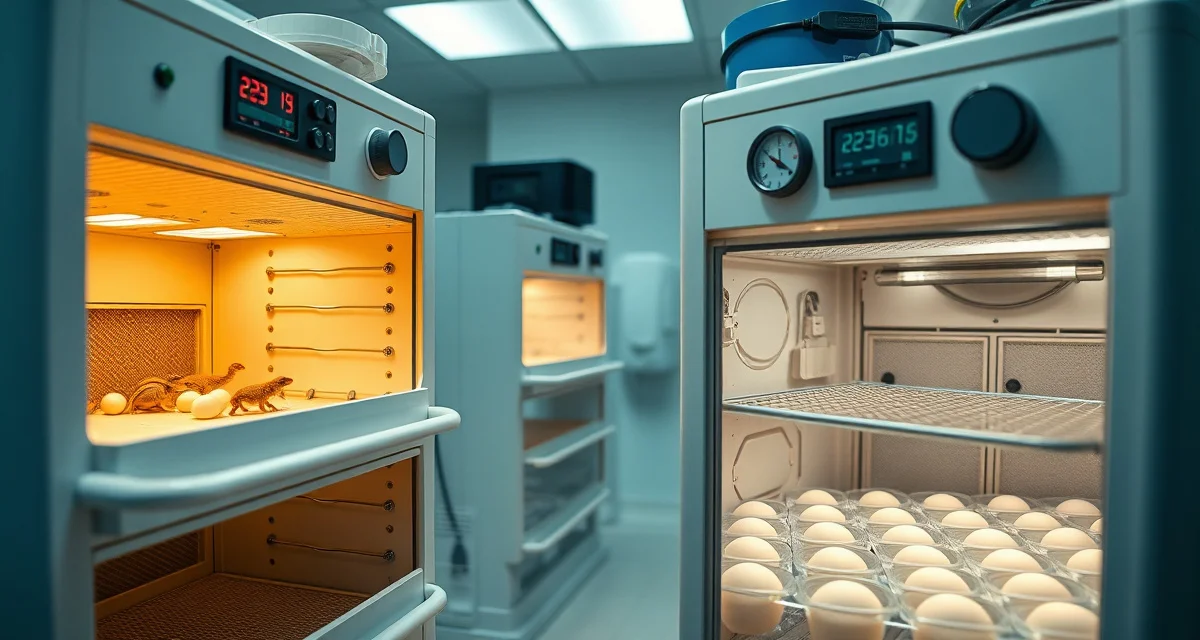
Incubation Equipment Guide for Reptile Breeders
By HatchLedger Editorial Team · Published 2025-04-08 · Updated Mar 13, 2026
The incubator you choose will define the ceiling on your hatch rates. A clutch of Pied eggs that went through a bad temperature spike during the first two weeks is a problem you can't undo. Getting equipment right upfront is cheaper than losing animals.
Incubator Types
Forced-Air Incubators
Forced-air units use a fan to circulate warm air, resulting in much more even temperature distribution than still-air designs. This matters in larger incubators where eggs near the heating element might be slightly warmer than eggs at the far end. For collections running more than a few clutches simultaneously, forced-air is the right call.
Reptibator / Zoo Med: Entry-level forced-air units. Work reasonably well for small operations. Temperature stability isn't as tight as purpose-built units, but many breeders run them successfully with careful calibration.
Hovabator with fan conversion: The Genesis 1588 Hovabator ships with a fan and digital thermostat built in. Originally designed for bird eggs, it's been a staple in the ball python breeding community for decades because it's affordable and actually works. Holds temperature well when not overfilled.
Brinsea: Higher-end poultry incubators that reptile breeders have adopted. Solid temperature regulation, reliable electronics. The Ovation series handles 45-100+ eggs depending on model.
Grumbach: German-made poultry incubators. Expensive but precise. Found in larger professional operations.
DIY and Converted Incubators
Most high-volume breeders build their own. A wine cooler or refrigerator converted with a heat source and thermostat gives you control over interior dimensions, shelving, and the ability to run a heater-cooler combination. This is how you get an incubator that holds 200+ eggs at once without spending $3,000 on commercial equipment.
Common DIY approach: foam cooler or insulated cabinet, small space heater or reptile heat tape as the heat source, Ranco or Inkbird thermostat as the controller. Total cost for a functional large incubator: $100-300 in materials.
Thermostats
The incubator itself is just a box. The thermostat is what controls temperature with precision. Many cheap incubators have poor built-in thermostats, the solution is to bypass the built-in thermostat and run an external one.
Inkbird ITC-308: Popular digital dual-stage thermostat. Cheap ($30-40), reliable, easy to program. Controls both heating and cooling outputs, which is useful if you're running a cooler-based DIY incubator.
Ranco ETC-111000: The long-standing industry standard. Simple, reliable, no frills. Single-stage (heating only). Used extensively in reptile rack setups and incubators.
Herpstat: Higher-end thermostat with proportional/proportional-integral-derivative (PID) control. Much tighter temperature regulation than on/off thermostats. If you're running expensive eggs, high-dollar pieds, banana clowns, the reduced temperature swings are worth the cost.
BN-LINK: Budget option. Gets the job done for basic setups.
Key spec to understand: On/off thermostats cycle your heat source on and off in response to temperature swings. This creates fluctuations of 0.5-2°F depending on your setup. PID thermostats reduce current to the heat source as temperature approaches setpoint, resulting in tighter swings of 0.1-0.3°F. For most ball python incubation, on/off is fine. For species with tighter temperature requirements, PID is better.
Temperature and Humidity Measurement
Do not trust your incubator's built-in readout without verifying it against a calibrated probe. A surprising number of "temperature problems" turn out to be inaccurate displays.
Calibrated digital probes: SensorPush, Govee, and Inkbird all make wifi-enabled temperature/humidity sensors that log data to your phone. Being able to see a 24-hour temperature graph is more useful than a single point reading. You'll catch night-time temperature drops, heater cycling patterns, and the brief spike that happened at 3am when the room temperature changed.
Infrared thermometers: Useful for spot-checking egg surface temperatures. Not a replacement for probe logging.
The ice water calibration: To verify a probe, submerge it in a 50/50 mix of ice and water. At sea level, true temperature is 32°F (0°C). Any offset is your calibration error. Adjust your thermostat setpoint accordingly.
Container Selection
Eggs don't sit loose in the incubator, they go in containers with substrate that maintains humidity. Common choices are deli cups (6oz for individual eggs, 32oz for small clutches), tupperware, and commercial egg containers.
Vented containers vs. sealed containers determine how much humidity exchange happens with the incubator environment. For most ball python setups, sealed containers with appropriate substrate moisture are used. See the full incubation substrate guide for ratios and substrate types.
Tracking Incubation Data
Equipment calibration is only useful if you record baseline readings and monitor them through the incubation period. Key data points to log per clutch:
- Incubator setpoint temperature
- Verified probe temperature (and any offset noted)
- Container substrate type and starting moisture ratio
- Humidity probe readings (if monitoring inside containers)
- Any temperature excursions during incubation
HatchLedger's clutch records let you attach all of this data to a specific clutch, so when you're reviewing hatch rates at the end of the season you can correlate outcomes with conditions. A clutch with 90% hatch rate tells you something. A clutch with 40% hatch rate combined with a noted 4°F temperature spike in week 2 tells you something specific. Track your incubation records per clutch, not just per season.
Common Equipment Failures and Backups
Thermostat failure: The most catastrophic failure mode. A thermostat that sticks "on" will cook your eggs within hours. Backup plans include a secondary thermostat in series (set 2°F higher as a safety cutoff), temperature alarms, or wifi sensor alerts. At minimum, set a temperature alert on your sensor that pages you if the incubator exceeds safe range.
Power outages: Eggs can tolerate short-term cooling better than overheating. Insulated containers and a well-insulated incubator will hold temperature for hours. A small UPS (uninterruptible power supply) on the incubator will cover brief outages.
Probe drift: Temperature probes degrade over time. Recalibrate against ice water at least once per season.
Good incubation equipment is an investment that pays back over every future season. A $150 Inkbird thermostat on a $200 DIY incubator outperforms a $300 mass-market unit with a poor thermostat. Know what you're buying and verify it before your eggs depend on it.
FAQ
What is Incubation Equipment Guide for Reptile Breeders?
This guide covers everything reptile breeders need to know about selecting and using incubation equipment, from entry-level forced-air units to professional-grade incubators. It explains the differences between incubator types, how temperature stability affects hatch rates, and which equipment suits different collection sizes. Whether you're incubating your first ball python clutch or managing dozens simultaneously, the guide helps you make informed equipment decisions before costly mistakes happen.
How much does Incubation Equipment Guide for Reptile Breeders cost?
The guide itself is free to read on HatchLedger. Incubation equipment costs vary widely: entry-level units like the Reptibator or Hovabator Genesis 1588 typically run $50–$150, mid-range Brinsea models range from $150–$400, and professional Grumbach incubators can exceed $1,000. Investing in reliable equipment upfront is significantly cheaper than losing clutches to temperature spikes or equipment failure.
How does Incubation Equipment Guide for Reptile Breeders work?
The guide walks you through incubator types, key features, and how each design affects egg development. Forced-air incubators circulate warm air with a fan for even temperature distribution. You learn how to evaluate temperature stability, capacity, and thermostat reliability, then match equipment to your breeding scale. Practical calibration tips help you get consistent results once you've chosen and set up your unit.
What are the benefits of Incubation Equipment Guide for Reptile Breeders?
Using the right incubation equipment dramatically improves hatch rates and reduces clutch losses. Stable temperatures during critical early development windows prevent irreversible damage to embryos. The guide helps you avoid common mistakes like overfilling incubators or relying on uncalibrated thermostats. For breeders working with high-value morphs like Pieds or other recessive genes, protecting each clutch with proper equipment pays for itself quickly.
Who needs Incubation Equipment Guide for Reptile Breeders?
Any reptile breeder incubating eggs needs this information, but it's especially valuable for those scaling beyond a few clutches per season. Beginners benefit from understanding which entry-level units actually perform reliably. Intermediate breeders managing multiple species or clutches simultaneously need to know when to upgrade. Advanced breeders running large operations will find guidance on professional-grade equipment that justifies the investment.
How long does Incubation Equipment Guide for Reptile Breeders take?
Reading the guide takes 10–15 minutes. Applying it—selecting, purchasing, and calibrating your equipment—depends on your setup, but most breeders can have a properly configured incubator running within a day or two of receiving it. The incubation period itself varies by species; ball pythons typically incubate for 55–60 days, so getting equipment dialed in before breeding season is time well spent.
What should I look for when choosing Incubation Equipment Guide for Reptile Breeders?
Prioritize temperature stability above all else—even minor fluctuations in the first two weeks can compromise a clutch. Look for a reliable thermostat, even heat distribution (fan-circulated is better than still-air for larger setups), appropriate capacity for your collection size, and a track record in the reptile breeding community. Ease of calibration and availability of replacement parts are also worth considering before committing to a unit.
Is Incubation Equipment Guide for Reptile Breeders worth it?
Yes, for any serious reptile breeder, understanding incubation equipment is essential. A single failed clutch of valuable morphs can exceed the cost of a professional incubator many times over. The guide helps you avoid false economies—cheap equipment with poor temperature regulation costs more in lost animals than the savings justify. Whether you're breeding ball pythons, colubrids, or other species, solid incubation setup is foundational to a successful breeding program.