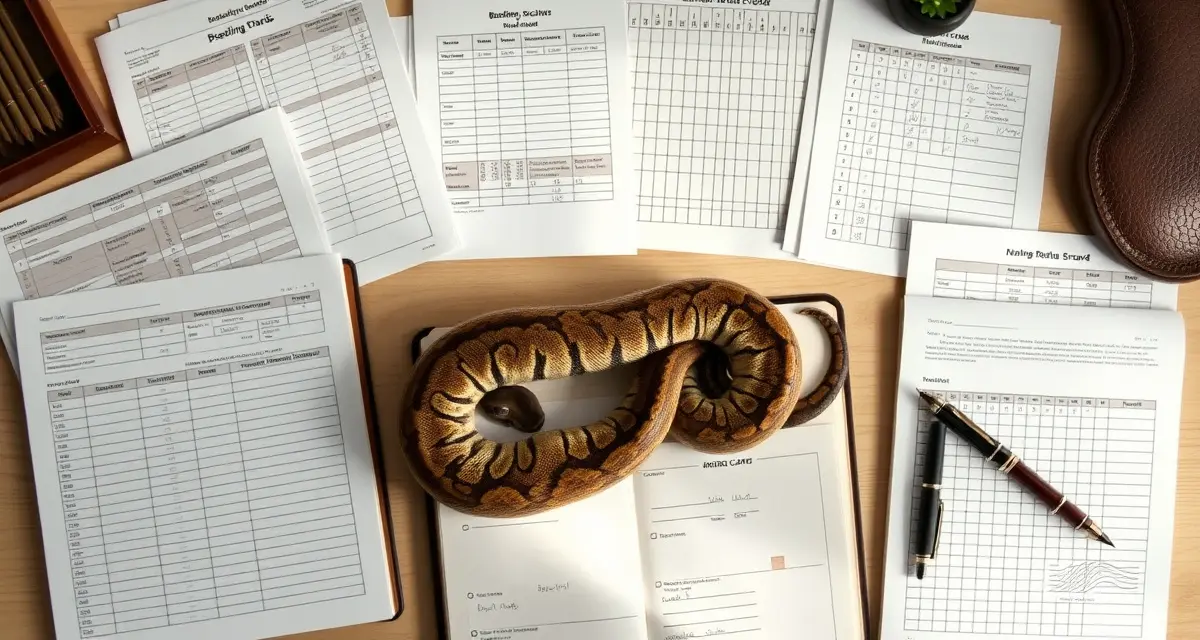
Burmese Python Record Keeping for Breeders: Complete Breeder Guide
By HatchLedger Editorial Team · Published 2025-03-19 · Updated Mar 13, 2026
Burmese python record keeping poses unique challenges compared to smaller species. The animals live 20-25 years. Breeding seasons are annual, with each season producing potentially massive clutches. Hatchlings grow into substantial animals within a year. Morph genetics projects span a decade or more. The sheer scale of information that accumulates over a serious Burmese breeding program makes systematic records essential rather than optional. Breeders using integrated software report 30% less time on administrative tasks -- time that's especially valuable when you're managing records for animals that may have been in your collection for a decade.
TL;DR
- Burmese pythons (Python bivittatus) are among the largest constrictors in captivity, with breeding females commonly exceeding 100-200 lbs.
- Clutch sizes average 25-50 eggs, making Burmese pythons among the most productive large constrictors in captive breeding.
- Cycling typically involves a 4-8 week period of reduced temperatures (dropping 8-12 degrees Fahrenheit) and reduced feeding frequency.
- Incubation parameters runs 60-65 days at 88-90 degrees Fahrenheit, with females capable of thermoregulating eggs by muscular shivering.
- Compliance requirements requirements for Burmese python ownership and interstate transport vary by state, with federal protections under the Lacey Act applying in some jurisdictions.
The goal of a Burmese breeding record system isn't just documentation for its own sake -- it's having the right information available when you need it. When a female is being evaluated for the upcoming season, when you're pricing a morph animal for sale, when a buyer asks for a health history -- good records make all of these situations manageable.
Core Record Categories
Individual animal records: Animal ID, species, morph, genetic status (visual, proven het, possible het), date acquired or hatched, source, weight history, health event log, and reproductive history.
Breeding records: For each season and each breeding pair, you need pairing dates, observed copulation events, estimated ovulation date, expected lay date, actual lay date, clutch statistics (egg count, slug count, viable eggs), incubation data, and final hatch data.
Hatchling records: Each hatchling from every clutch needs an individual record linked to the parent clutch: individual ID, birth weight, initial morph assessment, first shed date, first feeding date, ongoing feeding and weight log.
Health records: All veterinary visits, treatments, health events (respiratory infections, retained sheds, mites, injuries), and outcomes. Burmese pythons that live 20+ years will accumulate significant health histories that are only useful if documented.
Financial records: Acquisition costs, annual care costs per animal, veterinary expenses, sales revenue, and per-clutch P&L.
The Challenge of Long-Term Records
Most record systems work fine in the first year or two. The challenge is maintaining discipline and system integrity across 5, 10, or 15 years of breeding. Individual animals that were hatchlings when your system started will have years of accumulated data. Breeding pairs that went through 8 annual cycles will have 8 seasons of clutch records.
The only solution to long-term record integrity is a system that makes records easy to enter and easy to access. If entering a feeding event takes 30 seconds, you'll do it. If it requires opening a specific spreadsheet, finding the right tab, scrolling to the correct row, and entering data in a specific format, you'll skip it when you're tired or rushed. Skipped records become gaps, and gaps degrade the value of your whole system.
Records for Compliance
Federal and some state regulations may require records of large constrictor sales. Even where records aren't legally required, detailed documentation protects you in the event of a regulatory inquiry or buyer dispute. A sale record that includes the animal's ID, genetics, health status at sale, and buyer information is your evidence that a transaction was conducted appropriately.
If you're breeding regulated or potentially restricted subspecies, understand your specific record-keeping obligations before you produce animals for sale. Regulations in this space have changed historically and may continue to evolve.
Using Records for Program Evaluation
The annual evaluation of your Burmese breeding program should be data-driven. Which females produced the most viable eggs? Which pairings had the highest slug rates? Which morph combinations produced animals that sold most quickly at target prices? Which animals had health events that affected their productivity or your veterinary costs?
These questions can only be answered with good records. Without them, you're making decisions based on impressions -- which are sometimes accurate and sometimes not.
HatchLedger was built to make this kind of systematic record keeping practical for active breeders. Animal records, breeding logs, health events, and financial data all connect in one system rather than being scattered across spreadsheets, notebooks, and emails.
HatchLedger connects your husbandry logs to clutch P&L so every breeding season produces a complete performance picture rather than just a list of animals sold.
Frequently Asked Questions
What is the best approach to Burmese python record keeping?
Set up your record system to cover all five core categories: individual animal records, breeding records, hatchling records, health records, and financial records. Choose a system that makes data entry quick and retrieval easy -- if it's cumbersome to use, you won't maintain it consistently. Start records from the moment you acquire or hatch an animal and maintain them throughout its life in your collection. Use multi-year data to make breeding decisions rather than single-season impressions.
How do professional breeders handle Burmese python record keeping for large collections?
Professional Burmese breeders recognize that their records are a core business asset. They invest in systems that are actually usable day-to-day rather than technically complete but practically ignored. They update records consistently, review them before each breeding season, and use the data to make informed decisions about animal retention, program direction, and financial performance. Long-term records are particularly valuable for identifying which breeding animals are consistently productive and which are generating costs that aren't justified by their output.
What software helps manage Burmese python breeding records?
HatchLedger tracks every animal, clutch, and sale record for Burmese python breeders, with documentation that supports regulatory compliance and buyer confidence. When managing large clutches and compliance requirements simultaneously, a connected system prevents the record-keeping gaps that create problems at sale. Free for up to 20 animals.
Are Burmese pythons legal to own and breed in all US states?
No. Burmese pythons are listed as an injurious species under the Lacey Act, which restricts interstate transport. Several states have additional bans on ownership entirely. Check current state and federal regulations before acquiring or transporting animals. USARK maintains updated resources on applicable regulations.
How large should a Burmese python enclosure be for a breeding pair?
Breeding females typically require enclosures of at least 8x4 feet and often larger for full-grown adults. Dedicated breeding rooms or custom builds are standard at scale. Thermal gradient with hot spots at 88-92 degrees Fahrenheit and ambient temperatures in the mid-70s allows proper thermoregulation.
What is Burmese Python Record Keeping for Breeders: Complete Breeder Guide?
Burmese Python Record Keeping for Breeders: Complete Breeder Guide is a comprehensive resource covering how to systematically track every aspect of a Burmese python breeding program. It addresses the unique challenges of managing long-lived animals—spanning 20-25 year lifespans—alongside complex morph genetics projects, large clutches of 25-50 eggs, and the compliance requirements that come with owning one of the largest constrictors in captivity.
How much does Burmese Python Record Keeping for Breeders: Complete Breeder Guide cost?
The guide itself is free content provided by HatchLedger. HatchLedger's record keeping software, which the guide recommends for managing Burmese python breeding programs, is available via subscription. Breeders using dedicated software report spending 30% less time on administrative tasks—a meaningful return when managing animals and genetic projects that span a decade or more.
How does Burmese Python Record Keeping for Breeders: Complete Breeder Guide work?
The guide walks breeders through building a record system that tracks individual animals, cycling protocols (including the 4-8 week temperature reduction period), breeding pairings, clutch data, incubation logs at 88-90°F, hatchling growth, and morph genetics. It also covers compliance documentation for interstate transport and state-specific ownership regulations, helping breeders stay organized across every phase of the breeding season.
What are the benefits of Burmese Python Record Keeping for Breeders: Complete Breeder Guide?
Systematic record keeping gives Burmese breeders a clear genetic history for every animal, reduces errors in multi-year morph projects, and ensures compliance with state and federal regulations governing this species. Organized clutch and incubation records improve hatch rates over time. Breeders also benefit from faster administrative workflows, freeing up time for the hands-on work of managing large, physically demanding animals.
Who needs Burmese Python Record Keeping for Breeders: Complete Breeder Guide?
Any serious Burmese python breeder benefits from structured record keeping—especially those running multi-animal collections with long-term morph projects. Given that breeding females commonly exceed 100-200 lbs and clutches average 25-50 eggs, even small-scale breeders accumulate significant data quickly. Breeders navigating state compliance requirements or selling hatchlings commercially will find documentation practices particularly essential.
How long does Burmese Python Record Keeping for Breeders: Complete Breeder Guide take?
Setting up a basic record keeping system takes a few hours initially, but the guide is designed to integrate into your ongoing daily and seasonal routines. Cycling, breeding, incubation, and hatchling tracking each add incremental time throughout the year. Using software rather than spreadsheets significantly reduces that ongoing time investment—breeders report saving roughly 30% of administrative hours across a full breeding season.
Related Articles
- Reticulated Python Record Keeping for Breeders: Complete Breeder Guide
- Boa Constrictor Record Keeping for Breeders: Complete Breeder Guide
- Corn Snake Record Keeping for Breeders: Complete Breeder Guide
Sources
- USARK (United States Association of Reptile Keepers)
- Association of Reptilian and Amphibian Veterinarians (ARAV)
- US Fish and Wildlife Service (Injurious Wildlife regulations)
- Journal of Herpetology (Society for the Study of Amphibians and Reptiles)
- Florida Fish and Wildlife Conservation Commission
Get Started with HatchLedger
Burmese python breeding involves large animals, large clutches, and compliance documentation that is difficult to manage without a dedicated system. HatchLedger tracks every animal, clutch, and sale record in one place, giving you the documentation you need for regulatory compliance and buyer confidence. Try it free with up to 20 animals.