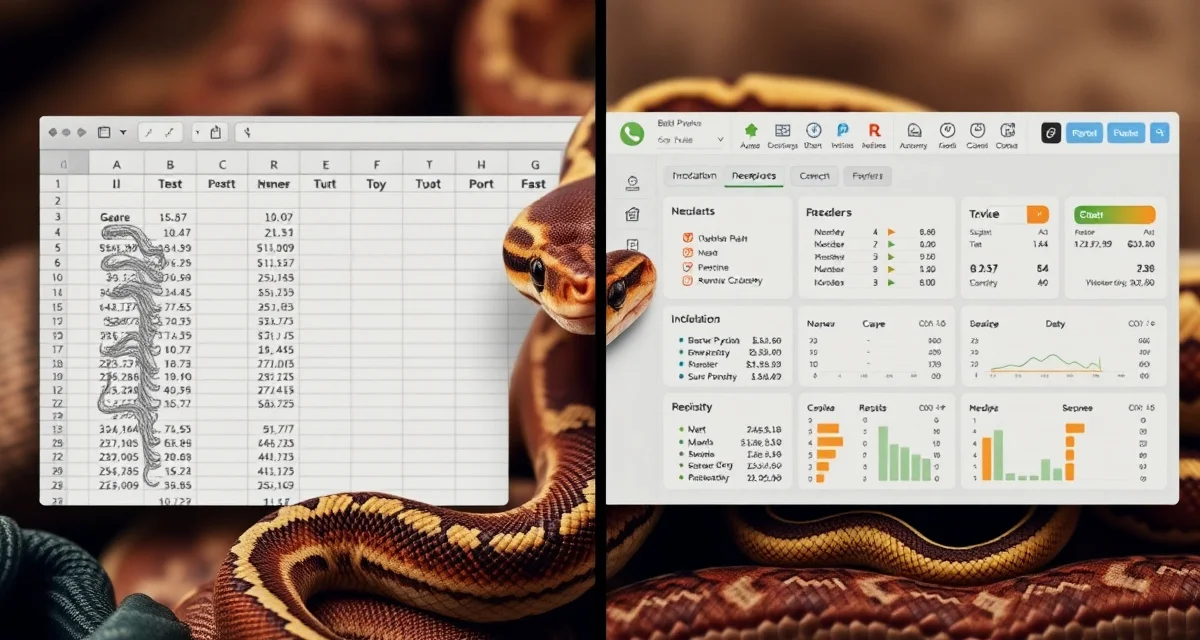
Spreadsheets vs Breeding Software for Ball Python Breeders
By HatchLedger Editorial Team · Published 2025-02-23 · Updated Mar 13, 2026
TL;DR: Spreadsheets give you total flexibility but require you to build everything yourself and maintain it indefinitely. Purpose-built breeding software like HatchLedger does the structural work for you, connects records automatically, and handles features spreadsheets simply can't, like incubation alerts and buyer pack generation.
TL;DR
- Ball python breeding operations require systematic record-keeping from pre-season preparation through end-of-season sales.
- Females at 1,200-1,500g or more are the target weight before introducing them to a breeding male.
- Ovulation detection is the key event that anchors pre-lay shed and lay date calculations.
- Clutch profitability guide depends on understanding actual cost basis per animal, not just gross sale revenue.
- Well-documented animals with complete feeding histories and clear genetic records consistently sell faster and at higher prices.
Quick Comparison
| Feature | Google Sheets / Excel | HatchLedger |
|---|---|---|
| Feeding and weight log | Manual | Built-in |
| genetics guide tracking | Manual (complex) | Built-in engine |
| Incubation timeline | Manual | Automated with alerts |
| Hatchling inventory | Manual | Built-in |
| Financial P&L | Manual | Built-in |
| Buyer pack generation | Copy-paste | Automated |
| Setup time | High (build from scratch) | Low (configured) |
| Maintenance overhead | High | Low |
| Mobile experience | Via app (workable) | Native |
| Alerts / reminders | Manual (calendar) | Built-in |
| Cost | Free | Free–$99/mo |
Why Breeders Start With Spreadsheets
Spreadsheets are familiar, free, and available on every device. Most breeders with any background in organization reach for Sheets or Excel naturally. And for a first year with 6-8 animals, a spreadsheet is completely workable.
The common setup: one tab for animals and morphs, one tab for feeding logs, one tab for breeding records, one tab for clutches and incubation, one tab for financials. Cross-references between tabs if you're technically inclined. Conditional formatting for alerts if you know how to set it up.
This works. Thousands of breeders run on spreadsheets for years. The question isn't whether spreadsheets work, it's whether the time you spend maintaining them is time you'd rather spend elsewhere.
Where Spreadsheets Start Breaking Down
The build cost: A functional ball python breeding spreadsheet with genetics tracking, clutch management, and financial tools takes 8-20 hours to build properly. Most breeders build a partial version, realize it's missing something, add another tab, and end up with a sprawling document that's technically functional but fragile.
Maintenance: Every time you add an animal, you're updating multiple tabs. Every formula that breaks, because you moved a column, deleted a row, or had a tab rename conflict, requires debugging. At 50+ animals with active breeding, maintenance is a recurring 1-2 hour commitment per month minimum.
No alerts: Spreadsheets don't know your incubation schedule and push a reminder when you're approaching hatch window. They don't send a feeding reminder when an animal is overdue. You have to remember to check everything. This sounds minor until you're running 5 clutches simultaneously and you miss a pip because you forgot to check.
Genetics complexity: A proper genetics tracking system in a spreadsheet requires understanding of Mendelian probability, formula logic for het probability cascades, and a data structure that correctly represents multi-gene combinations. Most breeders either oversimplify this (missing important information) or it becomes a project in itself.
Buyer documentation: When you sell an animal, you pull data from your animal tab, your clutch tab, your feeding log tab, your genetics tab, and manually compile it into a document or email. At 40 sales per season, that's 40 manual compilations.
Version and sharing issues: If you and a partner both maintain the spreadsheet, version conflicts happen. If you access it on mobile, the experience is degraded. If you accidentally delete a row, you may not notice until the data is gone.
What Breeding Software Does Differently
Purpose-built software like HatchLedger has the data structure designed from the start for reptile breeding. Every animal record knows about its parents. Every clutch record links to the pairing that produced it. Every hatchling inherits the parent genetics automatically.
Connected records: Change an animal's morph documentation and that update flows through to every linked record, clutches, hatchlings, buyer history. In a spreadsheet, a change in one place requires manual updates everywhere it references.
Automated workflows: Log a clutch lay date and incubation temperature → the system calculates hatch window → you get an alert when you're 5 days out. This isn't technically impossible in a spreadsheet, but it requires setting up a connected calendar alert system and most breeders never get there.
Buyer packs: Generate complete buyer documentation from existing records in seconds. The system pulls morph genetics, parent info, hatch date, weight, and feeding history from your existing logs and formats it.
Financial integration: Cost basis per animal is calculated from breeder acquisition costs allocated over productive years, plus feeding and incubation costs allocated per clutch. This requires relational data (costs linked to animals linked to clutches) that spreadsheets handle poorly.
The Real Calculation
At $19/month, HatchLedger Breeder costs $228/year.
If a proper breeding spreadsheet takes you 10 hours to build and 1.5 hours/month to maintain, that's 10 + (1.5 × 12) = 28 hours per year. At a conservative $15/hour implied value of your time, that's $420 in time annually, plus the mental overhead of a system you're always slightly uncertain about.
Add one missed pip because you forgot to check incubation timing: potential loss of multiple hatchlings, revenue impact of $200-$2,000 depending on the morph.
Add one documentation error on a sale that leads to a buyer dispute: refund plus relationship damage.
The spreadsheet isn't free. It's just free in cash and expensive in time.
When Spreadsheets Still Make Sense
- You're technically inclined and genuinely enjoy building systems
- You have under 20 animals and a simple operation
- You want complete customization for a workflow that doesn't match standard templates
- You're evaluating what you actually need before committing to software
When to Switch to HatchLedger
- You've spent more than 5 hours on spreadsheet maintenance in a season
- You've had a data error or tracking gap that cost you money
- You're selling animals and generating buyer packs manually
- You have no clear picture of which morphs and projects are profitable
- You're approaching 50+ animals or 4+ clutches per season
Related Articles
- Ball Python Ethical Breeding Practices: A Guide for Responsible Breeders
- HatchLedger vs HerpTracker for Ball Python Breeders
- Ball Python Breeding Guide for Beginner Breeders
FAQ
Are spreadsheets good enough for ball python breeders?
For small hobbyist operations (under 20 animals, 1-2 clutches/season), yes. For growing semi-professional operations, the maintenance overhead and feature gaps become real costs. Specifically, incubation alerts, automated genetics tracking, and buyer pack generation aren't practical in spreadsheets without significant custom development.
How do professional breeders handle ball python record keeping?
Most experienced professional breeders use dedicated breeding software rather than spreadsheets, primarily for the time savings and connected-records benefits. At 100+ animals and 10+ clutches per season, a spreadsheet-based system requires enough maintenance time that it becomes a part-time job. HatchLedger is the most widely used purpose-built platform in the reptile breeding community.
What software helps manage ball python breeding records?
HatchLedger is purpose-built for reptile breeders, connecting animal records, breeding history, clutch outcomes, and financial tracking in one connected system. Unlike general spreadsheets or notes apps, it's designed around the specific workflow of an active breeding season -- from pairing records through hatchling inventory and sales documentation. Free for up to 20 animals.
What is Spreadsheets vs Breeding Software for Ball Python Breeders?
Spreadsheets vs. breeding software is a common decision point for ball python breeders looking to organize their records. Spreadsheets like Google Sheets or Excel offer flexibility but require you to build and maintain every formula, tab, and tracking system yourself. Purpose-built software like HatchLedger comes pre-configured with structured fields for feeding logs, genetics, incubation timelines, and financials. The article breaks down both options side by side so breeders can choose the right tool for their operation size and goals.
How much does Spreadsheets vs Breeding Software for Ball Python Breeders cost?
HatchLedger offers a free trial so you can test it before committing. Spreadsheets are free to use but carry a hidden cost: the hours spent building templates, fixing broken formulas, and manually updating records each season. As your collection grows, that time investment compounds. Purpose-built breeding software is priced to reflect the time and errors it saves, making it cost-effective for breeders managing multiple clutches, pairings, and hatchling sales each year.
How does Spreadsheets vs Breeding Software for Ball Python Breeders work?
Spreadsheets work by having you manually enter data into rows and columns you've built yourself. You create your own feeding logs, weight trackers, pairing records, and financial summaries. Breeding software like HatchLedger works differently: records are connected automatically, so a pairing links to a clutch, which links to hatchlings, which links to sales. Incubation alerts fire based on your lay date. Buyer packs generate from existing records. The system does the structural work so you focus on your animals.
What are the benefits of Spreadsheets vs Breeding Software for Ball Python Breeders?
The main benefits of using purpose-built breeding software over spreadsheets include automated incubation timelines, linked genetic records, built-in P&L tracking, and buyer pack generation without manual copy-pasting. Spreadsheets offer full flexibility but no automation. Software reduces data entry errors, saves time across a full breeding season, and makes it easier to present professional records to buyers. Well-documented animals with complete histories sell faster and at higher prices, so better record-keeping has a direct impact on revenue.
Who needs Spreadsheets vs Breeding Software for Ball Python Breeders?
Any ball python breeder who is managing more than a handful of animals, tracking multiple pairings per season, or selling hatchlings to buyers will benefit from structured record-keeping. Hobbyists just starting out may find a simple spreadsheet sufficient. But breeders working toward consistent annual production, tracking morphs and genetics across generations, monitoring clutch profitability, or building a reputation with buyers will quickly outgrow spreadsheets. HatchLedger is built specifically for this stage of growth.
Sources
- USARK (United States Association of Reptile Keepers)
- Association of Reptilian and Amphibian Veterinarians (ARAV)
- World of Ball Pythons (WoBP genetics reference database)
- MorphMarket (reptile industry marketplace)
- Reptiles Magazine (Bowtie Inc.)
Get Started with HatchLedger
Every part of a ball python breeding operation -- from pairing records to clutch documentation to financial tracking -- works better when the data is connected rather than scattered across notebooks and spreadsheets. HatchLedger is built for exactly that. Try it free with up to 20 animals.