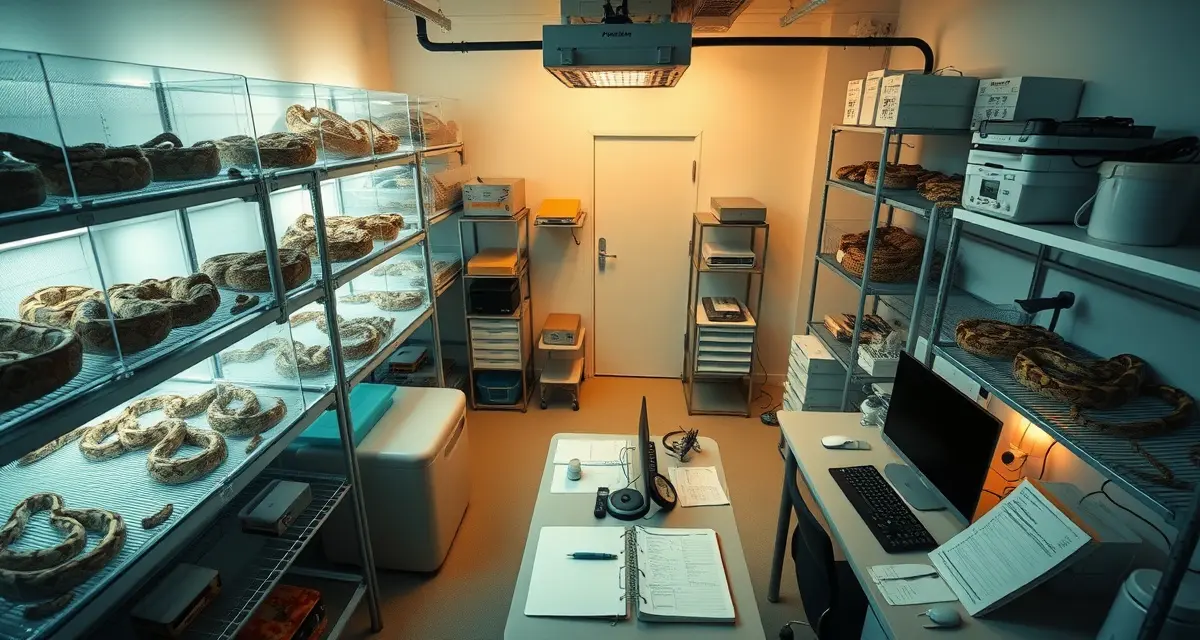
Scaling Your Ball Python Operation from 10 to 500 Animals
Scaling is where most ball python breeders either figure out operations or burn out. The jump from 10 animals to 50 animals doesn't feel like 5x the work, it feels like 15x the work because systems that handled 10 animals fall apart at 50. Here's what actually changes and how to manage it.
TL;DR
- Ball python breeding operations require systematic record-keeping from pre-season preparation through end-of-season sales.
- Females at 1,200-1,500g or more are the target weight before introducing them to a breeding male.
- Ovulation detection is the key event that anchors pre-lay shed and lay date calculations.
- Clutch profitability guide depends on understanding actual cost basis per animal, not just gross sale revenue.
- Well-documented animals with complete feeding histories and clear genetic records consistently sell faster and at higher prices.
The 10-Animal Operation: What Works
At 10 animals, you can manage mostly from memory. You know every animal's feeding history, approximate weight, and breeding status. Your records might be an index card per animal or a simple spreadsheet. This works because:
- Your mental model of the collection is complete
- Mistakes are recoverable, you catch problems before they compound
- One missed feeding or late weight check doesn't cascade into multiple issues
You're probably keeping animals in 1-2 rack systems, running 2-4 pairings per season, and producing 1-3 clutches. This is sustainable at low overhead.
The 50-Animal Inflection Point
At 50 animals, the mental model breaks down. You cannot remember every animal's status accurately. This is when you start making mistakes:
- Missing feeding schedules
- Confusing which female was in which pairing
- Selling a het animal at normal price because you forgot it was proven het
- Breeding an animal before it's ready because you didn't check its weight
The solution isn't working harder, it's systems. The breeder who scales from 10 to 50 to 500 successfully is the one who builds systems at 50 that can handle 500 without requiring proportional increases in personal attention.
The System Stack You Need at Scale
Animal Management
Every animal needs a unique ID, physical ID on the enclosure and a matching digital record. I use a numbering system that includes year of acquisition: 24-F-001 is the first female acquired in 2024.
All records in HatchLedger: morph, genetics guide, weight history, feeding log, shed log, vet visits. When you have 200 animals you cannot remember who got their monthly weight check last Tuesday. The software remembers.
Feeding Operations
At 10 animals: you feed everyone on Tuesday and remember who ate.
At 50 animals: rotating feeding schedule, multiple prey sizes needed, notes required on who refused.
At 200 animals: dedicated feeding days per rack section, prey inventory management, feeding sheets per rack.
HatchLedger's feeding logs capture each feeding event. You can filter animals by "last fed more than 14 days ago" to catch any animals slipping through.
Breeding Season Management
At 10 animals with 3-4 pairings: you remember introduction dates.
At 50 animals with 12-15 pairings: introduction schedules need to be in software.
At 200 animals with 50+ pairings: without a scheduling system, pairings get missed.
HatchLedger's breeding season planner manages all active pairings with scheduled introduction dates, lock records, and expected timeline calculations.
Incubation
At 10 animals, 1-2 clutches: one incubator works.
At 50 animals, 8-12 clutches: you need multiple incubators with backup heat.
At 200 animals, 40+ clutches potentially overlapping: incubation capacity planning becomes critical in January-February when multiple females are approaching lay simultaneously.
Scale your incubation capacity before your female count scales. A failed incubator with 8 clutches inside is a catastrophic loss.
Financial Thresholds for Infrastructure Investment
When to upgrade racks:
When adding another rack is cheaper than the per-animal cost of your current setup. Animal Plastics and Vision Racks become cost-effective at 20+ animals per rack system.
When to hire help:
When your feeding, cleaning, and record-keeping time exceeds 20 hours/week. Many breeders at 200+ animals have a part-time helper for feeding and cleaning days.
When to invest in dedicated space:
When animals are occupying rooms in your home that you need for other purposes, or when your home's HVAC can't maintain appropriate rack temperatures year-round without modification.
Common Scaling Mistakes
Scaling genetics before scaling infrastructure. Acquiring 30 new animals when you only have rack space for 20 creates immediate housing problems. Infrastructure first.
Scaling before sales channels are established. It doesn't matter how many animals you produce if you can't sell them. Know your buyer channels (MorphMarket, Instagram, direct buyers, shows) and their capacity before expanding production.
Ignoring per-animal economics as you scale. Feed costs, electricity, and time per animal should stay consistent or improve as you scale through operational efficiency. If your per-animal cost is increasing as you add animals, your systems aren't working.
Skipping software because "I can handle it." At 50+ animals, you can't. At 200 animals, trying to manage without purpose-built software is the primary cause of breeder burnout.
The HatchLedger Advantage at Scale
HatchLedger's Pro tier (unlimited animals) is specifically designed for the 200-500 animal operation. The system handles:
- Animal inventory with genetic records for every animal
- Breeding season planning for 50+ simultaneous pairings
- Incubation timeline tracking across overlapping clutches
- Hatchling inventory management for 200+ animals in grow-out simultaneously
- Budget calculator showing per-animal and per-clutch financials across the full operation
The Collective tier adds multi-user access, essential when you have a partner or employee who needs to update records independently.
FAQ
What is the best approach to scaling a ball python breeding operation?
Scale systems before scaling animal count. Invest in rack infrastructure, software, and defined processes before adding more pairings. Test each system at current scale before expanding, a feeding system that works for 50 animals should work for 100 before you add 50 more. Know your break-even per animal and verify that increasing scale improves rather than hurts your economics.
How do professional breeders handle scaling a ball python breeding operation?
Experienced large-scale breeders treat their operation as a business with clear operational protocols. They have documented feeding schedules, breeding season calendars, incubation tracking, and financial models. They use purpose-built software (like HatchLedger) for animal management rather than general-purpose tools that require constant customization. They scale gradually, testing infrastructure at each level before proceeding.
Sources
- USARK (United States Association of Reptile Keepers)
- Association of Reptilian and Amphibian Veterinarians (ARAV)
- World of Ball Pythons (WoBP genetics reference database)
- MorphMarket (reptile industry marketplace)
- Reptiles Magazine (Bowtie Inc.)
Get Started with HatchLedger
Every part of a ball python breeding operation -- from pairing records to clutch documentation to financial tracking -- works better when the data is connected rather than scattered across notebooks and spreadsheets. HatchLedger is built for exactly that. Try it free with up to 20 animals.