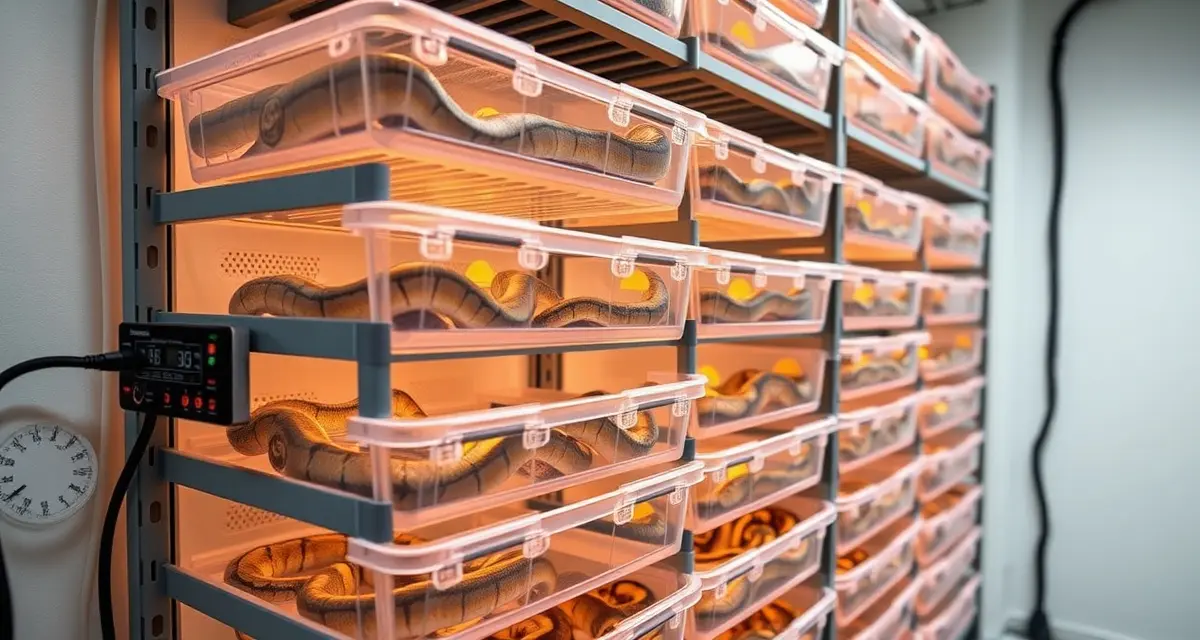
Ball Python Rack Systems: Setup and Management
When your collection outgrows individual enclosures, rack systems become the practical answer. They're space-efficient, temperature-stable, and easy to service at scale. But a poorly set up rack creates problems that follow you for years, temperature gradients, humidity failures, and animals that never settle.
TL;DR
- Ball python breeding operations require systematic record-keeping from pre-season preparation through end-of-season sales.
- Females at 1,200-1,500g or more are the target weight before introducing them to a breeding male.
- Ovulation detection is the key event that anchors pre-lay shed and lay date calculations.
- Clutch profitability guide depends on understanding actual cost basis per animal, not just gross sale revenue.
- Well-documented animals with complete feeding histories and clear genetic records consistently sell faster and at higher prices.
Getting your ball python rack system right from the start saves you from retrofitting later. Breeders using integrated software report 30% less time on administrative tasks, which means your rack management can be as efficient as your rack setup.
Why Breeders Use Rack Systems
A rack system houses multiple animals in individual tubs stacked within a frame. Tubs slide in and out for access. Heat is delivered from below, typically via heat tape or heat cable controlled by a thermostat, warming each tub's floor and creating a belly heat gradient.
The advantages over individual enclosures are notable. You can house 20+ animals in the floor space one large enclosure would occupy. Feeding and cleaning follow a production-line rhythm. Heat distribution is predictable once dialed in.
The tradeoffs are real too. Visual access is limited. Enrichment options are restricted. Ball pythons are secretive animals that do well in tubs, but the setup requires thoughtful management.
Choosing a Rack System
Purpose-Built vs. DIY
Purpose-built racks from manufacturers like Vision Products, Animal Plastics, Boaphile, and Freedom Breeder are designed specifically for reptile keeping. Tubs fit precisely, ventilation is engineered, and frame construction handles the weight of filled tubs safely.
DIY racks using melamine shelving and purchased tubs can work, but require careful planning for heat tape routing, tub fit tolerance, and structural load. Many breeders start DIY and switch to manufactured systems as they scale.
Tub Sizing
Match tub size to the animals you're housing. Common configurations:
- Hatchling and juvenile tubs: 6-quart, 15-quart, or similar small tubs for animals under 300g
- Sub-adult tubs: 28-quart or 41-quart for animals between 300g–1,000g
- Adult female tubs: 70-quart or larger for adults and breeding females
- Adult male tubs: Males are typically smaller and can be housed comfortably in 28–41-quart tubs through adulthood
Always evaluate your tub choice against the snake's ability to fully extend and find a suitable hide at both ends of the thermal gradient.
Vent Configuration
Ventilation matters for humidity control and air quality. Under-tub racks with solid tub lids need side ventilation. Most purpose-built racks and tubs have this engineered in. If you're using unmodified storage tubs, drill cross-ventilation holes or use ventilated lids, but be aware that excessive ventilation tanks your humidity.
Heat Tape Installation and Thermostat Control
Heat Tape Placement
Heat tape runs beneath each tub, providing the floor heat that creates the belly-heat gradient. Standard positioning puts heat tape covering roughly one-third of the tub floor, offset from center, creating a warm side and a cooler side.
Route heat tape through channels in the rack frame, ensuring good contact with the tub bottom. Uneven contact creates hot spots. Most purpose-built racks have pre-routed channels for this.
Thermostat Selection
This is not the place to cut corners. A failed thermostat can cook animals or leave them cold, both are life-threatening.
Use a proportional thermostat (not an on/off thermostat) for better temperature stability. Brands like Herpstat, Ranco, and Inkbird are commonly used by serious breeders. Proportional stats reduce heat tape temperature incrementally as the set point is approached, preventing the oscillation you get from basic on/off controls.
Temperature Settings
Set your warm side surface temperature to 88–92°F (31–33°C). The ambient air temperature of the rack room should be 78–82°F for the cool side of the tub to stay in range.
Verify actual temperatures with a temperature gun or probes, not just thermostat readings. Probe placement in thermostats can read differently from actual tub surface temperatures.
Humidity Management in Racks
Humidity is where many rack setups fail. Ball pythons need 60–80% ambient humidity, higher during shedding. Racks with excessive ventilation drop humidity too fast; racks with no airflow create stagnant conditions that breed bacteria.
Keep a humid hide in every tub, a lidded container with a damp substrate (coco fiber, sphagnum moss) works well. This gives animals access to high humidity when they need it without making the whole tub wet.
Deep substrate that holds moisture helps buffer against swings. Aspen is dry and light; coconut fiber and bioactive mixes retain moisture better. For rack systems where substrate changes need to be fast, aspen is practical, just supplement with the humid hide.
Cleaning and Maintenance Protocols
Spot Cleaning Schedule
Check every tub when you feed, typically every 7–14 days. Remove soiled substrate, replace water, inspect for any health concerns. This is the minimum standard.
Full Substrate Changes
Full substrate changes every 4–8 weeks per tub keep bacteria and odor under control. Stagger your change schedule so you're not doing every tub on the same day.
Disinfection Protocol
Disinfect tubs between animals and periodically throughout ownership. A 1:10 bleach-to-water solution (rinse thoroughly and allow to dry completely) or a reptile-safe disinfectant like F10 or Rescue works well. Residual chemical exposure is a real risk, always rinse and dry before returning animals.
Record-Keeping for Rack Collections
The challenge with a large rack collection is staying on top of each animal's individual history. Who ate last week? Who's in shed? Who's due for a weigh-in?
Pen-and-paper logs on each tub work at small scale. As collections grow, most breeders move to a spreadsheet or dedicated software. HatchLedger connects your individual animal records, feeding logs, weights, shed history, breeding notes, to your clutch data and financials, so nothing falls through the cracks.
The reptile breeder software comparison page has a detailed breakdown of what different tools offer for collection management.
FAQ
What is the best approach to ball python rack system setup?
Choose a rack size appropriate for your current collection with room to grow. Prioritize a quality proportional thermostat for heat tape control, this is the most critical component. Verify actual tub surface temperatures with a temperature gun before housing animals. Build a routine for checking each tub at every feeding to catch issues early.
How do professional breeders handle ball python rack system management?
Professional breeders run a systematic feeding and maintenance schedule, log each animal's feeding response and weight regularly, and replace substrate on a rotating schedule to avoid doing all tubs at once. They also keep spare thermostats on hand, a failed thermostat in a large rack is an emergency, and having a spare means it stays a manageable one.
What software helps manage ball python rack system record-keeping?
HatchLedger is purpose-built for reptile breeders, connecting animal records, breeding history, clutch outcomes, and financial tracking in one connected system. Unlike general spreadsheets or notes apps, it's designed around the specific workflow of an active breeding season -- from pairing records through hatchling inventory and sales documentation. Free for up to 20 animals.
Sources
- USARK (United States Association of Reptile Keepers)
- Association of Reptilian and Amphibian Veterinarians (ARAV)
- World of Ball Pythons (WoBP genetics reference database)
- MorphMarket (reptile industry marketplace)
- Reptiles Magazine (Bowtie Inc.)
Get Started with HatchLedger
Every part of a ball python breeding operation -- from pairing records to clutch documentation to financial tracking -- works better when the data is connected rather than scattered across notebooks and spreadsheets. HatchLedger is built for exactly that. Try it free with up to 20 animals.