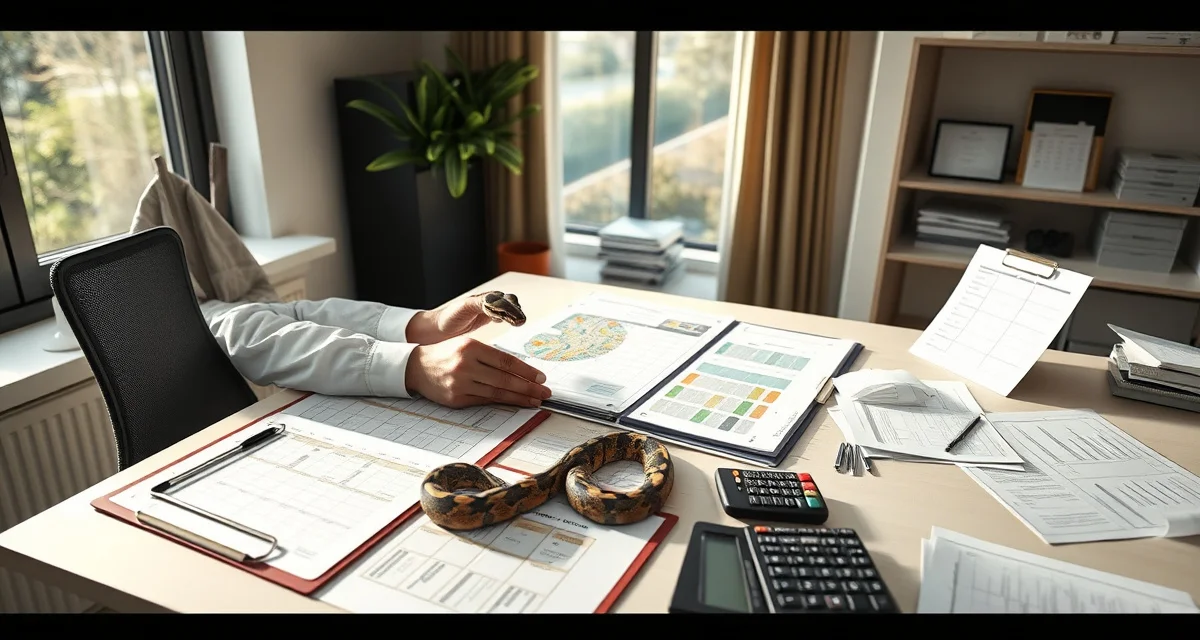
Ball Python Breeding Project Planning
Most failed or underperforming ball python breeding projects have one thing in common: they weren't planned. The breeder had a nice pair of animals, threw them together in October, and hoped for the best. No financial targets, no genetic outcome goals, no timeline. By March they had a clutch they couldn't sell because the market didn't want what they produced.
TL;DR
- Ball python breeding operations require systematic record-keeping from pre-season preparation through end-of-season sales.
- Females at 1,200-1,500g or more are the target weight before introducing them to a breeding male.
- Ovulation detection is the key event that anchors pre-lay shed and lay date calculations.
- Clutch profitability guide depends on understanding actual cost basis per animal, not just gross sale revenue.
- Well-documented animals with complete feeding histories and clear genetic records consistently sell faster and at higher prices.
Good project planning changes that. Here's how to structure a ball python breeding project from initial concept through first-season execution.
Step 1: Define Your Target Animal
Before you buy a single breeder, decide what you're trying to produce. Be specific. "Nice ball pythons" is not a plan. "Pastel Clown females in the $800-$1,400 range" is a plan.
Your target animal determines:
- Which foundation genetics guide you need
- How many seasons before you see your first visual
- What your price floor and ceiling are
- Who your buyer is
Clown projects are reliable, established markets. Pied projects are similar. More exotic targets (Scaleless, new double recessives) take longer and require niche buyer relationships.
Project Types by Timeline
1-2 season projects:
- Co-dom combo projects (Pastel x Enchi, GHI x Mojave, etc.)
- Visual recessive x het pairings to produce visual offspring in season 1
- Super form production from proven co-dom animals
2-4 season projects:
- Het x het recessive projects (Clown, Pied, Axanthic)
- Co-dom + recessive combinations building from het foundation
4+ season projects:
- Double recessive projects (Clown Pied, Albino Clown, Axanthic Pied)
- Scaleless and other rare recessive combinations
Step 2: Assess Your Current Inventory
List every animal you currently have that could contribute to the project. For each animal, record:
- Species and sex
- Morph / genes (visual, proven het, possible het)
- Current weight and age
- Estimated breeding-ready date (females should be 1,500g+ minimum, ideally 1,700g)
- Acquisition cost
This inventory is your starting point. In HatchLedger, enter every animal before planning any pairings. The system connects animals to pairings and offspring through the lineage engine, but only if the animals are in the database first.
Step 3: Identify Genetic Gaps
Compare your target animal against your inventory. What genes are you missing?
If your target is Enchi Clown and you have:
- 2 female Enchis (no Clown)
- 1 male het Clown (no Enchi)
Your gap is: female het Clown or female Enchi het Clown. You need to acquire one.
Price out the gaps. A female Enchi het Clown from a reputable source might cost $400-$700. That's your acquisition budget for this season.
Step 4: Build the Financial Model
Every breeding project is a business decision. Before you start, know:
Input costs:
- Acquisition cost of foundation animals
- Ongoing feeding costs ($30-$60/year per adult on rats)
- Housing costs per animal
- Utilities (electricity for rack heating)
- Incubation equipment if you don't already have it
Expected output:
- Clutch size estimate (4-8 eggs typical)
- Expected phenotype distribution from your planned pairing
- Price per phenotype based on current market
Break-even analysis:
If your foundation animals cost $1,200 total and annual maintenance is $200, you need to generate at least $1,400 in year one to break even on the foundation. Most projects don't break even in year one, plan for that.
HatchLedger's budget calculator tracks cost per egg and cost per hatchling, giving you actual numbers rather than estimates as the project progresses.
Step 5: Plan the Pairing Schedule
Ball python breeding season runs October through March. Plan:
- Which females are going into each pairing
- Which males are breeding which females
- Introduction schedule (every 10-14 days)
- Rotation if a male is breeding multiple females
Note male capacity: a healthy adult male can breed 3-5 females per season without significant condition loss. Watch body weight. If a male loses more than 12% of body weight, rest him and feed him up before reintroducing.
Load your pairing schedule into HatchLedger's breeding season planner before October. Set expected window dates for each pair.
Step 6: Set Up Record Systems Before Season Starts
The worst time to set up a tracking system is when eggs are hatching and you have 30 hatchlings to process. Build your systems in August-September.
In HatchLedger:
- Enter all animals with full genetics
- Set up planned pairings
- Create incubator records
- Set hatch window alerts for expected clutch dates
The first lock happens fast. If you're not ready to record it, you'll miss it and your timeline calculations will be off.
Common Planning Mistakes
Breeding underweight females. A female under 1,500g is too small. Under 1,200g she can be seriously harmed by the nutritional demand of follicle development. Patience here saves you animals.
No market research. Know what your target animals are actually selling for before you commit to a project. MorphMarket listings and recent sales give you current data. Markets shift, Banana prices dropped 60% in three years as production increased. Don't build a project on 2020 price assumptions.
Single-project dependency. Running only one pairing per season means one bad clutch ruins your entire year. Run 3-5 pairings minimum once your collection allows it. Diversification of pairing outcomes protects annual revenue.
Ignoring het value. In recessive projects, the het offspring are your cash flow while you wait for visuals. Price and sell them properly, don't undersell hets because they "look normal."
FAQ
What is the best approach to ball python breeding project planning?
Start with the target animal and work backward. Know what you're trying to produce, what it sells for, what it costs to produce, and how many seasons before you see your first visual output. Write this down. Review it each season. Adjust based on market changes and actual results. Good planning isn't a one-time exercise, it's an ongoing management process.
How do professional breeders handle ball python breeding project planning?
Experienced breeders plan 2-3 seasons ahead for recessive projects and 1-2 seasons ahead for co-dom projects. They maintain a simple financial model tracking investment vs. revenue for each project, re-evaluate genetics purchases against market conditions annually, and use HatchLedger's budget calculator to track actual cost per hatchling against their projections.
Sources
- USARK (United States Association of Reptile Keepers)
- Association of Reptilian and Amphibian Veterinarians (ARAV)
- World of Ball Pythons (WoBP genetics reference database)
- MorphMarket (reptile industry marketplace)
- Reptiles Magazine (Bowtie Inc.)
Get Started with HatchLedger
Every part of a ball python breeding operation -- from pairing records to clutch documentation to financial tracking -- works better when the data is connected rather than scattered across notebooks and spreadsheets. HatchLedger is built for exactly that. Try it free with up to 20 animals.