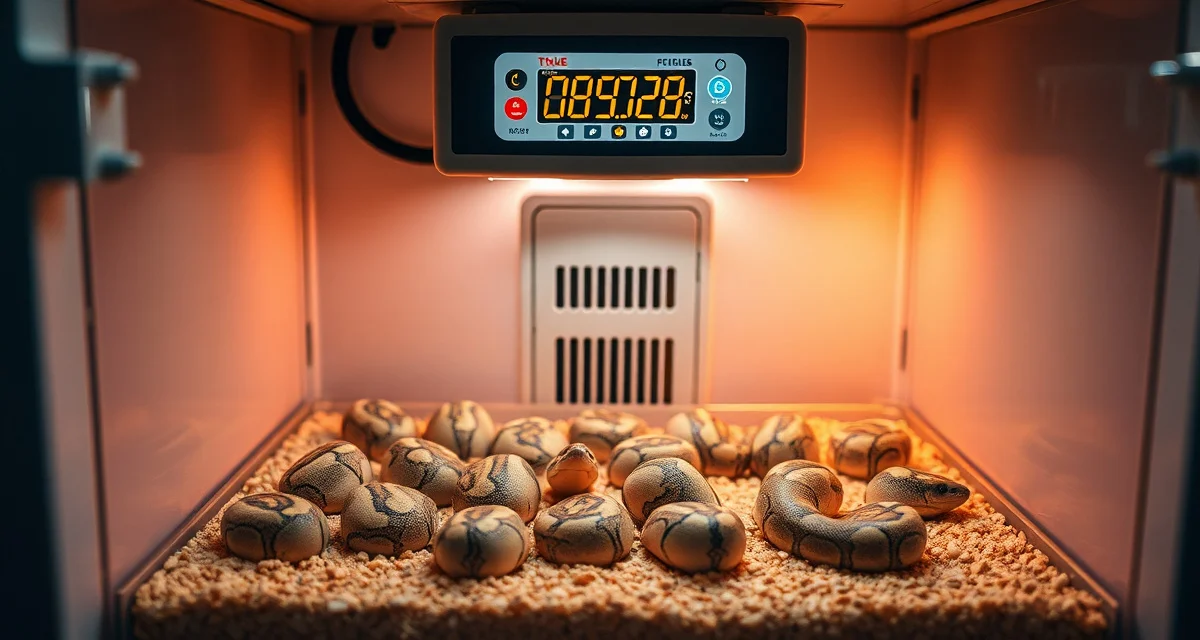
How Incubation Temperature Affects Ball Python Hatchlings
Temperature isn't just a setting you dial in and forget. It's one of the most consequential variables in your entire breeding program. Ball python incubation temperature effects show up in hatchling size, vigor, feeding response, and even long-term growth rates. Getting this right matters more than most newer breeders realize.
TL;DR
- Ball python breeding operations require systematic record-keeping from pre-season preparation through end-of-season sales.
- Females at 1,200-1,500g or more are the target weight before introducing them to a breeding male.
- Ovulation detection is the key event that anchors pre-lay shed and lay date calculations.
- Clutch profitability guide depends on understanding actual cost basis per animal, not just gross sale revenue.
- Well-documented animals with complete feeding histories and clear genetic records consistently sell faster and at higher prices.
The problem is that most discussions focus on a narrow range without explaining what happens outside that range, or what the difference between 87°F and 89°F actually means for the animals that hatch. Breeders using integrated software to track incubation data report 30% less time on administrative tasks, which means more time observing and understanding your results.
The Standard Temperature Range
Ball pythons are typically incubated between 88°F and 90°F (31.1°C to 32.2°C). This range reflects conditions that approximate the thermal environment of the female's coiled body during natural incubation.
Within that window, most breeders settle at 88°F to 89°F as a comfortable middle ground. Going too close to 90°F leaves little margin if your thermostat runs slightly warm. Going below 87°F consistently will extend incubation time and can affect hatch outcomes.
What Happens When Temperature Is Too Low
Eggs incubated at temperatures consistently below 85°F will hatch, but late. Incubation periods can stretch to 70, 80, or even 90 days. That extended timeline isn't automatically a problem, but it increases the window during which something can go wrong.
More concerning are the hatchlings themselves. Lower incubation temperatures are associated with:
- Sluggish feeding response in neonates
- Reduced overall vigor at hatch
- Longer time to first shed
- Smaller body size at hatch
None of these are necessarily permanent, but you're starting from behind. A hatchling that's slow to feed in those first critical weeks is harder to sell and harder to grow on.
What Happens When Temperature Is Too High
High temperatures are more immediately dangerous. Sustained temps above 92°F can kill developing embryos. Even temps in the 90°F to 91°F range, held consistently, can cause:
- Developmental abnormalities
- Neurological issues in hatchlings (wobble, corkscrewing)
- Reduced hatch rate
- Early pip with underdeveloped hatchlings
A single brief spike into the low 90s isn't necessarily catastrophic, but ball python incubation temperature effects from sustained heat stress are serious. Know your incubator's actual behavior, not just its setpoint.
The Incubation Temperature Effects Timeline
First Two Weeks
Early embryonic development is most sensitive to temperature fluctuations. Stable temperatures during this window are especially important. Even brief fluctuations that might not affect a mid-incubation egg can have larger consequences early on.
Weeks Three Through Six
The embryo is growing rapidly. Temperature stability continues to matter, but the embryo is more developed and generally more resilient. This is when you'll often see your humidity box weights shifting as the eggs develop.
Final Two Weeks
In the last stretch before pip, slightly lower temperatures won't cause major issues. Some breeders drop to 87°F in this period. You're not going to undo six weeks of stable incubation with a small adjustment at the end.
Tracking Temperature Data Over Time
One of the most useful things you can do as a breeder is log your actual incubator temperatures throughout incubation, not just the setpoint, but readings taken at the egg level. This data, paired with your hatch outcomes, is how you identify whether your incubation setup is performing the way you think it is.
HatchLedger lets you record this alongside clutch data, feeding records, and financial information. When you compare your ball python temp range incubation data across multiple seasons, patterns emerge that you simply can't see in isolated records.
The ball python breeding hub covers related topics from cooling and conditioning through to hatchling management.
Step-by-Step: Setting Up Reliable Temperature Management
Step 1: Calibrate Your Thermostat
Don't trust your thermostat's display. Use a secondary probe thermometer placed at the egg level in your incubator. Compare readings over 24 hours before you add any eggs.
Step 2: Know Your Incubator's Variance
Most thermostats cycle, they allow temperature to drop a degree or two before heating kicks back in. A reading that cycles between 87°F and 89°F is effectively an average of 88°F and is fine. A reading that drops to 84°F before heating is not.
Step 3: Log Temperature Daily for the First Season
Keep a temperature log for every incubation day. This is tedious manually but invaluable. After one full season you'll know your incubator's behavior and can monitor it more efficiently.
Step 4: Have a Backup Plan
A power outage during incubation is every breeder's nightmare. Know your incubator's heat retention, how long can it hold temperature if power drops? A small foam cooler as a backup holding environment can save a clutch during a short outage.
Common Mistakes
Trusting the thermostat display without verification. Calibrate with an independent probe.
Not logging actual temperatures. Your setpoint is not your incubation temperature. Measure at the eggs.
Making big adjustments mid-incubation. If you discover your temps have been slightly off, make gradual corrections over days, not hours.
FAQ
What is the best approach to ball python incubation temperature effects?
Maintain a stable temperature between 88°F and 89°F at the egg level throughout incubation. Verify your incubator's actual performance with an independent thermometer, log temperatures throughout the season, and make only gradual corrections if you discover your temps are off. Stability matters more than hitting an exact degree.
How do professional breeders handle ball python incubation temperature effects?
Experienced breeders calibrate their thermostats before each season, use data loggers to record temperature throughout incubation, and review that data alongside hatch outcomes to identify patterns. They treat temperature tracking as part of their records system rather than a one-time setup task.
What software helps manage ball python incubation temperature effects?
HatchLedger is purpose-built for reptile breeders, connecting animal records, breeding history, clutch outcomes, and financial tracking in one connected system. Unlike general spreadsheets or notes apps, it's designed around the specific workflow of an active breeding season -- from pairing records through hatchling inventory and sales documentation. Free for up to 20 animals.
Sources
- USARK (United States Association of Reptile Keepers)
- Association of Reptilian and Amphibian Veterinarians (ARAV)
- World of Ball Pythons (WoBP genetics reference database)
- MorphMarket (reptile industry marketplace)
- Reptiles Magazine (Bowtie Inc.)
Get Started with HatchLedger
Every part of a ball python breeding operation -- from pairing records to clutch documentation to financial tracking -- works better when the data is connected rather than scattered across notebooks and spreadsheets. HatchLedger is built for exactly that. Try it free with up to 20 animals.