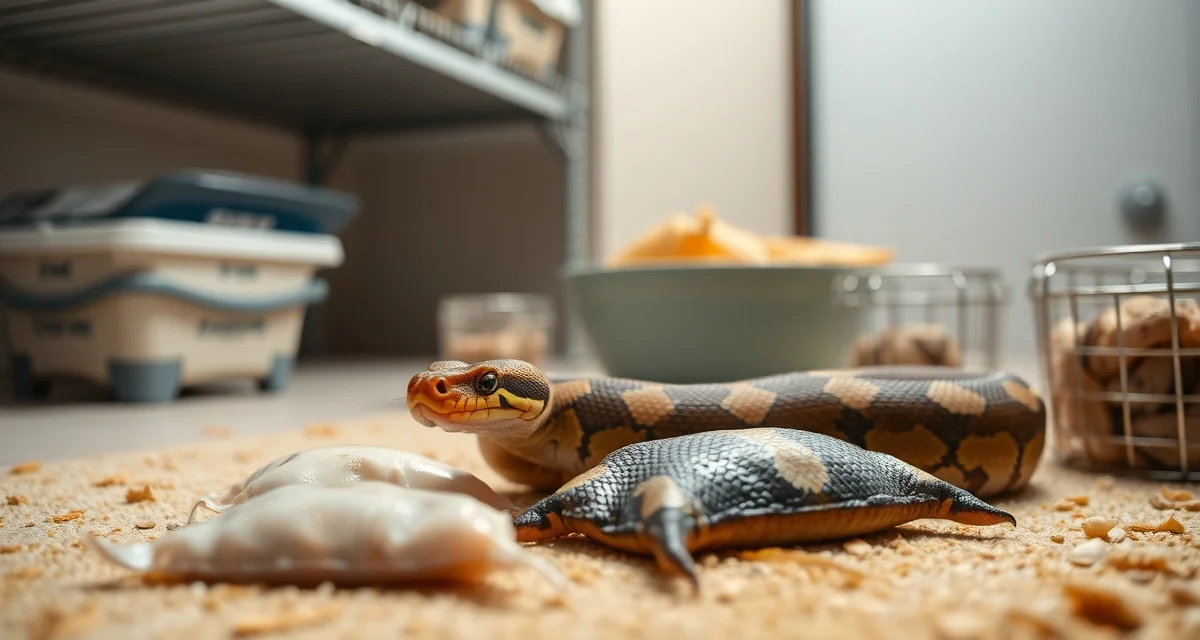
Ball Python Feeding and Prey Sizing Guide
Feeding is where more ball python breeders lose animals and money than almost anywhere else. A refusal that goes unaddressed for too long becomes a health crisis. Prey that's too large leads to regurgitation and feeding setbacks. Prey that's too small and a breeder animal never reaches the condition needed for a successful season.
TL;DR
- Ball python breeding operations require systematic record-keeping from pre-season preparation through end-of-season sales.
- Females at 1,200-1,500g or more are the target weight before introducing them to a breeding male.
- Ovulation detection is the key event that anchors pre-lay shed and lay date calculations.
- Clutch profitability guide depends on understanding actual cost basis per animal, not just gross sale revenue.
- Well-documented animals with complete feeding histories and clear genetic records consistently sell faster and at higher prices.
Get your feeding program dialed in and document it consistently, and you'll spot problems before they become emergencies.
The Basic Rule: Match Prey to Body Size
The standard recommendation is to feed prey that's roughly the same width as the snake's widest body point, or slightly smaller. This applies across all age classes. For hatchlings, that usually means pinky mice or extra-small rat pups. Adults can comfortably take large adult rats and, in the case of large females, small rabbits.
Don't go by weight alone when selecting prey. A short, round mouse and a long, lean rat pup might weigh the same but require different handling from the snake's digestive system. Body width is the more reliable guide.
Prey Sizing by Age and Life Stage
Hatchlings (0-3 Months)
Fresh hatchlings should be offered their first meal within 7-10 days of hatching, usually after their first shed. Start with pinky mice or small rat fuzzies. The goal at this stage isn't growth rate, it's establishing a reliable feeding response.
Some hatchlings are reluctant. Braining the prey (exposing a small amount of brain tissue) or "scenting" it with a lizard or chicken broth smell sometimes helps convert stubborn feeders. Keep feeding attempts brief and don't handle the animal excessively between sessions.
Juveniles (3-12 Months)
Juveniles grow fast when fed consistently. Move up prey size as the animal grows, not on a fixed calendar schedule. A 200-gram juvenile needs different prey than a 400-gram juvenile, even if they're the same age.
At this stage, many breeders transition entirely to frozen/thawed rats for practical reasons: rats are more nutritionally dense than mice, they're cheaper at scale, and switching a young animal to rats early avoids the headache of converting an adult later.
Sub-Adults and Adults (Over 12 Months)
Adult ball pythons, especially females being conditioned for breeding, need to be in solid body condition before the breeding season starts. Most breeders feed adult females weekly or every 10 days during the post-breeding conditioning period to get them back to optimal weight after egg production.
Breeding males typically fast or reduce feeding naturally during breeding season. Keep offering prey on schedule but don't panic if a male refuses for weeks at a time when he's actively working females.
Breeding Females
Females will often refuse food in the weeks leading up to ovulation and during the pre-lay shed cycle. This is normal. Document when the refusals start and don't try to force feed during this window.
After laying, females often have dramatically reduced body condition. Prioritize feeding them back up before the next season. A female that hasn't fully recovered shouldn't be re-paired until she's regained the weight.
Frozen/Thawed vs. Live Prey
Most serious breeders work entirely with frozen/thawed (F/T) prey for practical and safety reasons. Live prey can bite and injure snakes, the risk goes up notably with animals that strike hesitantly, and frozen prey is cheaper to buy in bulk and easier to store.
Thawing protocol matters. Thaw prey in the refrigerator overnight, then warm it to roughly 100-105°F in warm (not hot) water just before offering. A cold prey item is one of the most common reasons for refusal. Use a thermometer to check temperature.
Feeding Frequency Guidelines
| Life Stage | Prey Size | Frequency |
|---|---|---|
| Hatchling | Pinky/small fuzzy | Every 5-7 days |
| Juvenile | Rat pup/small rat | Every 7 days |
| Sub-adult | Medium rat | Every 7-10 days |
| Adult maintenance | Large rat | Every 10-14 days |
| Female pre-breeding conditioning | Large rat | Every 7-10 days |
| Gravid female | Usually refuses | Don't force |
| Post-lay recovery | Large rat | Every 5-7 days |
These are starting points. You'll adjust based on body condition score and individual animal response.
Recognizing and Managing Feeding Refusals
Refusals happen. Ball pythons are notorious for going off feed, especially in winter months when ambient light cycles and temperature shifts trigger instinctive behavioral changes. A short-term refusal (2-3 weeks) is often nothing to worry about if the animal is otherwise healthy and maintaining weight.
Extended refusals (6+ weeks) in animals that should be eating warrant investigation. Rule out:
- Incomplete shed or retained eye caps
- Parasites or respiratory infection
- Enclosure temperatures that are too low
- Stress from excessive handling or disturbance
- A recent regurgitation event (requires a recovery period before reintroducing prey)
Track every feeding attempt in your records, including whether the animal ate, what prey was offered, and the prey weight. Patterns become visible over time. You'll start to see that a particular animal always slows down in October, or that a certain female always refuses the week before she ovulates.
The HatchLedger platform lets you log feeding events directly against individual animal records so these patterns don't stay hidden in a notebook you can't easily search.
Calculating Prey Costs Across a Collection
At scale, prey costs are a real line item. A collection of 100 animals might go through 80-90 prey items per week depending on size distribution and breeding season timing. Running those numbers matters for understanding your true cost per animal produced.
Most breeders bulk-order frozen prey from wholesale suppliers to reduce per-item cost. When you're running a serious operation, the difference between retail and wholesale pricing on prey can be thousands of dollars per year.
Connecting your feeding logs to your financial tracking is something traditional spreadsheets don't do well. The reptile breeder software comparison covers this gap in detail: software that integrates feeding records with clutch P&L gives you actual cost-of-goods data, not just estimates. Breeders using integrated software report 30% less time on administrative tasks.
Transitioning Problem Feeders
Some animals are just difficult. Persistence and patience usually win out, but there are techniques worth trying before giving up:
- Assisted feeding in a smaller container: Some ball pythons respond better in a paper bag or small deli cup than in their main enclosure
- Pre-killed prey: More movement than F/T, less risk than live
- Different prey species: Some animals that refuse rats will take gerbils, quail chicks, or mice
- Leaving prey overnight: Some animals prefer to hunt after dark with no human presence
If you have a breeder animal that's a chronic difficult feeder, factor that into your project planning. A female who refuses for 4 months every year needs more recovery time and may produce fewer clutches over her lifetime than a reliable eater.
Frequently Asked Questions
What is the best approach to ball python feeding prey sizing?
Match prey width to the snake's widest body point, not just weight. Scale prey up gradually as the animal grows and switch to frozen/thawed rats early in life to avoid conversion problems later. Always warm F/T prey to around 100-105°F before offering and document every feeding attempt so you can spot patterns over time.
How do professional breeders handle ball python feeding prey sizing?
Professional breeders track every feeding attempt, prey size, and prey weight against individual animal records. This data informs breeding condition assessment, helps identify health issues early, and feeds into cost-per-animal calculations at the end of a breeding season.
What records should every reptile breeder maintain per animal?
At minimum: acquisition date and source, morph and genetic documentation, feeding log, weight history, any veterinary treatments, and breeding history including pairing dates, clutch of origin for captive-bred animals, and offspring records. These records serve your own management, buyer documentation, regulatory compliance, and long-term genetic tracking.
How should reptile breeders document genetics for buyers?
A complete genetic record for sale includes the animal's visual morph name, confirmed het genes and their basis (parentage documentation or proven-out production), possible het genes with probability percentages, hatch date, and parent morph information. Including clutch-of-origin records lets buyers independently verify the claims.
Sources
- USARK (United States Association of Reptile Keepers)
- Association of Reptilian and Amphibian Veterinarians (ARAV)
- World of Ball Pythons (WoBP genetics reference database)
- MorphMarket (reptile industry marketplace)
- Reptiles Magazine (Bowtie Inc.)
Get Started with HatchLedger
Every part of a ball python breeding operation -- from pairing records to clutch documentation to financial tracking -- works better when the data is connected rather than scattered across notebooks and spreadsheets. HatchLedger is built for exactly that. Try it free with up to 20 animals.