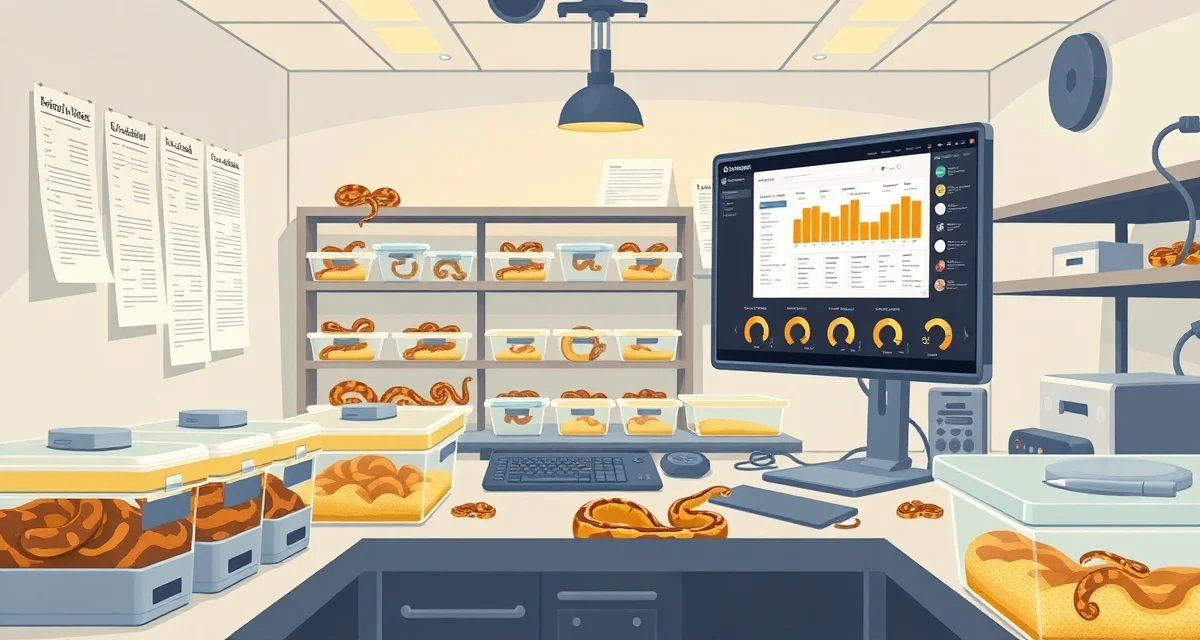
Ball Python Multi-Clutch Season Management: Planning Multiple Pairings
By HatchLedger Editorial Team · Published 2025-04-27 · Updated Mar 13, 2026
Breeders using integrated software report 30% less time on administrative tasks, and multi-clutch season management is where that efficiency gap between software users and spreadsheet users becomes most visible. When you have 10, 20, or 30 active pairings running simultaneously, the complexity of tracking each female's status, pairing history, and expected timeline is genuinely unmanageable without a systematic approach.
TL;DR
- Ball python breeding operations require systematic record-keeping from pre-season preparation through end-of-season sales.
- Females at 1,200-1,500g or more are the target weight before introducing them to a breeding male.
- Ovulation detection is the key event that anchors pre-lay shed and lay date calculations.
- Clutch profitability guide depends on understanding actual cost basis per animal, not just gross sale revenue.
- Well-documented animals with complete feeding histories and clear genetic records consistently sell faster and at higher prices.
Most intermediate breeders reach a point where their operation grows beyond what they can track by memory and basic spreadsheets. That's when multi-clutch season management becomes a skill in itself.
Planning the Season Before It Starts
Multi-clutch season management starts before cooling begins. Before you introduce any pairs, you should have:
A complete pairing plan: Every intended pairing documented: female, male, genetic goals, priority ranking. If you have more pairings planned than males available, you need to know which pairings to prioritize.
A cycling timeline: When each female starts the cooling protocol (not all need to start simultaneously), when you expect ovulations based on prior season data, when you expect eggs based on ovulation dates.
Incubation capacity planning: How many clutches can your incubator(s) handle at once? If you expect 15 clutches within a 3-week window, verify your incubation setup can handle that load.
Rack availability: How many rack positions are available for gravid females requiring individual pre-lay setups? Gravid females need appropriate space and a lay box; they shouldn't be crammed into spaces that make egg-laying difficult.
Managing Overlapping Breeding Timelines
Ball pythons in the same collection don't all follow identical timelines. Some females cycle faster; some males are more active at different temperatures. In a multi-female operation, you'll have females at different stages simultaneously:
- Some females in early cooling
- Some in active breeding with regular pairings
- Some post-ovulation waiting to lay
- Some incubating clutches
- Some already sold out from early clutches
This overlapping cycle requires a status system. Every female in the breeding program should have a clear current status that you can see at a glance.
Status categories:
- Cooling (in cycle, pre-ovulation)
- Active pairing (introductions ongoing)
- Ovulated (post-OV, pre-lay shed)
- Pre-lay shed (lay imminent)
- Gravid/ready to lay
- Eggs in incubator
- Done for season (back on normal maintenance feeding)
- Skipping season (rest year)
Without a status system, animals fall through cracks. A female who ovulated six weeks ago and still hasn't laid should be checked; she may need intervention. You won't notice if you're not tracking.
Male Management Across Multiple Females
Males are a bottleneck in multi-pairing operations. A single male can service multiple females, but not infinitely and not without management:
Rotation schedule: Each male should have a planned rotation schedule. If a male is being paired with four females, each female typically gets introductions on alternating weeks. The male gets rest days between pairings.
Male condition monitoring: Males that aren't eating or are losing weight during breeding season need to be pulled from rotation temporarily. A depleted male who goes off-feed for 6 weeks needs priority recovery. Track every male's weight through breeding season separately from the females.
Pairing logs: Every introduction should be logged: date, which female, duration, whether a lock was observed. With multiple males and multiple females, this log becomes essential. Without it, you lose track of which female got her last pairing from which male and whether she's been adequately serviced.
Ovulation Detection at Scale
In a multi-female operation, ovulation events happen throughout the season. You need a system for detecting them when you're not watching every animal every day.
Regular checks: Physical palpation of females every 7-10 days during the active breeding phase, looking for the characteristic mid-body swelling of a developing ovum. Once ovulation is detected, document the date immediately and shift that female's status to post-OV.
Weight as a proxy: A spike in weight without corresponding prey in the gut can indicate follicular development. Tracking weight regularly helps flag females approaching ovulation.
Once ovulation is detected, the clock starts: pre-lay shed typically 30-45 days post-OV, egg laying 7-30 days after the pre-lay shed. Knowing these windows for each female helps you stage incubator prep and nest box setup.
Incubation Coordination
When multiple clutches are laid within a 2-4 week window, incubation management becomes complex:
Container labeling: Every egg container in the incubator must be clearly labeled: female identity, clutch date, expected hatch window. No exceptions. Unlabeled clutches become a problem when you have 6 containers in the incubator.
Staggered checking schedule: Clutches laid 2 weeks apart should be checked on different schedules. Knowing which clutch is at day 30 and which is at day 45 helps you prioritize attention.
Hatch window overlap: If multiple clutches are hatching within the same week, you need enough individual containers to house each clutch separately as hatchlings emerge. Plan ahead.
Tracking Through HatchLedger
HatchLedger's breeding records give each female a current status that's visible across your collection view, pairing logs that connect every introduction to the correct animals, and clutch records linked to the ovulation dates and parent records.
The HatchLedger reptile breeder software lets you see all active breeding projects simultaneously without rebuilding context from scattered notes every time you check in on the operation.
Frequently Asked Questions
What is the best approach to managing multiple concurrent ball python breeding pairings?
Create a status system for every female in the breeding program, maintain pairing logs for every male introduction, track male condition separately from females, and plan incubation capacity before the season starts. Software that shows every animal's current status at a glance reduces the mental overhead of managing overlapping timelines.
How do professional breeders handle multi-clutch season management?
Production breeders plan the entire season before introducing any pairs, assign status categories to every breeding animal and update them at each change, maintain male rotation schedules to avoid depleting males servicing multiple females, and use digital records to track pairing history per female throughout the season.
What records should every reptile breeder maintain per animal?
At minimum: acquisition date and source, morph and genetic documentation, feeding log, weight history, any veterinary treatments, and breeding history including pairing dates, clutch of origin for captive-bred animals, and offspring records. These records serve your own management, buyer documentation, regulatory compliance, and long-term genetic tracking.
How should reptile breeders document genetics for buyers?
A complete genetic record for sale includes the animal's visual morph name, confirmed het genes and their basis (parentage documentation or proven-out production), possible het genes with probability percentages, hatch date, and parent morph information. Including clutch-of-origin records lets buyers independently verify the claims.
What is Ball Python Multi-Clutch Season Management: Planning Multiple Pairings?
Ball python multi-clutch season management is the practice of systematically planning, tracking, and executing multiple breeding pairings within a single season. It covers everything from pre-season female conditioning and pairing schedules to ovulation detection, clutch monitoring, and end-of-season sales tracking. As operations grow beyond a handful of females, informal tracking breaks down—multi-clutch management provides the structured approach needed to maintain accurate records across 10, 20, or 30 simultaneous pairings without losing critical data.
How much does Ball Python Multi-Clutch Season Management: Planning Multiple Pairings cost?
Multi-clutch season management as a practice costs nothing beyond your time, but breeders typically invest in dedicated reptile breeding software to make it viable at scale. Software platforms like HatchLedger offer subscription-based pricing that replaces error-prone spreadsheets. The ROI is measurable: integrated software users report spending roughly 30% less time on administrative tasks, and well-documented animals with complete records consistently sell faster and at higher prices, directly offsetting subscription costs.
How does Ball Python Multi-Clutch Season Management: Planning Multiple Pairings work?
Multi-clutch season management works by anchoring every female's timeline to key biological events. You track each female's weight and conditioning before pairing, log pairing dates and observed copulations, monitor for ovulation, then calculate expected pre-lay shed and lay dates from that ovulation event. With multiple females at different stages simultaneously, a centralized system flags what needs attention each day—which females to pair, which are approaching lay, and which clutches are ready to pull.
What are the benefits of Ball Python Multi-Clutch Season Management: Planning Multiple Pairings?
The core benefits are reduced administrative time, fewer missed critical events, and higher sale prices. Systematic records let you identify which pairings produce the most profitable clutches, calculate true cost basis per animal rather than relying on gross revenue estimates, and present buyers with complete feeding and genetic histories. Breeders with organized records close sales faster because buyers trust documented animals. At scale, the difference between systematic and informal tracking is the difference between a manageable operation and a chaotic one.
Who needs Ball Python Multi-Clutch Season Management: Planning Multiple Pairings?
Any ball python breeder running more than a handful of active pairings in a season needs structured multi-clutch management. Hobbyists with one or two females can track by memory, but intermediate and advanced breeders with 10 or more pairings will quickly find that mental tracking leads to missed ovulations, forgotten pairing dates, and inaccurate cost calculations. Commercial breeders and anyone scaling toward a profitable reptile business benefit most, as documentation quality directly impacts resale value and operational efficiency.
How long does Ball Python Multi-Clutch Season Management: Planning Multiple Pairings take?
A full multi-clutch ball python season typically runs five to seven months from initial cooling through final hatchling sales. Pre-season conditioning and cooling begins in the fall, pairings are introduced in late fall or winter, ovulation occurs one to three months into pairing, and eggs are laid roughly 30 days post-ovulation. Incubation adds another 55 to 60 days before hatching. Administrative planning—building your tracking system and pairing schedule—should begin at least four to six weeks before cooling starts.
Related Articles
- Ball Python Wintertime Breeding Season Management: Cold Weather Husbandry Guide
- Ball Python Off-Season Collection Management: Maintaining Your Animals Between Breeding Seasons
Sources
- USARK (United States Association of Reptile Keepers)
- Association of Reptilian and Amphibian Veterinarians (ARAV)
- World of Ball Pythons (WoBP genetics reference database)
- MorphMarket (reptile industry marketplace)
- Reptiles Magazine (Bowtie Inc.)
Get Started with HatchLedger
Every part of a ball python breeding operation -- from pairing records to clutch documentation to financial tracking -- works better when the data is connected rather than scattered across notebooks and spreadsheets. HatchLedger is built for exactly that. Try it free with up to 20 animals.