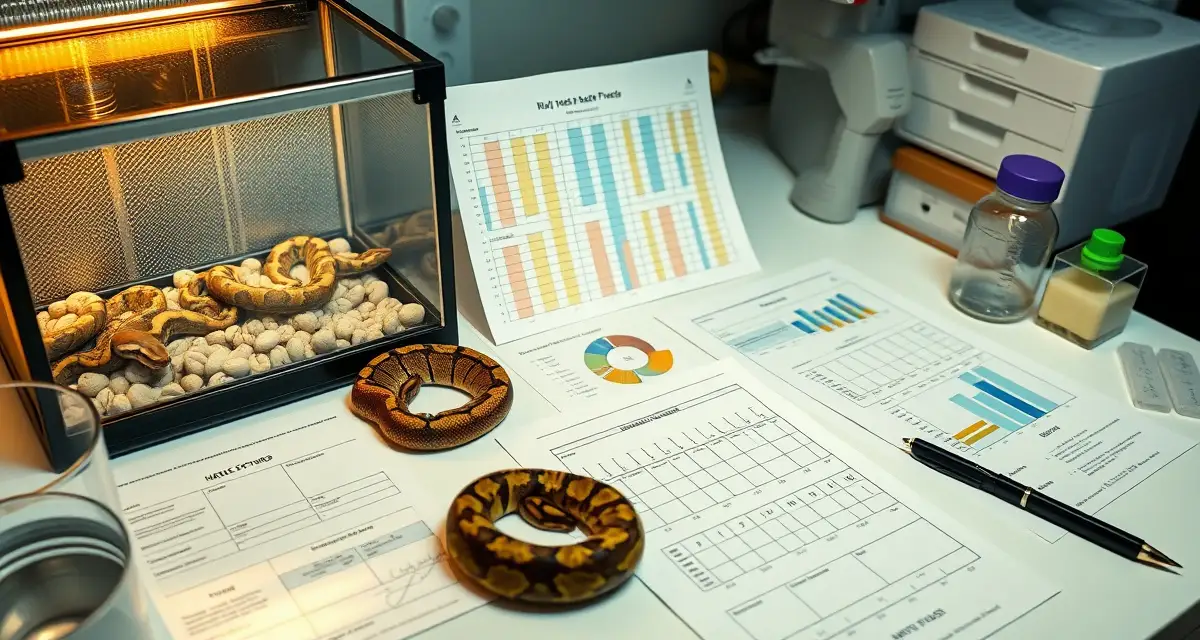
Tracking Lifetime Production Per Ball Python Female
One of the most valuable datasets in a long-running breeding program is the complete lifetime production record for each breeding female. How many clutches has she produced? How many viable offspring over her career? What was her average clutch size, and did it peak and then decline? This longitudinal data drives breeding decisions, retirement decisions, and helps you understand which females are your most productive assets. Breeders using integrated software report 30% less time on administrative tasks, giving you the time to maintain the complete records that make lifetime tracking possible.
TL;DR
- Ball python breeding operations require systematic record-keeping from pre-season preparation through end-of-season sales.
- Females at 1,200-1,500g or more are the target weight before introducing them to a breeding male.
- Ovulation detection is the key event that anchors pre-lay shed and lay date calculations.
- Clutch profitability guide depends on understanding actual cost basis per animal, not just gross sale revenue.
- Well-documented animals with complete feeding histories and clear genetic records consistently sell faster and at higher prices.
Why Lifetime Production Records Matter
Breeding decisions: A female with a strong production history (consistent clutches, high hatch rates, good clutch sizes) is an animal worth investing in with premium males and high-value pairings. A female with declining production or inconsistent clutch quality may need a different approach.
Retirement decisions: At some point, every breeding female's production declines to where the cost of housing, feeding, and the health risks of continued breeding outweigh the value she produces. Knowing her lifetime production helps you make this call based on data rather than sentiment.
Program evaluation: Which females have been your most productive assets over their careers? This tells you what to look for in your next generation of breeding animals.
Health context: A female whose production suddenly declines from her historical pattern may have an emerging health issue worth investigating. Her lifetime record provides the context to recognize a change as abnormal.
What to Track Per Breeding Season
For each breeding season, for each female:
- Season dates (when paired first, when she laid)
- Number of pairings attempted
- Number of pairings with confirmed locks
- Ovulation date (if observed)
- Pre-lay shed date
- Lay date
- Total egg count (fertile + slugs)
- Fertile egg count
- Hatch count (how many fertile eggs produced live hatchlings)
- Female's weight at lay and post-lay recovery weight
- Any health events during the season
This per-season record, repeated across multiple years, builds the lifetime production profile.
Calculating Key Production Metrics
From your lifetime records, you can calculate:
Average clutch size: Total fertile eggs / number of clutches. This is your baseline for what this female typically produces.
Average hatch rate: Total hatchlings / total fertile eggs across all clutches. Hatch rates below 75-80% consistently may indicate incubation or fertility issues worth investigating.
Peak production years: Which seasons did she produce her largest clutches? Is there a pattern to her best years (good conditioning, specific male, specific season timing)?
Slug rate trends: Is her slug rate increasing over time? Increasing slug rates in an established female may indicate declining reproductive efficiency as she ages.
Recovery trajectory: How quickly does she return to pre-breeding weight each season? Is that timeline getting longer?
When Production Data Signals a Problem
Some patterns in lifetime production records are early warnings worth acting on:
- Clutch size declining over 2-3 consecutive seasons without an obvious husbandry cause
- Hatch rates declining despite consistent incubation practices
- Recovery time increasing season over season
- Increasing slug rates in a female who previously produced clean clutches
- Repeated breeding season health issues
These patterns may indicate age-related reproductive decline, underlying health issues, or husbandry problems. The earlier you identify them, the better your options for responding.
Lifetime Production and Retirement Decisions
At some point, the data will support a retirement decision. Signs a breeding female should be retired:
- Average clutch size has declined to a point where her production doesn't justify her care costs
- Repeated health complications during or after breeding seasons
- Very high slug rates consistently over multiple seasons
- Age-related indicators (significantly reduced feeding response, poor muscle tone, marked weight changes) suggesting general health decline
Retirement doesn't mean euthanasia. Many retired breeding animals can become low-maintenance pets or be placed with experienced keepers who want adult animals.
Keep complete lifetime production records in HatchLedger's breeding management system, where each season's data connects to the animal's full history. For tools that support longitudinal production tracking, see the reptile breeder software comparison.
Frequently Asked Questions
What is the best approach to tracking lifetime ball python female production records?
Record the same consistent data points for every breeding season: clutch size, hatch rate, female weight at lay, and recovery timeline. Calculate running averages and trends after each season. Review the full production history annually when making decisions about which females to breed the coming season and when to retire animals. A female's lifetime record, not any single season's performance, should drive these decisions.
How do professional breeders handle lifetime production tracking for breeding females?
Established breeders maintain complete seasonal records for every breeding female and review the accumulated history when making program decisions. They've often seen clear patterns in how female production evolves over a career: increasing output in the first few seasons, a productive peak in the middle years, and eventual decline. Recognizing where each female is in this trajectory helps them make better decisions about when to breed, when to hold off, and when to retire.
What software helps manage ball python lifetime female production records?
HatchLedger is purpose-built for reptile breeders, connecting animal records, breeding history, clutch outcomes, and financial tracking in one system. Unlike generic spreadsheets, it's designed around the specific workflow of an active breeding season. Free for up to 20 animals.
What records should every reptile breeder maintain per animal?
At minimum: acquisition date and source, morph and genetic documentation, feeding log, weight history, any veterinary treatments, and breeding history including pairing dates, clutch of origin for captive-bred animals, and offspring records. These records serve your own management, buyer documentation, regulatory compliance, and long-term genetic tracking.
How should reptile breeders document genetics for buyers?
A complete genetic record for sale includes the animal's visual morph name, confirmed het genes and their basis (parentage documentation or proven-out production), possible het genes with probability percentages, hatch date, and parent morph information. Including clutch-of-origin records lets buyers independently verify the claims.
Sources
- USARK (United States Association of Reptile Keepers)
- Association of Reptilian and Amphibian Veterinarians (ARAV)
- World of Ball Pythons (WoBP genetics reference database)
- MorphMarket (reptile industry marketplace)
- Reptiles Magazine (Bowtie Inc.)
Get Started with HatchLedger
Every part of a ball python breeding operation -- from pairing records to clutch documentation to financial tracking -- works better when the data is connected rather than scattered across notebooks and spreadsheets. HatchLedger is built for exactly that. Try it free with up to 20 animals.