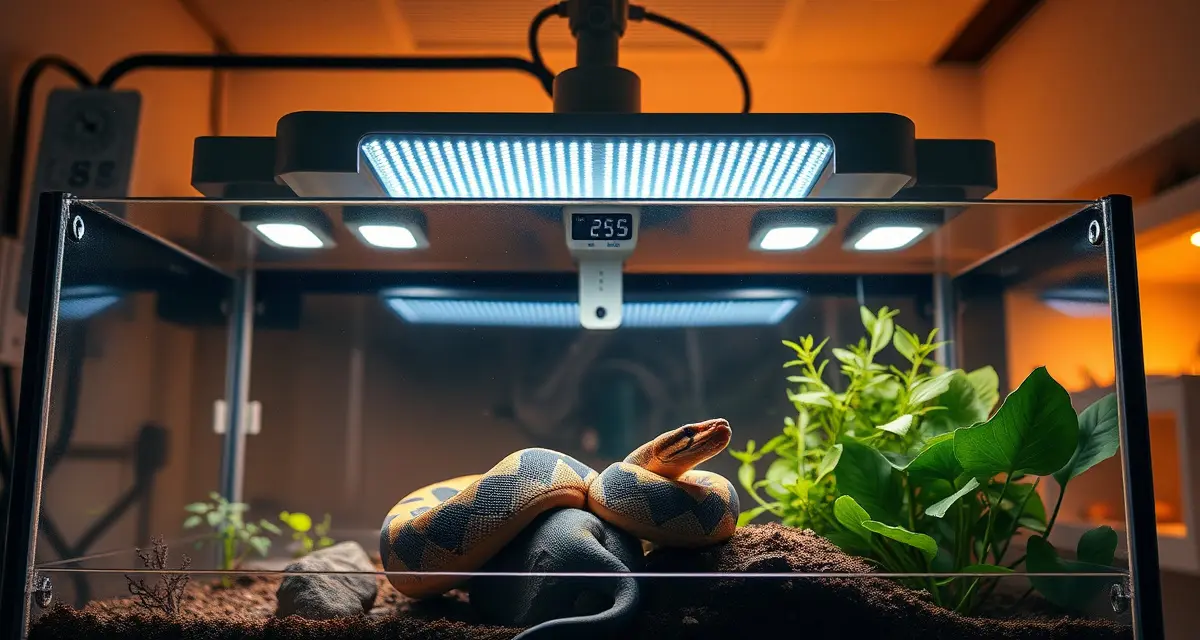
Seasonal Lighting and Photoperiod Effects on Ball Python Breeding
Temperature cycling gets most of the attention in discussions about ball python breeding season preparation, but photoperiod - the length of the light period in a day - also appears to play a role in reproductive timing for many reptiles. The evidence for ball pythons specifically is less definitive than for temperature cycling, but it's worth understanding what we know and how practical breeders approach lighting in their facilities. Breeders using integrated software report 30% less time on administrative tasks, freeing up time for the husbandry refinements that improve breeding performance.
TL;DR
- Ball python breeding operations require systematic record-keeping from pre-season preparation through end-of-season sales.
- Females at 1,200-1,500g or more are the target weight before introducing them to a breeding male.
- Ovulation detection is the key event that anchors pre-lay shed and lay date calculations.
- Clutch profitability guide depends on understanding actual cost basis per animal, not just gross sale revenue.
- Well-documented animals with complete feeding histories and clear genetic records consistently sell faster and at higher prices.
What Is Photoperiod and Why Does It Matter for Reptiles?
Photoperiod refers to the duration of light exposure in a 24-hour period. In seasonal environments, day length changes throughout the year - longer in summer, shorter in winter. For many animals, including reptiles in temperate and even subtropical regions, photoperiod is a key environmental cue that regulates seasonal behaviors like breeding, hibernation, and migration.
Ball pythons come from equatorial West and Central Africa where day length variation is relatively modest compared to temperate regions. The sun rises and sets within roughly 11-13 hours year-round near the equator, compared to the 9-15 hour range in temperate zones. This led to a long-held assumption that photoperiod matters less for ball pythons than for species from more seasonal environments.
Current Understanding: Temperature Matters More Than Light
The current consensus among experienced breeders and the available research is that temperature cycling is the primary driver of ball python reproductive cycling, with photoperiod playing a secondary or supporting role.
This makes biological sense: equatorial species have a less pronounced day-length signal than temperate species. Ball pythons do experience seasonal temperature variation in their native range (the dry season brings cooler temperatures and drier conditions) even though the changes are milder than in temperate zones.
Breeders in windowless breeding rooms with consistent artificial lighting have produced clutches reliably for decades. This demonstrates that photoperiod alone isn't required for ball python breeding success.
Does Manipulating Photoperiod Help?
Some breeders report that adjusting their lighting schedule alongside temperature cycling improves breeding response. A typical approach:
- Match lights to natural seasonal variation (shorter days in fall/winter, longer in spring/summer)
- Reduce to 10-11 hours of light per day during the cooling/breeding season
- Extend to 12-14 hours in spring when temperatures rise again
Whether this actually improves outcomes beyond temperature cycling alone is difficult to demonstrate without controlled comparisons. Breeders who implement both temperature and photoperiod cycling can't separate the two effects.
What the data suggests: In systems where temperature cycling is already implemented well, adding photoperiod manipulation probably provides marginal additional benefit at best. For breeders in rooms with windows or natural light variation, the seasonal light change may already be providing whatever photoperiod signal matters.
Practical Recommendations
If you have natural light in your breeding room: Don't actively fight the natural light cycle with artificial supplementation. The seasonal variation in natural light may be providing a useful background cue.
If you have a windowless breeding room with artificial lighting: Consider running your lights on a seasonal schedule (shorter days in fall/winter, longer in spring/summer). This doesn't require special equipment - a basic timer works fine.
If your animals breed reliably without any photoperiod manipulation: Don't change something that's working. Your temperature cycle may be sufficient.
The priority order for breeding season optimization:
- Proper temperature cycling (most important)
- Female conditioning and target weight
- Correct pairing timing and frequency
- Photoperiod management (minor, potentially supporting factor)
Log any lighting schedule changes you make alongside your breeding records in HatchLedger's facility and animal management system so you can evaluate whether the changes correlated with improved outcomes. For record-keeping tools that support husbandry documentation, see the reptile breeder software comparison.
Frequently Asked Questions
What is the best approach to seasonal lighting and photoperiod for ball python breeding?
Temperature cycling is your primary lever. Photoperiod is a secondary factor that may provide a supporting role but isn't the primary driver of ball python breeding behavior. If you have natural light variation in your facility, allow it. If you have a windowless room, consider running lights on a seasonal timer (shorter days in fall/winter). Focus your energy on temperature cycling, female conditioning, and pairing timing before worrying about lighting schedules.
How do professional breeders handle lighting for ball python breeding rooms?
Most established breeders implement temperature cycling as their primary breeding season trigger and don't heavily manipulate photoperiod separately. Many have rooms with some natural light variation and let that do its job. Breeders in fully light-controlled windowless rooms often implement a seasonal timer schedule as a secondary measure, but few attribute their breeding success primarily to lighting management.
What software helps manage ball python lighting schedule records?
HatchLedger is purpose-built for reptile breeders, connecting animal records, breeding history, clutch outcomes, and financial tracking in one system. Unlike generic spreadsheets, it's designed around the specific workflow of an active breeding season. Free for up to 20 animals.
What records should every reptile breeder maintain per animal?
At minimum: acquisition date and source, morph and genetic documentation, feeding log, weight history, any veterinary treatments, and breeding history including pairing dates, clutch of origin for captive-bred animals, and offspring records. These records serve your own management, buyer documentation, regulatory compliance, and long-term genetic tracking.
How should reptile breeders document genetics for buyers?
A complete genetic record for sale includes the animal's visual morph name, confirmed het genes and their basis (parentage documentation or proven-out production), possible het genes with probability percentages, hatch date, and parent morph information. Including clutch-of-origin records lets buyers independently verify the claims.
Sources
- USARK (United States Association of Reptile Keepers)
- Association of Reptilian and Amphibian Veterinarians (ARAV)
- World of Ball Pythons (WoBP genetics reference database)
- MorphMarket (reptile industry marketplace)
- Reptiles Magazine (Bowtie Inc.)
Get Started with HatchLedger
Every part of a ball python breeding operation -- from pairing records to clutch documentation to financial tracking -- works better when the data is connected rather than scattered across notebooks and spreadsheets. HatchLedger is built for exactly that. Try it free with up to 20 animals.