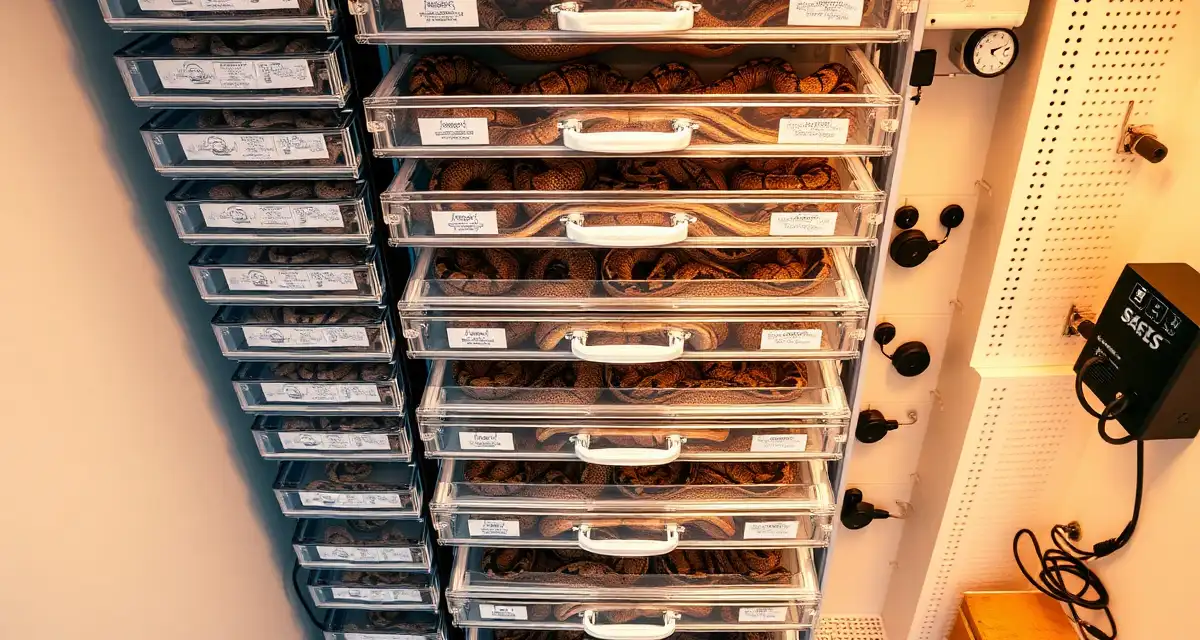
Rack System Management for Ball Python Breeding Collections
Rack systems are the standard housing solution in professional and semi-professional ball python breeding operations. They allow large numbers of animals to be housed efficiently in a limited space with consistent environmental conditions. But a rack system that isn't managed correctly creates problems at scale - temperature inconsistency, hygiene failures, and organizational chaos that makes tracking animals difficult. Breeders using integrated software report 30% less time on administrative tasks, which is especially meaningful when you're managing 30 or more animals in a rack environment.
TL;DR
- Ball python breeding operations require systematic record-keeping from pre-season preparation through end-of-season sales.
- Females at 1,200-1,500g or more are the target weight before introducing them to a breeding male.
- Ovulation detection is the key event that anchors pre-lay shed and lay date calculations.
- Clutch profitability guide depends on understanding actual cost basis per animal, not just gross sale revenue.
- Well-documented animals with complete feeding histories and clear genetic records consistently sell faster and at higher prices.
Why Racks Work for Breeding Programs
A well-designed rack system provides:
- Space efficiency: Multiple tubs stacked in the space that would house one or two individual terrariums
- Temperature consistency: Heat tape or heat cable running along each tub level provides consistent belly heat without the variable output of individual heat mats
- Ease of feeding and cleaning: Tub access is straightforward, and paper towel substrate is standard in racks for easy cleaning
- Visual management: Animals can be checked quickly by sliding each tub out to observe condition and food response
The tradeoff is reduced enrichment and space compared to large naturalistic enclosures. For breeding operations where the priority is reliable, healthy animals managed efficiently, racks represent a pragmatic choice that most professional breeders have made.
Temperature Control in Rack Systems
The most critical aspect of rack management is temperature. Common approaches:
Heat tape: Runs along a specific depth position in the tub slide slot, contacting the bottom of the tub. The fraction of the tub floor directly over the tape is warm; the rest is ambient temperature.
Proportional thermostats: The gold standard for rack temperature control. These adjust heating output proportionally rather than simply switching on/off, which reduces temperature swings. Essential for larger racks where a single thermostat controls multiple levels.
Probe placement: Your thermostat probe must be in the right position - at tub level, in the zone being controlled. Probes at the top of the rack or in ambient air don't accurately represent tub-level temperatures.
Verification: Periodically check actual tub temperatures with an independent thermometer. Racks can develop hotspots or cold zones as heat tape ages. A tub that should be 88°F on the warm side at 78°F on the cool side needs to actually be at those temperatures, not what you assume the thermostat produces.
Hygiene Management
Paper towel substrate in rack tubs is standard because it allows quick visual inspection and efficient cleaning.
Spot cleaning: Remove soiled paper towels and replace as needed. Every 7-10 days minimum for most animals.
Full tub cleaning: Remove the animal, remove all substrate and furnishings, wash the tub with appropriate disinfectant, dry thoroughly, and re-setup. Monthly is a reasonable minimum, more frequently if the animal has any health issues.
Water bowls: Change water every 2-3 days. Wash bowls with disinfectant weekly.
Mite prevention: Rack systems can become mite reservoirs if cleaning slips. Pay attention to the sliding rails and corners of tubs where mites hide. At the first sign of mites in any tub, treat the entire rack.
Organizational Systems for Multiple Animals
With 20-50 animals in a rack, organization is not optional. Common approaches:
Tub labeling: Label each tub position with the animal ID. Use durable, moisture-resistant labels. If you've moved an animal, update the label immediately.
Position maps: A photo or diagram of your rack layout, updated whenever animals are moved. Post it near the rack.
Animal ID tags inside tubs: A small card inside each tub with the animal's ID, sex, morph, and DOB. This gives you the critical information at a glance when you open a tub without needing to cross-reference elsewhere.
Digital records matched to physical positions: Every animal's record in HatchLedger's breeding management system should note their current rack position so you can find them from either direction - from the record to the rack, or from the rack to the record.
When Rack Animals Need More Than Rack Housing
Some situations call for moving animals out of the standard rack:
- Pre-lay females: Move to a larger enclosure with lay box
- Animals recovering from illness: May benefit from the ability to monitor more closely
- Animals requiring unusual husbandry: Some situations don't work well in standard rack tub sizes
Planning for these temporary relocations is part of rack management. Know where additional housing is available before you need it.
For how tools support rack-based collection management, see the reptile breeder software comparison.
Frequently Asked Questions
What is the best approach to managing a ball python rack system in a breeding program?
Verify temperatures at tub level independently of your thermostat display. Maintain a consistent cleaning schedule (spot clean as needed, full clean monthly minimum). Label every tub position and keep labels updated when animals move. Match your physical rack organization to your digital records so you can find any animal from either direction. Inspect heat tape annually and replace on any sign of deterioration.
How do professional breeders handle large rack system management for ball pythons?
Established breeders with large racks typically have systematic weekly schedules for cleaning, water changes, and animal checks. They verify rack temperatures periodically and respond to any thermostat or heat tape issues immediately because temperature failures can affect many animals at once. They use a consistent animal ID system that links physical tub labels to digital records so they can manage population tracking at scale without relying on memory.
What software helps manage ball python rack system and animal location records?
HatchLedger is purpose-built for reptile breeders, connecting animal records, breeding history, clutch outcomes, and financial tracking in one system. Unlike generic spreadsheets, it's designed around the specific workflow of an active breeding season. Free for up to 20 animals.
What records should every reptile breeder maintain per animal?
At minimum: acquisition date and source, morph and genetic documentation, feeding log, weight history, any veterinary treatments, and breeding history including pairing dates, clutch of origin for captive-bred animals, and offspring records. These records serve your own management, buyer documentation, regulatory compliance, and long-term genetic tracking.
How should reptile breeders document genetics for buyers?
A complete genetic record for sale includes the animal's visual morph name, confirmed het genes and their basis (parentage documentation or proven-out production), possible het genes with probability percentages, hatch date, and parent morph information. Including clutch-of-origin records lets buyers independently verify the claims.
Sources
- USARK (United States Association of Reptile Keepers)
- Association of Reptilian and Amphibian Veterinarians (ARAV)
- World of Ball Pythons (WoBP genetics reference database)
- MorphMarket (reptile industry marketplace)
- Reptiles Magazine (Bowtie Inc.)
Get Started with HatchLedger
Every part of a ball python breeding operation -- from pairing records to clutch documentation to financial tracking -- works better when the data is connected rather than scattered across notebooks and spreadsheets. HatchLedger is built for exactly that. Try it free with up to 20 animals.