Managing Multiple Ball Python Clutches in One Season
Once your breeding program expands beyond one or two pairs, you'll find yourself managing multiple clutches at overlapping stages of incubation simultaneously. Organization becomes critical. Without a clear system, it's easy to confuse which eggs belong to which clutch, miscalculate hatch windows, or miss check intervals. Breeders using integrated software report 30% less time on administrative tasks - and multi-clutch management is exactly where that time savings is most felt.
TL;DR
- Ball python breeding operations require systematic record-keeping from pre-season preparation through end-of-season sales.
- Females at 1,200-1,500g or more are the target weight before introducing them to a breeding male.
- Ovulation detection is the key event that anchors pre-lay shed and lay date calculations.
- Clutch profitability guide depends on understanding actual cost basis per animal, not just gross sale revenue.
- Well-documented animals with complete feeding histories and clear genetic records consistently sell faster and at higher prices.
The Core Challenge: Tracking Independent Variables Per Clutch
Each clutch in your incubator has its own:
- Lay date
- Expected hatch window
- Parent identity
- Egg count
- Candling history
- Incubation substrate and preparation details
A system that treats these as independent records - even if the eggs are in the same incubator - prevents the errors that come from treating multiple clutches as a single event.
Physical Organization in the Incubator
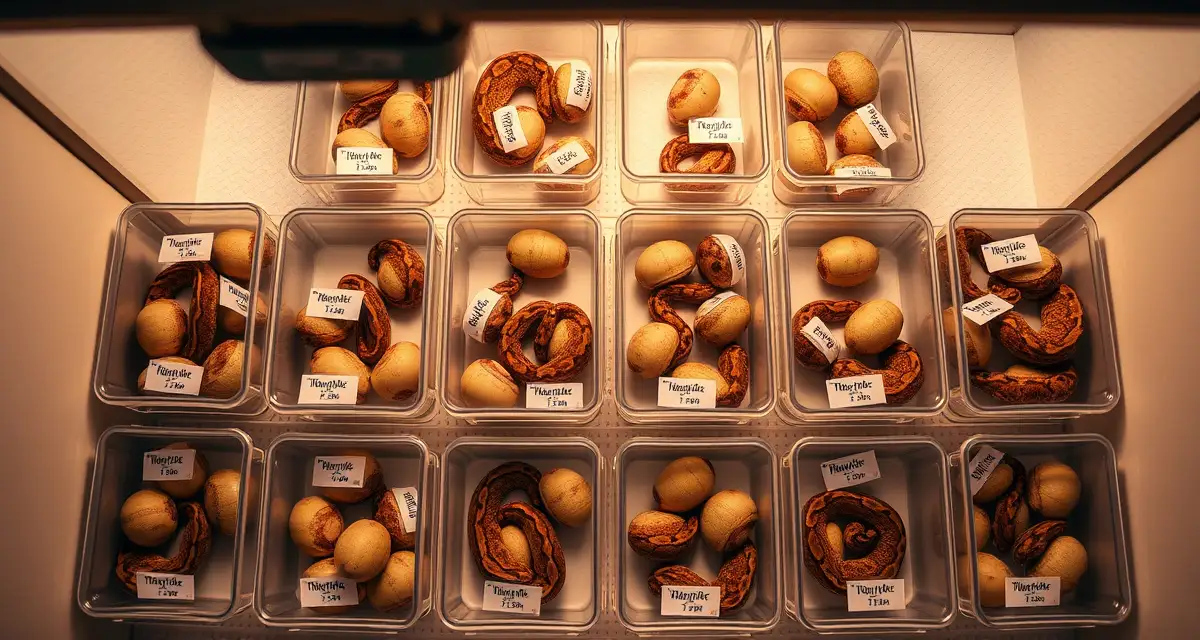
Label every egg box clearly. Minimum labeling:
- Female ID (or female name/code)
- Lay date
- Expected hatch window
Use waterproof labels or write directly on the container with a permanent marker. A label that fades or falls off in a humid incubator is useless.
If you're using a large incubator with space for many containers, arrange containers consistently. Some breeders line them up in lay date order so the oldest clutch (closest to hatch) is always in the same position. This makes it easier to check the right containers more frequently as their hatch window approaches.
Incubation Scheduling
With multiple clutches at different stages, you need to track each clutch's monitoring schedule independently.
Early incubation (days 1-21): Check weekly. Verify egg appearance, substrate moisture, and container seal.
Mid incubation (days 21-50): Check every 5-7 days. Eggs should be increasingly opaque on candling. Maintain substrate moisture.
Late incubation (day 50+): Check every 2-3 days. Pipping can start any time after day 50-55.
Within 10 days of expected hatch: Check daily or every other day.
A calendar or scheduling system that flags which clutch is due for a check on which date prevents any clutch from going unmonitored too long. This is where using dedicated software versus a calendar app makes a real difference in efficiency.
Preventing Egg Mix-Ups
In a multi-clutch season, never move eggs between containers without thorough documentation. If you need to open one container and have another nearby, close and clearly replace the lid before opening a second one.
When you collect eggs from the lay box and transfer to the incubation container, confirm each egg box's label immediately before any other clutch activity.
If you're hatching out neonates while other clutches are still incubating, set up your neonate containers in a different location from your incubator to prevent any confusion about which animals are from which clutch.
Matching Hatchlings to Clutches
This seems obvious but gets complicated in a busy season. When pipping begins:
- Mark the container clearly "HATCHING - [Female ID] - [Lay Date]"
- Transfer hatchlings to labeled individual containers promptly once they're fully out
- Log which egg they emerged from if egg identity matters for genetic documentation
For high-value genetic combinations where knowing individual egg identity matters (e.g., understanding which egg position in the clutch certain phenotypes came from), photograph the eggs in position before the first pip and again after full emergence.
Maintaining Records Per Clutch
Every clutch in a multi-clutch season gets its own record:
- Lay date and egg count
- Substrate type and preparation date
- Incubation temperature
- Candling date(s) and results
- Any adjustments made (substrate moisture top-up, temperature corrections)
- First pip date and full hatch date
- Final hatch count (fertile hatched, fertile dead-in-egg, slugs)
This per-clutch documentation makes your season data meaningful. You can compare hatch rates, incubation length, and other variables across clutches to understand whether different preparation methods, timing, or parent combinations affected outcomes.
Track all of this in HatchLedger's multi-clutch management system, where each clutch is its own record connected to the parent animals and the resulting hatchlings. For how different platforms handle multi-clutch organization, see the reptile breeder software comparison.
Frequently Asked Questions
What is the best approach to managing multiple ball python clutches in one incubation season?
Label every egg container clearly with the female identity, lay date, and expected hatch window. Track each clutch independently with its own monitoring schedule. As the season progresses and your oldest clutch approaches hatch while newer clutches are still in early incubation, keep physical separation clear and documentation current. Review your check schedule for all active clutches at the start of each week so nothing slips past a monitoring window.
How do professional breeders handle multiple ball python clutch management?
Experienced breeders treat each clutch as a completely independent entity within the incubator, even if multiple clutches are sharing the same incubator space. They maintain a per-clutch log and a scheduling system (calendar, software, or physical chart) that tracks each clutch's monitoring intervals and hatch windows. At scale, this systematic approach prevents the costly errors that come from treating a four-clutch season as a single management event.
What software helps manage ball python multiple clutch incubation records?
HatchLedger is purpose-built for reptile breeders, connecting animal records, breeding history, clutch outcomes, and financial tracking in one system. Unlike generic spreadsheets, it's designed around the specific workflow of an active breeding season. Free for up to 20 animals.
What records should every reptile breeder maintain per animal?
At minimum: acquisition date and source, morph and genetic documentation, feeding log, weight history, any veterinary treatments, and breeding history including pairing dates, clutch of origin for captive-bred animals, and offspring records. These records serve your own management, buyer documentation, regulatory compliance, and long-term genetic tracking.
How should reptile breeders document genetics for buyers?
A complete genetic record for sale includes the animal's visual morph name, confirmed het genes and their basis (parentage documentation or proven-out production), possible het genes with probability percentages, hatch date, and parent morph information. Including clutch-of-origin records lets buyers independently verify the claims.
Sources
- USARK (United States Association of Reptile Keepers)
- Association of Reptilian and Amphibian Veterinarians (ARAV)
- World of Ball Pythons (WoBP genetics reference database)
- MorphMarket (reptile industry marketplace)
- Reptiles Magazine (Bowtie Inc.)
Get Started with HatchLedger
Every part of a ball python breeding operation -- from pairing records to clutch documentation to financial tracking -- works better when the data is connected rather than scattered across notebooks and spreadsheets. HatchLedger is built for exactly that. Try it free with up to 20 animals.