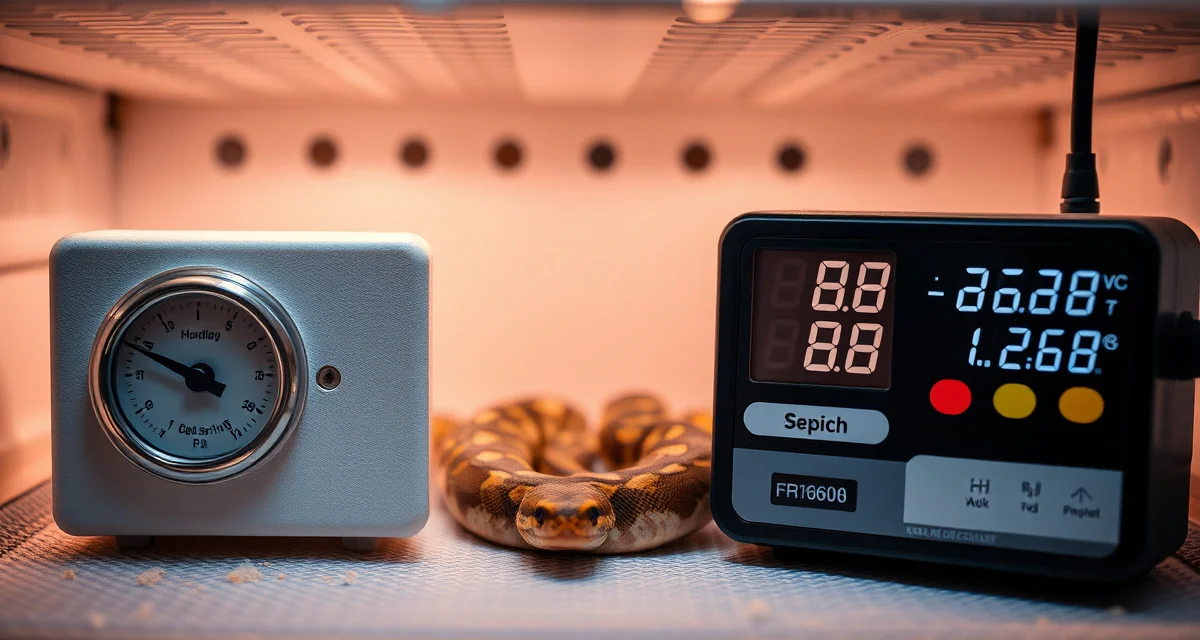
Digital vs. Analog Incubation Monitoring for Ball Python Eggs
By HatchLedger Editorial Team · Published 2025-06-17 · Updated Mar 13, 2026
Monitoring temperature and humidity during incubation accurately is not optional - it's the foundation of consistent hatch rates. A few degrees of error in temperature read and you could be running hotter or cooler than you think, affecting development time and potentially causing developmental issues. Breeders using integrated software report 30% less time on administrative tasks, which means you can spend more time on the hands-on monitoring that incubation requires.
TL;DR
- Ball python breeding operations require systematic record-keeping from pre-season preparation through end-of-season sales.
- Females at 1,200-1,500g or more are the target weight before introducing them to a breeding male.
- Ovulation detection is the key event that anchors pre-lay shed and lay date calculations.
- Clutch profitability guide depends on understanding actual cost basis per animal, not just gross sale revenue.
- Well-documented animals with complete feeding histories and clear genetic records consistently sell faster and at higher prices.
The choice between digital and analog monitoring tools is really about accuracy, cost, and reliability - and the answer is fairly clear once you understand what each type offers.
Analog Monitoring Tools
Analog thermometers and hygrometers use physical mechanisms - bimetallic coils, hair hygrometers, liquid columns - to measure temperature and humidity. They've been used in reptile keeping for decades.
Advantages:
- No batteries required
- Simple and durable
- Inexpensive
Disadvantages:
- Accuracy is often poor. Many inexpensive analog tools are off by 5-10°F from actual temperature, and analog hygrometers can be off by 10-20% relative humidity or more.
- Difficult to calibrate or verify accuracy
- May drift over time
- Can't log data or alert you to changes
For reptile egg incubation, where temperature precision of ±1-2°F matters significantly, an analog thermometer that reads 5°F low means you think you're incubating at 88°F but you're actually running at 93°F. That's a meaningful problem.
Verdict: Analog tools are not recommended as your primary monitoring method for ball python incubation.
Digital Monitoring Tools
Digital thermometers and hygrometers use electronic sensors to measure temperature and humidity. Quality varies widely.
Basic digital thermometer/hygrometer combos:
- Cost: $10-20
- Accuracy: Typically ±1-2°F for temperature, ±3-5% for humidity
- Probe or remote sensor: Many have external probes that go inside the incubator while the display unit stays outside
- Good for: Basic monitoring at reasonable accuracy
Calibration: Even digital tools can be off from the factory. For temperature-critical applications like incubation, calibration against a reference thermometer is valuable. You can use a NIST-traceable reference thermometer or an ice bath method (0°C at ice water saturation) as a baseline check.
High-accuracy digital options:
- Calibrated probes from scientific supply companies
- Thermostat manufacturer's integrated temperature displays (since your thermostat is controlling temperature, its sensor's accuracy matters most)
- Digital probe thermometers designed for precise temperature control
What Matters Most: Your Thermostat's Sensor
For temperature control during incubation, your thermostat's probe is the most important measurement in your system - because it's what the thermostat uses to maintain temperature. If your thermostat reads 2°F cool, it will maintain an actual temperature that's 2°F higher than your set point.
This is why:
- Know your thermostat's accuracy specification
- Verify your thermostat's setpoint against a known-accurate thermometer at the probe location in your incubator
- Adjust your setpoint to compensate if there's a known offset
A thermostat verified to be running 1°F hot means you should set it to 87°F to achieve 88°F actual temperature at the probe.
Using Multiple Sensors
A single temperature reading inside an incubator can be misleading because temperature may not be perfectly uniform throughout. Smart practice:
- Have at least one independent thermometer separate from your thermostat probe
- Place sensors at egg level, not at the top of the incubator (warm air rises - the top of the incubator may read warmer than where eggs actually sit)
- Periodically compare readings between your thermostat display and your independent monitor
If your two sensors consistently agree, you have confidence in your setup. If they diverge by more than 2-3°F, investigate before assuming one is correct.
Logging Temperature and Humidity Data
Record the temperature and humidity you verify in your incubation setup at the start of each clutch. Note any adjustments you make during incubation. If a clutch has an unusually long or short incubation period, or if hatch rates are unexpectedly poor, your incubation log is where you'll look for contributing factors.
Track these details alongside your clutch records in HatchLedger's incubation management system. For broader tool comparisons, the reptile breeder software comparison covers how different platforms handle this kind of data.
Frequently Asked Questions
What is the best approach to digital vs. analog incubation monitoring for ball python eggs?
Use digital monitoring as your primary system. Analog tools are inaccurate enough to cause real problems in temperature-sensitive incubation. Invest in at least two digital thermometers - one as your primary and one as a cross-check. Verify your thermostat's actual output against a known-accurate thermometer and adjust your setpoint to compensate for any offset. For humidity, a digital hygrometer inside your egg box gives you direct readings that analog tools can't match in accuracy.
How do professional breeders handle incubation temperature and humidity monitoring?
Experienced breeders typically have their incubation setup calibrated before breeding season begins. They verify thermostat accuracy, know their probe placement, and use at least two independent temperature measurements. Many keep a log of daily or weekly temperature readings during active incubation to catch any drift that might indicate a thermostat problem. Incubation failures traced to temperature issues are almost always preventable with better monitoring.
What software helps manage ball python incubation monitoring records?
HatchLedger is purpose-built for reptile breeders, connecting animal records, breeding history, clutch outcomes, and financial tracking in one system. Unlike generic spreadsheets, it's designed around the specific workflow of an active breeding season. Free for up to 20 animals.
What records should every reptile breeder maintain per animal?
At minimum: acquisition date and source, morph and genetic documentation, feeding log, weight history, any veterinary treatments, and breeding history including pairing dates, clutch of origin for captive-bred animals, and offspring records. These records serve your own management, buyer documentation, regulatory compliance, and long-term genetic tracking.
How should reptile breeders document genetics for buyers?
A complete genetic record for sale includes the animal's visual morph name, confirmed het genes and their basis (parentage documentation or proven-out production), possible het genes with probability percentages, hatch date, and parent morph information. Including clutch-of-origin records lets buyers independently verify the claims.
What is Digital vs. Analog Incubation Monitoring for Ball Python Eggs?
Digital vs. analog incubation monitoring refers to the choice between electronic sensors with digital readouts versus traditional mechanical tools like bimetallic thermometers and hair hygrometers for tracking temperature and humidity during ball python egg incubation. Digital tools offer precise numerical readings and often include logging or alert features, while analog tools rely on physical mechanisms. The right choice directly impacts hatch rates, as even small measurement errors can affect embryo development and overall clutch success.
How much does Digital vs. Analog Incubation Monitoring for Ball Python Eggs cost?
Analog thermometers and hygrometers are inexpensive, typically ranging from $5–$30, making them accessible for beginners. Digital units vary widely — basic digital probes start around $15–$40, while multi-probe systems with data logging and alerts can run $50–$200 or more. Purpose-built incubation monitoring software or integrated breeding platforms may carry monthly subscription costs but can reduce administrative overhead by up to 30%, offsetting costs through time savings at scale.
How does Digital vs. Analog Incubation Monitoring for Ball Python Eggs work?
Analog tools use physical mechanisms — bimetallic coils expand and contract with temperature changes, while hair hygrometers respond to moisture in the air — moving a needle across a dial. Digital monitors use electronic sensors to measure conditions and display numerical readings, often updating in real time. Higher-end digital systems log readings automatically over time and can send alerts when conditions drift outside set thresholds, giving breeders a continuous data record throughout the 55–60 day incubation period.
What are the benefits of Digital vs. Analog Incubation Monitoring for Ball Python Eggs?
Digital monitoring offers measurably greater accuracy, easier readability, and the ability to log data over time — critical when temperature errors of just a few degrees can affect development timelines or cause defects. Analog tools are low-cost and require no power, but drift in calibration over time. For breeders managing multiple clutches, digital systems reduce manual record-keeping, improve consistency across seasons, and provide documentation that supports better decision-making and more transparent animal histories at the point of sale.
Who needs Digital vs. Analog Incubation Monitoring for Ball Python Eggs?
Any ball python breeder who incubates eggs needs reliable monitoring tools — from hobbyists managing a single clutch to commercial operations running dozens simultaneously. Breeders targeting consistent hatch rates, specific morph outcomes, or professional-grade record-keeping will benefit most from digital solutions. Those just starting out may begin with analog tools, but as clutch volume grows, the accuracy and time-saving advantages of digital monitoring become increasingly important for maintaining healthy animals and profitable operations.
How long does Digital vs. Analog Incubation Monitoring for Ball Python Eggs take?
The monitoring itself runs continuously throughout the entire incubation period, which for ball pythons typically spans 55–65 days depending on temperature. Setting up a digital system takes minutes, while calibrating analog tools can require periodic adjustments. Data logging systems collect readings automatically with no ongoing time investment. Manual analog checks should happen at least once or twice daily. Breeders using integrated software report spending 30% less time on administrative tasks, freeing more hours for hands-on clutch care during this critical window.
Related Articles
- Candling Ball Python Eggs: How to Check Fertility and What You're Looking For
- Identifying Fertile Ball Python Eggs vs. Slugs at Lay
Sources
- USARK (United States Association of Reptile Keepers)
- Association of Reptilian and Amphibian Veterinarians (ARAV)
- World of Ball Pythons (WoBP genetics reference database)
- MorphMarket (reptile industry marketplace)
- Reptiles Magazine (Bowtie Inc.)
Get Started with HatchLedger
Every part of a ball python breeding operation -- from pairing records to clutch documentation to financial tracking -- works better when the data is connected rather than scattered across notebooks and spreadsheets. HatchLedger is built for exactly that. Try it free with up to 20 animals.