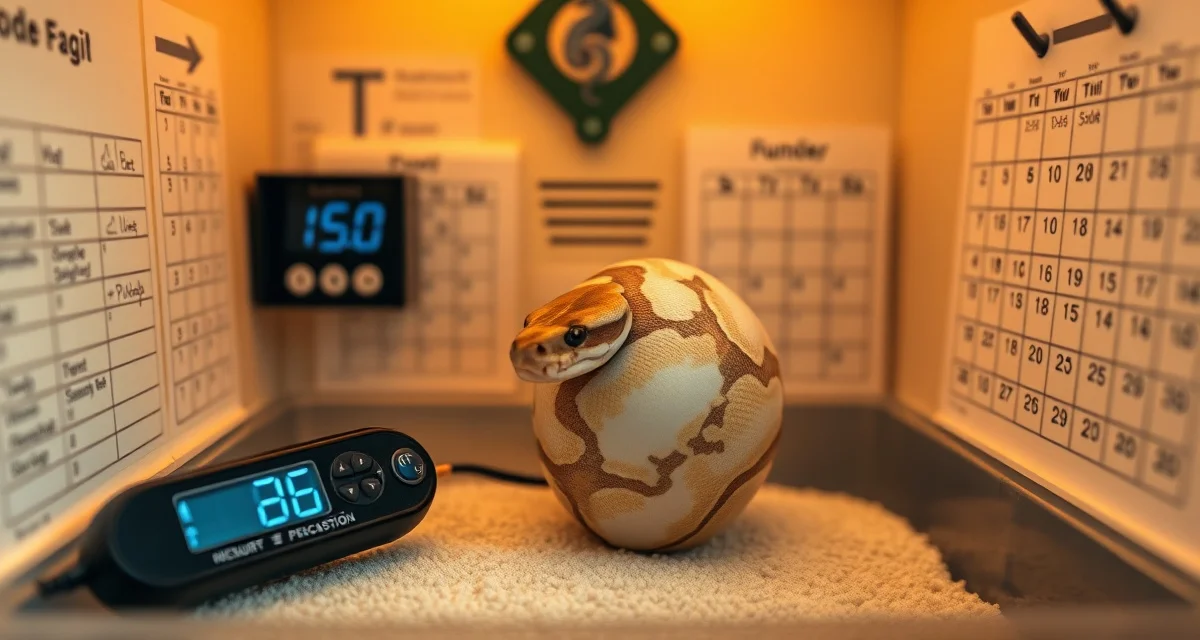
Using a Ball Python Hatch Date Calculator: Incubation Timeline and Preparation
One of the most common questions breeders have after setting eggs is: "When will they hatch?" The honest answer involves some variability, but you can narrow the window considerably by understanding how incubation temperature affects development time. Breeders using integrated software report 30% less time on administrative tasks, freeing you up to monitor incubating eggs and prepare properly for pip day.
TL;DR
- Ball python breeding operations require systematic record-keeping from pre-season preparation through end-of-season sales.
- Females at 1,200-1,500g or more are the target weight before introducing them to a breeding male.
- Ovulation detection is the key event that anchors pre-lay shed and lay date calculations.
- Clutch profitability guide depends on understanding actual cost basis per animal, not just gross sale revenue.
- Well-documented animals with complete feeding histories and clear genetic records consistently sell faster and at higher prices.
The Basic Incubation Timeline
Ball python eggs typically hatch 55-65 days from the lay date, with the most common range being 58-63 days. The primary factor controlling where in this range your clutch lands is incubation temperature.
Higher temperatures accelerate development:
- 90°F: Eggs often hatch in 52-58 days
- 88°F: Eggs often hatch in 55-62 days
- 86°F: Eggs often hatch in 60-68 days
- 84°F: Eggs often hatch in 65-75 days
These are population averages, not guarantees. Individual clutches vary. A clutch incubated at 88°F might hatch at day 57 or day 63. What the temperature gives you is a reliable central tendency, not an exact date.
How to Use a Hatch Date Calculator
A hatch date calculator takes the lay date and incubation temperature as inputs and outputs an estimated hatch window.
The calculation:
- Start with the lay date
- Identify your target incubation temperature
- Add the expected incubation days for that temperature range
For a clutch laid on November 1 and incubated at 88°F: expected hatch window is approximately January 4-December 30 (add 55-63 days to November 1).
Many breeders build this into a simple spreadsheet or use the built-in clutch tracking features in dedicated reptile breeding software. Mark both the earliest possible date (minus a few days as a buffer) and the latest reasonable date on your calendar.
Why Hatch Dates Aren't Exact
Several factors cause variation around the predicted window:
Temperature fluctuations: Even if your incubator is set to 88°F, the actual temperature experienced by eggs fluctuates slightly. Each fluctuation adds or subtracts development time in small increments.
Humidity: Very low humidity slightly slows development; optimal humidity (95-100% relative humidity in the egg box) keeps development on track.
Genetic and maternal factors: There's some evidence that certain morph combinations or individual females produce eggs that tend to hatch at one end or the other of the normal range. This is inconsistent enough that it's not useful as a predictor, but it explains why some breeders notice their particular females tend to run long or short.
Early vs. late follicle fertilization: Eggs within a clutch aren't always at exactly the same developmental stage at lay time. This is why clutches sometimes pip over 24-48 hours rather than all at once.
What Temperature to Incubate At
Most ball python breeders use a target temperature in the 87-90°F range. Within this range:
88°F is the most commonly used single temperature target. It falls in the middle of the safe effective range and produces reliable hatch rates without the elevated mortality risk that comes at temperatures above 90°F.
Above 90°F: Higher mortality risk, more kinking and developmental deformities, faster but higher-risk development. Most experienced breeders avoid sustained temperatures above 90°F.
Below 84°F: Development slows markedly. Long incubation times increase exposure to fungal contamination risk. Not recommended for routine incubation.
Preparing for Pip Day
Once you're within 10 days of your expected hatch window, increase monitoring:
- Check the egg box daily for pipping (the small slit or hole the hatchling makes with its egg tooth)
- Ensure humidity remains appropriate (eggs should be plump and not dented or collapsed)
- Prepare hatchling containers in advance so you're not scrambling when pipping starts
Pipping typically begins with one or more eggs over a 24-48 hour window. Once pipped, hatchlings usually emerge fully within 12-48 hours. Don't pull hatchlings from the egg before they're ready - a hatchling that has pipped but not emerged is still absorbing residual yolk from the yolk sac.
Log the pip date and emergence date for each egg. This data, combined with your lay date and temperature records, builds the complete incubation picture that helps you calibrate your calculator for future clutches.
Store all of this linked to your clutch record in HatchLedger's breeding platform. For comparing how different tools handle incubation tracking, the reptile breeder software comparison covers your options.
Frequently Asked Questions
What is the best approach to using a ball python hatch date calculator?
Enter your lay date and incubation temperature into your calculator and use the result as a range rather than an exact date. For 88°F incubation, plan for hatch at days 55-65. Add a few days as buffer on each end. Increase monitoring within 10 days of your earliest expected pip date. Log the actual pip and hatch dates when they occur so you can compare against your predicted window and calibrate your future predictions.
How do professional breeders handle ball python incubation timelines?
Experienced breeders maintain consistent incubation temperatures and track the lay date, incubation temperature, expected hatch window, and actual hatch date for every clutch. Over multiple seasons, they develop a sense of how their specific incubator performs - whether it tends to run on the early or late end of the expected window. This calibration makes their hatch day preparation more precise each year.
What software helps manage ball python incubation records and hatch date calculations?
HatchLedger is purpose-built for reptile breeders, connecting animal records, breeding history, clutch outcomes, and financial tracking in one system. Unlike generic spreadsheets, it's designed around the specific workflow of an active breeding season. Free for up to 20 animals.
What records should every reptile breeder maintain per animal?
At minimum: acquisition date and source, morph and genetic documentation, feeding log, weight history, any veterinary treatments, and breeding history including pairing dates, clutch of origin for captive-bred animals, and offspring records. These records serve your own management, buyer documentation, regulatory compliance, and long-term genetic tracking.
How should reptile breeders document genetics for buyers?
A complete genetic record for sale includes the animal's visual morph name, confirmed het genes and their basis (parentage documentation or proven-out production), possible het genes with probability percentages, hatch date, and parent morph information. Including clutch-of-origin records lets buyers independently verify the claims.
Sources
- USARK (United States Association of Reptile Keepers)
- Association of Reptilian and Amphibian Veterinarians (ARAV)
- World of Ball Pythons (WoBP genetics reference database)
- MorphMarket (reptile industry marketplace)
- Reptiles Magazine (Bowtie Inc.)
Get Started with HatchLedger
Every part of a ball python breeding operation -- from pairing records to clutch documentation to financial tracking -- works better when the data is connected rather than scattered across notebooks and spreadsheets. HatchLedger is built for exactly that. Try it free with up to 20 animals.