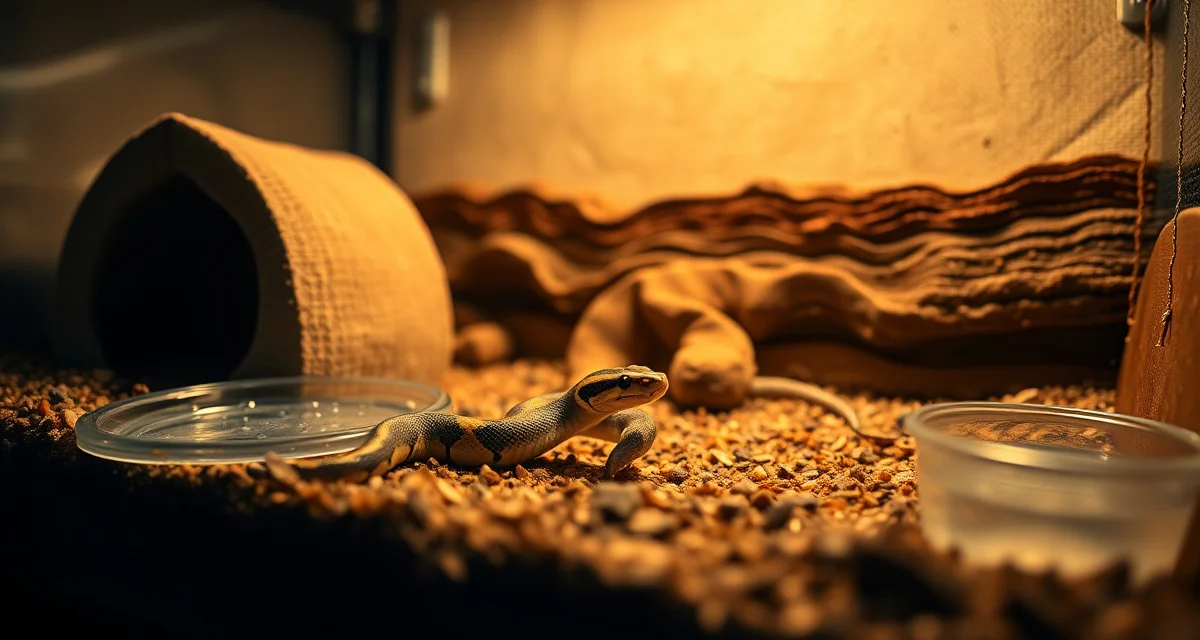
Ball Python Enclosure Sizing from Hatchling to Adult
Enclosure sizing is one of those topics where the hobby has genuinely evolved. Recommendations from ten or fifteen years ago look different from current best practice, and the research on reptile welfare has shifted what most experienced breeders consider appropriate at every life stage.
TL;DR
- Ball python breeding operations require systematic record-keeping from pre-season preparation through end-of-season sales.
- Females at 1,200-1,500g or more are the target weight before introducing them to a breeding male.
- Ovulation detection is the key event that anchors pre-lay shed and lay date calculations.
- Clutch profitability guide depends on understanding actual cost basis per animal, not just gross sale revenue.
- Well-documented animals with complete feeding histories and clear genetic records consistently sell faster and at higher prices.
This guide covers sizing guidelines at each life stage, how breeder operations approach this practically at scale, and the welfare considerations that matter for both the animals and your reputation as a seller.
Why Enclosure Size Matters
Ball pythons are often described as a "small space" snake because they're relatively sedentary in captivity. That characterization is accurate, but it doesn't mean any size will do. An enclosure that's too large for a small hatchling can cause feeding stress and difficulty maintaining temperature. An enclosure that's too small for an adult limits natural movement, creates humidity imbalances, and may impact breeding condition.
The goal is an enclosure that fits the animal's body size and behavioral needs at each stage of life.
Hatchling Sizing (0-6 Months)
Hatchlings are small, often stressed, and prone to refusing food when they feel exposed. Starting in a smaller enclosure helps them feel secure, find their hide easily, and establish reliable feeding.
Recommended minimum: 10-gallon equivalent (approximately 20" x 10" x 12")
Many breeders start hatchlings in 6-quart shoebox tubs within a rack system. These work well as long as the thermal gradient is maintained. The key is that the hide covers a meaningful portion of the floor space so the animal can feel fully enclosed.
Avoid oversized enclosures at this stage. A hatchling in a 40-gallon tank with a lot of open space often won't settle, won't use the hide reliably, and may refuse to eat. The "too much space" problem is real and often overlooked by new keepers.
Juvenile Sizing (6 Months - 18 Months)
As the animal approaches 500-800 grams, it's ready for a mid-sized enclosure. The goal here is enough space to express some natural behavior, including exploration and constriction, without the stress triggers of a very large open enclosure.
Recommended size: 20-gallon long equivalent (30" x 12" x 12") or equivalent tub
In rack systems, this is typically the transition to larger tub sizes, often 28-32 quart containers. These give the animal more room while still maintaining the semi-enclosed feel that ball pythons prefer.
At this stage, enrichment elements become more useful. A secondary hide on the cool side, some texture in the substrate, and occasional environmental variation (like adding a new hide structure) support behavioral complexity.
Sub-Adult Sizing (18 Months - 3 Years)
Sub-adults, typically in the 800-1500 gram range, need a meaningful upgrade in enclosure size. Animals that spend too long in undersized enclosures at this stage often develop stereotypic behaviors like persistent nose rubbing, which can cause permanent snout damage.
Recommended size: 40-gallon equivalent (36" x 18" x 18") or equivalent tub
In rack systems, 41-quart or 56-quart tubs are commonly used for animals in this range. Females generally need to move to larger tubs sooner than males due to faster growth.
This is also when bioactive substrate setups become a viable option if you're keeping animals in display enclosures rather than a rack. The added complexity of a bioactive system is more manageable for a smaller number of display animals than across a full breeding collection.
Adult Sizing (3+ Years)
Adult ball pythons, especially females, can exceed 4-5 feet and 2500 grams, though average females typically settle in the 1500-2000 gram range. Adults need enclosures that allow them to stretch out partially, access both ends of their thermal gradient, and have hides that fit them properly.
Recommended minimum for adults:
- Males: 4' x 2' x 2' or equivalent (about 40-gallon minimum)
- Females: 4' x 2' x 2' minimum, 4' x 4' x 2' preferred for larger animals
In rack systems, adult females in breeding programs are commonly housed in 66-106 quart tubs depending on the animal's size. The tub needs to be large enough that the animal isn't perpetually coiled uncomfortably but small enough to maintain the thermal gradient.
Oversized enclosures for adults aren't as problematic as for hatchlings, but they do make temperature and humidity management harder. A 4-foot snake in a 6-foot enclosure needs more heat source coverage to maintain a proper gradient.
Scaling Enclosure Management in a Breeding Operation
Managing enclosures across a collection of 50, 100, or more animals requires a system. Most dedicated breeders use one of two approaches:
Rack systems are the industry standard for efficiency. Ball pythons in properly set up racks typically feed reliably, have stable temperatures, and can be managed at a much higher density than individual glass enclosures. The tradeoff is limited visibility and the need for more systematic health checks since the animals aren't as observable day-to-day.
Individual enclosures work well for display animals, special projects, or breeders who prefer more direct observation. The tradeoff is notably more space, more equipment, and more labor per animal.
Most operations over 50 animals use racks for the majority of the collection and individual enclosures for select display animals or projects they want to showcase.
Tracking Enclosure Assignments in Your Records
At scale, knowing which animal is in which enclosure matters. Animals get moved during breeding season, after health events, when they're sized up, and when new animals arrive. Without clear records, collections can become disorganized quickly.
The HatchLedger platform lets you log enclosure assignments against animal records so you always know where an animal is, when it was moved, and why. This connects directly to health logs, feeding records, and breeding history in a way that isolated spreadsheets can't match. Breeders using integrated software report 30% less time on administrative tasks, which adds up when you're managing individual records for hundreds of animals.
The reptile breeder software comparison breaks down how different tools handle this kind of multi-animal collection management, which is worth reviewing before you commit to a tracking system.
Common Sizing Mistakes to Avoid
Starting hatchlings too large. This causes feeding stress and is one of the most preventable reasons for feed refusals in new hatchlings.
Failing to upsize on schedule. Animals that spend too long in undersized enclosures develop behavioral issues and may have impaired growth.
Ignoring hide sizing. The hide needs to fit the animal snugly. A hide that's too large doesn't provide the security signal a ball python needs to feel comfortable. Scale hides up as you scale enclosures up.
Inadequate thermal gradient in large enclosures. Large enclosures need either multiple heat sources or a heat source positioned to provide a meaningful warm end while leaving the other end cooler. A single heat mat in a 4-foot enclosure doesn't create a proper gradient.
Frequently Asked Questions
What is the best approach to ball python enclosure sizing?
Size enclosures to match the animal's body size at each life stage. Start hatchlings small (6-10 gallon equivalent) to reduce feeding stress, and scale up steadily as the animal grows. Adult females need at minimum a 4' x 2' footprint, with larger being better for animals over 2000 grams. In rack systems, use appropriately sized tubs with secure lids and proper thermal management.
How do professional breeders handle ball python enclosure sizing?
Most professional breeders use rack systems with tub sizes matched to animal life stage across the bulk of their collection. They have a defined schedule for when animals move to larger tubs based on weight, not just age, and track those transitions in their records to keep collection management organized.
What records should every reptile breeder maintain per animal?
At minimum: acquisition date and source, morph and genetic documentation, feeding log, weight history, any veterinary treatments, and breeding history including pairing dates, clutch of origin for captive-bred animals, and offspring records. These records serve your own management, buyer documentation, regulatory compliance, and long-term genetic tracking.
How should reptile breeders document genetics for buyers?
A complete genetic record for sale includes the animal's visual morph name, confirmed het genes and their basis (parentage documentation or proven-out production), possible het genes with probability percentages, hatch date, and parent morph information. Including clutch-of-origin records lets buyers independently verify the claims.
Sources
- USARK (United States Association of Reptile Keepers)
- Association of Reptilian and Amphibian Veterinarians (ARAV)
- World of Ball Pythons (WoBP genetics reference database)
- MorphMarket (reptile industry marketplace)
- Reptiles Magazine (Bowtie Inc.)
Get Started with HatchLedger
Every part of a ball python breeding operation -- from pairing records to clutch documentation to financial tracking -- works better when the data is connected rather than scattered across notebooks and spreadsheets. HatchLedger is built for exactly that. Try it free with up to 20 animals.