Case Study: Scaling to 300 Ball Pythons Without Burnout
There's a transition point that every ambitious ball python breeder eventually hits. You've grown from 20 animals to 80, and that growth felt manageable. You kept growing to 150, and things got harder but you adapted. Then somewhere between 150 and 300, the systems that got you here stop working well enough to keep going. Records become unreliable. Animals get missed. The joy that brought you into the hobby gets buried under administrative overhead.
TL;DR
- Ball python breeding operations require systematic record-keeping from pre-season preparation through end-of-season sales.
- Females at 1,200-1,500g or more are the target weight before introducing them to a breeding male.
- Ovulation detection is the key event that anchors pre-lay shed and lay date calculations.
- Clutch profitability guide depends on understanding actual cost basis per animal, not just gross sale revenue.
- Well-documented animals with complete feeding histories and clear genetic records consistently sell faster and at higher prices.
Three hundred animals is a real operation. This case study covers what it takes to scale to that level without losing your mind, your animals, or your business.
What 300 Animals Actually Requires
A 300-animal ball python collection requires:
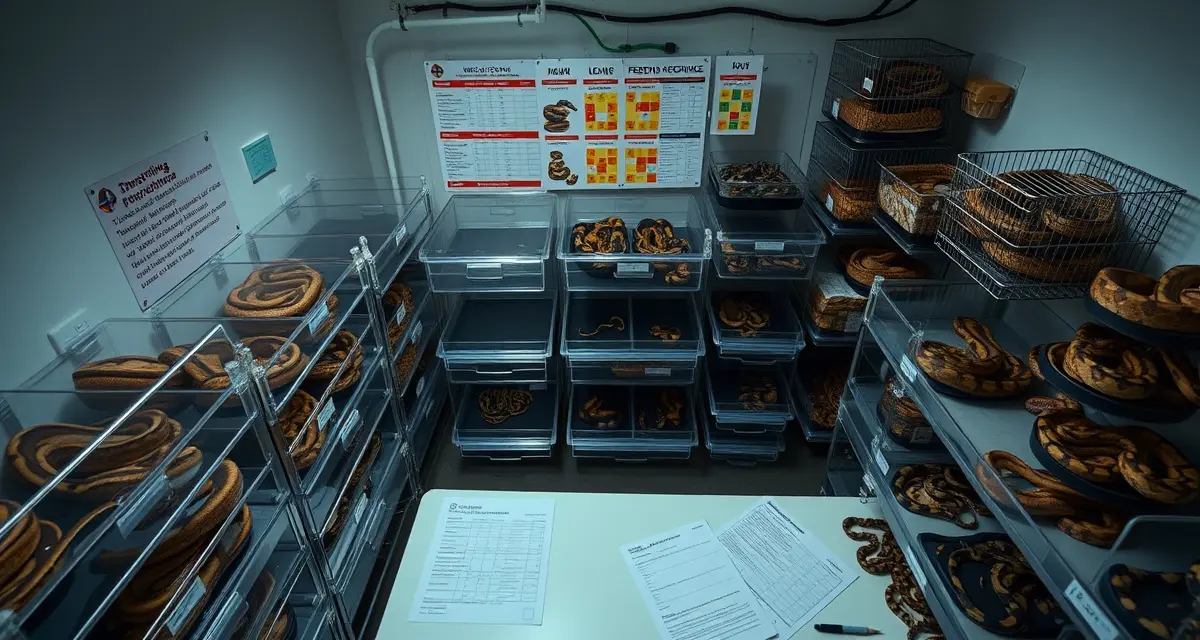
- Physical space: typically 2-3 dedicated rack room setups
- Infrastructure: multiple thermostats, HVAC management, backup heat sources
- Time: a daily feeding, watering, and health-check schedule that can easily consume 4-6 hours per day during peak season
- Capital: feed costs at this scale run $400-600 per month or more depending on animal size distribution
- Organization: the ability to locate any animal instantly, know when it last ate, know its complete genetic profile, and track its health history
None of those requirements on their own are insurmountable. But they all become harder simultaneously as you scale past 150 animals, which is why so many breeders stall at that number or retreat back to smaller collections after a painful period at the larger scale.
Stage 1: Physical Infrastructure
The physical plant has to come first. Before you add the animals, build the rooms to hold them properly.
Three dedicated rack rooms at this scale is a common configuration:
- Room A: Adult breeding females and post-lay recovery animals
- Room B: Adult males and sub-adults growing toward breeding age
- Room C: Hatchlings and juveniles from the current and previous seasons
Each room needs independent climate control, backup heat capacity, and a thermostat monitoring system that can alert you to failures. A thermostat failure at 2am on a Saturday is a different emergency when you have 300 animals than when you have 30.
Room-level humidity management is more practical than individual enclosure management at this scale. A whole-room humidifier in each room, with a room hygrometer, gives you baseline humidity without the labor of managing individual enclosures daily.
Lighting timers for consistent photoperiod across all three rooms matter for breeding season conditioning. The animals' behavioral responses to seasonal light changes are real, and you want them happening on a controlled schedule, not randomly.
Stage 2: Feeding System
Feeding 300 animals requires a system that eliminates missed feedings. The most common approach at this scale is section-based feeding schedules:
- Monday: Room A, odd racks
- Tuesday: Room A, even racks
- Wednesday: Room B, odd racks
- Thursday: Room B, even racks
- Friday: Room C, juvenile racks
- Weekend: Catch-up, hatchlings, animals on special schedules
Every feeding event gets logged against the individual animal's record. Not "fed Room A" as a block, each animal has a dated feeding log entry. At 300 animals, this sounds like an enormous data entry burden, but it becomes routine within a few weeks and the payoff is immediate: you never have to wonder when an animal last ate, and patterns become visible (this rack section always has 2-3 refusals in January, probably a temperature issue at that spot in the room).
Stage 3: Health Monitoring at Scale
At 300 animals, you will have health events constantly. Not because you're doing something wrong, but because statistical certainty means that across 300 animals, something is always happening. A respiratory infection here, a stuck shed there, a female in questionable breeding condition, a male who stopped eating two weeks ago.
Managing this requires moving from reactive to proactive monitoring. Reactive monitoring means you notice a problem when you happen to observe the animal and it's obvious. Proactive monitoring means:
- Every animal gets a brief visual assessment every week
- Every animal gets weighed monthly with the weight logged
- Any animal with a logged health flag gets a follow-up check on a specific date
- Temperature checks across all room sections happen on a weekly rotation
The flagging system is critical. When you log that an animal has a suspicious respiratory sound, you need to see that animal again in three days, not "sometime soon." Without a system that creates follow-up flags, things get lost in the volume.
Stage 4: Record-Keeping Infrastructure
This is where collections fail on the way to 300. The breeders who successfully scale and sustain a 300-animal operation are almost universally running purpose-built software, not spreadsheets. The reason is simple: spreadsheets are flat files. They don't link related records across tables. They don't create automatic flags or follow-ups. They don't connect feeding logs to health logs to clutch records to financial data.
The HatchLedger platform handles this connected-record need natively. Animal records link to parent records, which link to clutch records, which link to offspring records. Health logs are attached to individual animals. Feeding logs are date-stamped against individual animals. Financial data connects to clutch records. You can search any dimension of this data: which animals are visual Pied, which haven't eaten in 14 days, which clutches produced the highest margin this season.
Breeders using integrated software report 30% less time on administrative tasks. At 300 animals, 30% of what would otherwise be several hours of daily administrative work is substantial. That's the difference between sustainable daily operation and grinding yourself into burnout.
Stage 5: Delegation and Routine
Three hundred animals is too much for one person to manage alone at high quality over the long term. Most successful operations at this scale have at minimum one reliable part-time helper for feeding and basic checks, freeing the primary breeder for the higher-judgment work: health assessment, genetic planning, buyer communication, and financial management.
Standard operating procedures (SOPs) for every routine task make delegation possible. A new helper can feed Room B correctly on the first day if there's a clear written procedure and the animals are clearly labeled. They can't improvise quality health assessments, but they can follow a checklist.
The breeding room setup, the rack labeling system, the feeding schedule, and the record-logging protocol should all be documented outside of any one person's head. If you take a week off and someone else cares for the animals, the operation should continue without meaningful disruption.
Avoiding Burnout
Burnout in reptile breeding is real and it's common at the 150-300 animal scale. The early stages of growth are exciting. The established large-scale operation is a business, and businesses have routine, repetitive work.
What prevents burnout:
- Clear separation of roles. Some tasks are high-value and engaging (genetics planning, photographing new hatchlings, buyer relationships). Others are pure maintenance (weekly feeding, substrate changes). Minimize the ratio of maintenance to meaningful work as much as your infrastructure allows.
- Systems that work. Nothing burns breeders out faster than systems that constantly fail or require workarounds. If your records are unreliable, if animals are mislabeled, if the thermostat fails regularly, that friction compounds. Investing in infrastructure that actually works reliably is an investment in your own sustainability.
- Financial clarity. Breeding 300 animals and not knowing whether you're making money is stressful. Knowing your margins, your carry costs, and your projected season revenue is grounding even when numbers are difficult.
The reptile breeder software comparison covers how different tools address the operational complexity that leads to burnout when it goes unmanaged.
Frequently Asked Questions
What is the best approach to scaling ball python 300 animals case study?
Build the physical infrastructure before adding the animals, not simultaneously. Implement a systematic feeding and health monitoring schedule before you're managing 300 animals, because building habits at 100 is much easier than fixing broken systems at 300. Invest in purpose-built record-keeping software rather than trying to extend spreadsheets to a scale they weren't designed for.
How do professional breeders handle scaling ball python 300 animals case study?
Professional breeders at large scale treat their operation as a business with systems, SOPs, and clear operational roles. They delegate routine care tasks to reliable help, invest in infrastructure that works without constant intervention, and use software that provides real-time visibility into collection status, feeding history, and financial performance.
What records should every reptile breeder maintain per animal?
At minimum: acquisition date and source, morph and genetic documentation, feeding log, weight history, any veterinary treatments, and breeding history including pairing dates, clutch of origin for captive-bred animals, and offspring records. These records serve your own management, buyer documentation, regulatory compliance, and long-term genetic tracking.
How should reptile breeders document genetics for buyers?
A complete genetic record for sale includes the animal's visual morph name, confirmed het genes and their basis (parentage documentation or proven-out production), possible het genes with probability percentages, hatch date, and parent morph information. Including clutch-of-origin records lets buyers independently verify the claims.
Sources
- USARK (United States Association of Reptile Keepers)
- Association of Reptilian and Amphibian Veterinarians (ARAV)
- World of Ball Pythons (WoBP genetics reference database)
- MorphMarket (reptile industry marketplace)
- Reptiles Magazine (Bowtie Inc.)
Get Started with HatchLedger
Every part of a ball python breeding operation -- from pairing records to clutch documentation to financial tracking -- works better when the data is connected rather than scattered across notebooks and spreadsheets. HatchLedger is built for exactly that. Try it free with up to 20 animals.