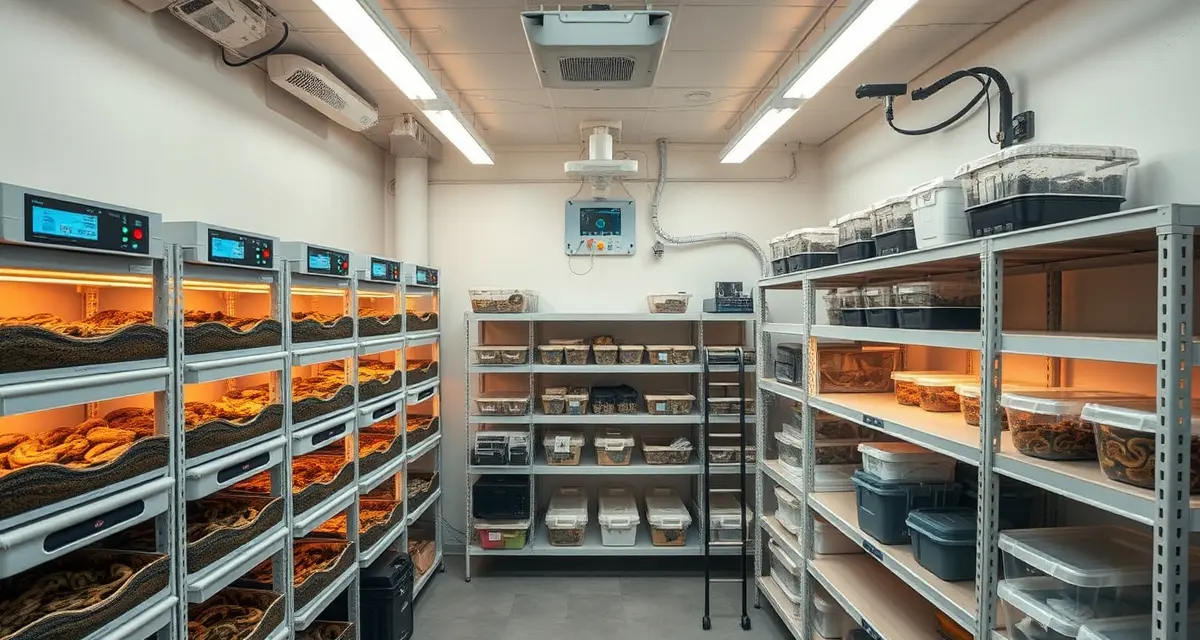
Setting Up a Ball Python Breeding Room
Running your breeding operation out of your living room works, until it doesn't. The day you have 30 racks, two incubators, and a tub of new hatchlings sitting next to your couch is the day you realize you needed a dedicated ball python breeding room setup about six months ago.
TL;DR
- Ball python breeding operations require systematic record-keeping from pre-season preparation through end-of-season sales.
- Females at 1,200-1,500g or more are the target weight before introducing them to a breeding male.
- Ovulation detection is the key event that anchors pre-lay shed and lay date calculations.
- Clutch profitability guide depends on understanding actual cost basis per animal, not just gross sale revenue.
- Well-documented animals with complete feeding histories and clear genetic records consistently sell faster and at higher prices.
A purpose-built breeding room isn't just about space. It's about environmental control, workflow efficiency, and the kind of operational separation that lets your collection run like a program rather than a hobby. Breeders using integrated software report 30% less time on administrative tasks, and a good room setup is what makes those systems work.
Planning Before You Build
Choose the Right Space
Basements and spare bedrooms are the most common choices. Each has tradeoffs.
Basements offer stable ambient temperatures year-round, critical for maintaining rack temps without huge HVAC bills. They're typically out of the main living areas, keeping animal smell and maintenance activity separate. The downside: humidity tends to run high, natural lighting is minimal, and flood risk needs to be addressed.
Spare bedrooms are more accessible, easier to climate-control with existing HVAC, and simpler to wire and modify. They're also closer to the rest of your living space, which matters if you have family members who didn't sign up to live next to 200 ball pythons.
Garages and outbuildings work in mild climates but require serious insulation and supplemental heating/cooling to stay stable in temperature extremes.
Calculate Your Space Requirements
Before designing your layout, inventory what you need to house. Count your:
- Current animals by size class (hatchlings, juveniles, sub-adults, adults)
- Projected growth over 2–3 seasons
- Incubation equipment
- Food storage (freezer for frozen/thawed feeders, prep area)
- Supply storage (substrate, tubs, hides, tools)
- Record-keeping workstation
Calculate rack footprint for current and projected collections, add 30% buffer, and plan your room around that number. Running out of space two seasons in is a common and avoidable mistake.
Environmental Control
Temperature
Ball pythons need ambient room temperatures of 78–82°F for rack systems to maintain proper gradients. Your breeding room needs to hold this temperature consistently regardless of season.
A dedicated mini-split or window AC unit with heat pump functionality is the most reliable solution for most rooms. Central HVAC is harder to isolate to one room and often cycles in ways that create temperature swings. A mini-split maintains a set temperature with much less variance.
Budget for the unit, installation, and a smart thermostat that you can monitor remotely. Temperature crashes at 2am during winter are a real risk, remote monitoring is worth it.
Humidity
Depending on your climate, you may need to add or remove humidity from your breeding room. Target 50–60% ambient relative humidity in the room itself; individual enclosures and humid hides will bring each animal's microclimate to the 60–80% it needs.
A dehumidifier is standard in basement setups. A whole-room humidifier can help in dry climates. Hygrometers placed at multiple points in the room give you a real picture rather than one spot reading.
Ventilation and Air Quality
Animals produce waste. Substrate outgasses. A breeding room without adequate air exchange develops strong odors and potentially unhealthy air quality for both animals and you.
An exhaust fan venting to outside, paired with a fresh air intake, is the right answer. Even a window with a fan works in mild climates. The goal is air turnover without creating drafts or temperature instability at rack level.
Room Layout and Workflow Design
Rack Placement
Position racks to allow full tub access from the front. Leave at least 36 inches of aisle space in front of each rack, you'll often be standing there for 5–10 minutes while handling an animal or cleaning a tub. Racks back-to-back with a central aisle is an efficient layout if the room width allows it.
Keep racks away from exterior walls in cold climates. The ambient temperature near an exterior wall can be notably cooler than room center, affecting gradient consistency.
Incubation Station
Dedicate a separate area to incubation. This should include your incubator(s), a work surface for egg pulling and tub setup, your weighing scale, and storage for incubation supplies. Keeping this separate from your main rack area makes it easier to maintain the higher temperatures incubation sometimes requires and prevents contamination if a problem egg goes bad.
Food Prep and Storage
A small chest freezer for frozen/thawed feeders, a prep area for thawing and feeding, and secure storage for feeding tongs, bags, and related supplies. Separate this from your main work area if possible, smell management matters when you're spending hours in this room.
Record-Keeping Station
A desk or wall-mounted shelf with your laptop or tablet, printer for labels, and any physical records you maintain. Position it where you can log information while standing at the rack or incubation area. Friction in your record-keeping system means records don't get kept.
HatchLedger works well as a mobile-first system, logging from your phone while you're at each rack eliminates the need to transcribe notes later.
Electrical Planning
A breeding room's electrical load is higher than most rooms. Heat tape across multiple racks, thermostats, incubators, climate control, lighting, and your work station all draw power.
Have a licensed electrician assess your panel capacity before setting up. Run dedicated circuits for your racks and incubators, sharing circuits with other household loads creates voltage fluctuation risk. Install GFCI outlets throughout; reptile rooms often have water and substrate that increase shock risk.
Surge protectors on all electronics are non-negotiable. A power surge that takes out your thermostat is a preventable disaster.
Safety and Containment
Escape Prevention
Any gap in a tub lid or rack frame is a potential escape route. Audit your rack system before animals move in. Clip lids securely, check tub tolerances, and ensure tubs can't be pushed open by persistent animals.
Have a standard escape protocol: know where to look first, keep the room door closed when working, and do a head count after any maintenance.
Fire Safety
Heat tape and thermostats that malfunction can cause fires. Have a smoke detector in the room. Use surge-protected power strips. Inspect heat tape for wear periodically. Keep the area around electrical components clear of substrate and debris.
Labeling and Organization
A breeding room without a clear labeling system becomes unmanageable as collections grow. Every tub should have a label with the animal's ID, morph, sex, hatch date, and any key notes. Every rack position should be mapped in your records system.
HatchLedger's animal tracking connects to physical labels, you can generate consistent ID labels and update records from your phone while you're in the room, rather than trying to remember which animal was which when you get back to your computer.
FAQ
What is the best approach to ball python breeding room setup?
Start with environmental control, consistent temperature and manageable humidity are the foundation everything else depends on. Plan your layout around workflow: incubation area separate from main housing, food prep separate from animal areas, and a record-keeping station positioned where you'll actually use it. Overplan your electrical capacity and space; breeding collections grow faster than most breeders expect.
How do professional breeders handle ball python breeding room setup and management?
Professional breeders treat their room as operational infrastructure rather than a storage space. They invest in quality climate control, run dedicated electrical circuits, and design their layout around minimizing the time each animal interaction takes. Remote temperature monitoring is standard for operations where a failure could affect dozens or hundreds of animals.
What software helps manage ball python breeding room records?
HatchLedger is purpose-built for reptile breeders, connecting animal records, breeding history, clutch outcomes, and financial tracking in one connected system. Unlike general spreadsheets or notes apps, it's designed around the specific workflow of an active breeding season -- from pairing records through hatchling inventory and sales documentation. Free for up to 20 animals.
Sources
- USARK (United States Association of Reptile Keepers)
- Association of Reptilian and Amphibian Veterinarians (ARAV)
- World of Ball Pythons (WoBP genetics reference database)
- MorphMarket (reptile industry marketplace)
- Reptiles Magazine (Bowtie Inc.)
Get Started with HatchLedger
Every part of a ball python breeding operation -- from pairing records to clutch documentation to financial tracking -- works better when the data is connected rather than scattered across notebooks and spreadsheets. HatchLedger is built for exactly that. Try it free with up to 20 animals.