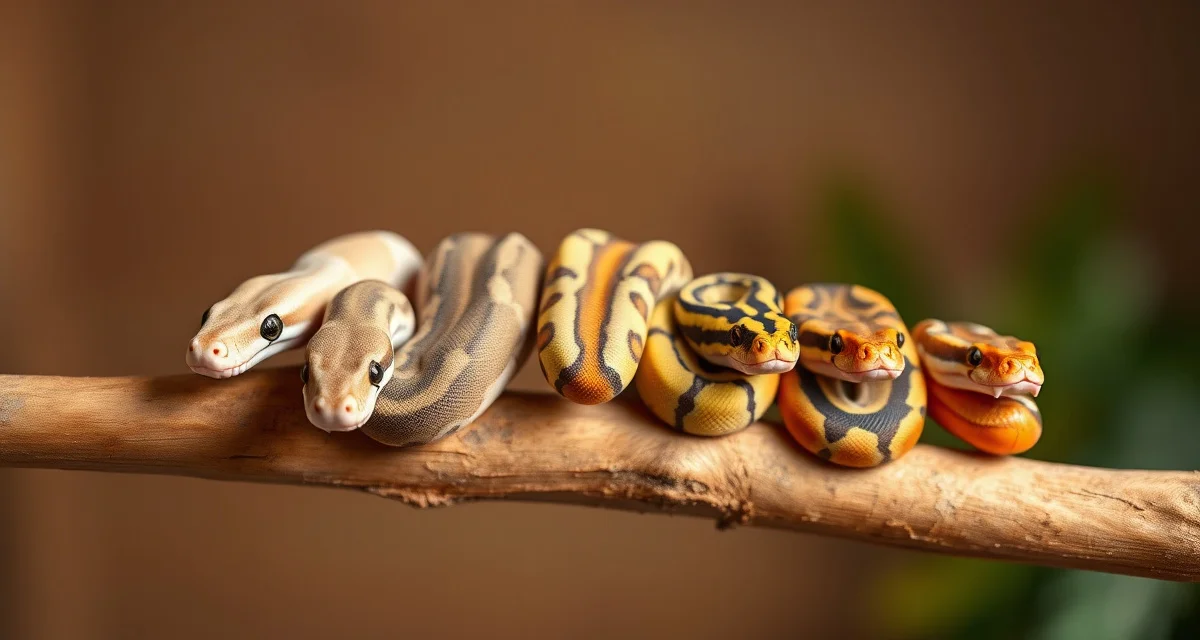
7 Best Ball Python Morphs for Beginning Breeders
Starting with the right morphs is one of the biggest advantages you can give yourself as a new ball python breeder. The best beginner morphs are visually visible in single-copy form (so you know what you have), have accessible market prices, and produce interesting offspring that are easy to sell. These seven morphs are where smart breeders start.
TL;DR
- Pastel is the top beginner co-dominant: females cost $75–$200, and a Pastel x Pastel pairing produces 25% Super Pastels, 50% Pastels, and 25% normals, all sellable.
- Lesser and Mojave are the most practical entry points into the BEL complex; crossing them produces Blue-Eyed Leucistics from the very first clutch.
- Banana sells itself on MorphMarket due to visual appeal, but its sex-linked production characteristics require study before you start pairing.
- Fire is frequently underpriced relative to its combo utility, pairing it with Lesser and Pastel gives access to a wide variety of combination animals without touching recessives.
- Avoid working all seven morphs at once; a four-animal starter collection (Pastel female, Pinstripe male, Lesser female, Mojave male) gives strong combo potential with manageable complexity.
- Breeders using integrated management software spend about 30% less time on admin, critical time for beginners still learning animal husbandry.
- Co-dominant and dominant morphs are recommended for year one specifically because they show visual results immediately, unlike recessives that can take multiple seasons to express.
1. Pastel
Pastel is the introductory co-dominant gene for good reason. A single-copy Pastel shows clear visual difference from a normal, so you know exactly what you have the day it hatches. The Super Pastel from Pastel x Pastel pairings is distinctively bright and worth a meaningful premium.
Pastel females cost $75 to $200 and Pastel males are cheaper still. They produce offspring across the full range of your other pairings that are visually more attractive than normals. Almost every experienced breeder uses Pastel somewhere in their program.
For a beginner, Pastel x Pastel is a simple first project: 25% Super Pastel, 50% Pastel, 25% normal. All sellable. Genetics are simple to explain to buyers.
2. Enchi
Enchi is another co-dominant that shows strong visual difference from a single copy. It reduces dorsal pattern and adds yellow-orange tones. The Super Enchi has even cleaner, more reduced patterning.
Like Pastel, Enchi makes almost any combo animal more attractive. A Pastel Enchi already looks distinctly different from either parent. For a beginner building a small collection, having Enchi in a few animals gives you combo flexibility without adding recessive complexity.
Entry price for Enchi animals is very accessible, $100 to $300 for most morphs. The market for Enchis and Enchi combinations is consistent.
3. Pinstripe
Pinstripe is a dominant gene (not strictly co-dominant in the traditional sense) that produces a clean, reduced lateral pattern with a characteristic stripe running the length of the body. Animals are consistently attractive, and the morph stacks well with virtually everything.
Pinstripe x Pinstripe pairings produce Super Pinstripes that look similar to single-copy animals, so there's no super-form premium here, but you will produce 25% supers and they're still sellable. The value of Pinstripe is as a building block in multi-gene combination projects.
4. Lesser
Lesser is the most practical entry point into the Blue-Eyed Leucistic (BEL) complex. A single-copy Lesser has some visual appeal on its own, but the real payoff comes from crossing Lesser with Mojave, Butter, Phantom, Russo, or other BEL complex genes to produce white Blue-Eyed Leucistic animals.
BELs are consistently in demand, and a beginner can produce them without deep pockets. A pair of Lesser animals is affordable, and even a Lesser x Mojave pairing gives you a shot at BELs from the first clutch.
Buying a Lesser or Mojave female is a strong beginner move. The market is clear, the genetics are straightforward, and buyers love BELs.
5. Fire
Fire is a co-dominant in the same complex as Black Pastel and Cinnamon, producing reduced pattern and a reddish-orange ground color. The Super Fire is a clean white-to-cream animal with dark eyes, distinct from the blue-eyed leucistics but striking in its own way.
Fire is often underpriced relative to its visual appeal and combo utility. A beginner who builds with Fire, Lesser, and Pastel has access to a wide variety of beautiful combination animals without working with recessives at all.
6. Banana
If you want a morph that sells itself on MorphMarket, Banana is hard to beat. The yellow-orange ground color with brown spotting is immediately eye-catching in listing photos. Buyers who aren't deep into genetics can look at a Banana and understand why it's attractive.
The sex-linked production characteristics of the Banana gene are worth understanding before you start. Banana males tend to produce more Banana offspring than statistically expected, which affects how you plan pairings. Read the specific genetics before buying, but don't let that complexity stop you from working with this morph.
7. Mojave
Mojave is a co-dominant with a distinctive appearance, notable for being part of the BEL complex. Mojave x Lesser (or Mojave x Butter, Mojave x Phantom, etc.) produces BELs. A well-conditioned Mojave female is a versatile building block for a beginning breeder.
Single-copy Mojaves are attractive animals in their own right. Stacking Mojave with Pastel or Enchi produces visually distinct animals that are easy to market. And the BEL potential means you can always pursue that angle with the right pairing.
Tips for Getting Started with These Morphs
Don't try to work all seven morphs at once. Pick two or three that complement each other and build deliberately. A Pastel female, a Pinstripe male, and a Lesser female with a Mojave male gives you a solid four-animal starter collection with interesting combo potential and clear marketable outcomes.
Track everything from day one. Every feeding, every weight, every pairing introduction, and every egg count. The ball python breeding hub covers breeding operation management in detail. And when you're ready to evaluate your first season's results, the reptile breeder software comparison resources will show you what dedicated tracking tools can do that spreadsheets can't.
Breeders using integrated management software spend about 30% less time on admin. As a beginner, that's time you need to be learning your animals, not wrestling with spreadsheets.
Frequently Asked Questions
What are the best ball python morphs for beginning breeders?
Pastel, Enchi, Lesser, and Banana are excellent starting points. They're co-dominant or have accessible genetics, produce visible results from the first clutch, and have consistent market demand without requiring multi-season waiting periods.
How do professional breeders choose morphs for beginners to start with?
They recommend morphs with immediate visual feedback (visible in single copy), accessible entry price, and reliable market demand. Avoiding recessives in year one reduces complexity while you learn animal husbandry and business basics.
What software helps beginning ball python breeders manage their records?
HatchLedger is built for reptile breeders at every experience level, tracking animal records, clutch data, feeding logs, and financial information from a single platform without requiring a spreadsheet background.
Should beginners avoid recessive morphs entirely?
Not permanently, but avoiding them in year one is sound advice. Recessives like Albino, Clown, and Pied require pairing two copies of the gene to produce visual animals, which means you can spend an entire season producing only het offspring with no visual payoff. Once you understand your animals' feeding schedules, breeding cycles, and egg incubation, adding a recessive project becomes much more manageable.
How many animals do I actually need to start a ball python breeding operation?
A functional starter collection can be as small as four animals. Two females and two males with complementary genetics, such as the Pastel, Pinstripe, Lesser, and Mojave combination described in this article, gives you multiple pairing options and realistic combo potential without overwhelming your budget or your enclosure space.
How do I price my ball python offspring as a new breeder?
MorphMarket is the most reliable pricing reference for current market rates. Search for animals with the same morph combination as your offspring and filter by recently sold listings rather than active listings. New breeders often price slightly below established sellers to build feedback and reputation, which is a reasonable short-term strategy.
Does the sex of a ball python affect which morph to buy first?
Yes, particularly with Banana. Because Banana males pass the gene to a higher-than-expected percentage of offspring, starting with a Banana female rather than a male gives you more predictable production ratios. For most other morphs on this list, sex matters primarily for cost, males are typically less expensive than females of the same morph.
Sources
- World of Ball Pythons (morphmarket.com/world-of-ball-pythons), morph genetics reference database widely used by breeders
- MorphMarket Industry Data, MorphMarket, reptile classifieds platform publishing market pricing and sales trend data for ball python morphs
- Ball Python Care Guidelines, Association of Reptilian and Amphibian Veterinarians (ARAV), veterinary standards for captive ball python husbandry
- Reptile Breeder Business Resources, United States Association of Reptile Keepers (USARK), regulatory and business guidance for reptile breeding operations
- Herpetological Review, Society for the Study of Amphibians and Reptiles (SSAR), peer-reviewed publication covering captive breeding research and genetics
Get Started with HatchLedger
Every pairing, clutch, feeding log, and weight record you track from your first season becomes the foundation of a real breeding operation. HatchLedger is built specifically for reptile breeders working with ball pythons and similar species, so you can record the morph combinations, incubation data, and offspring outcomes covered in this article without adapting a generic spreadsheet to fit your needs. Start your free trial and see how much clearer your breeding program looks when everything is in one place.