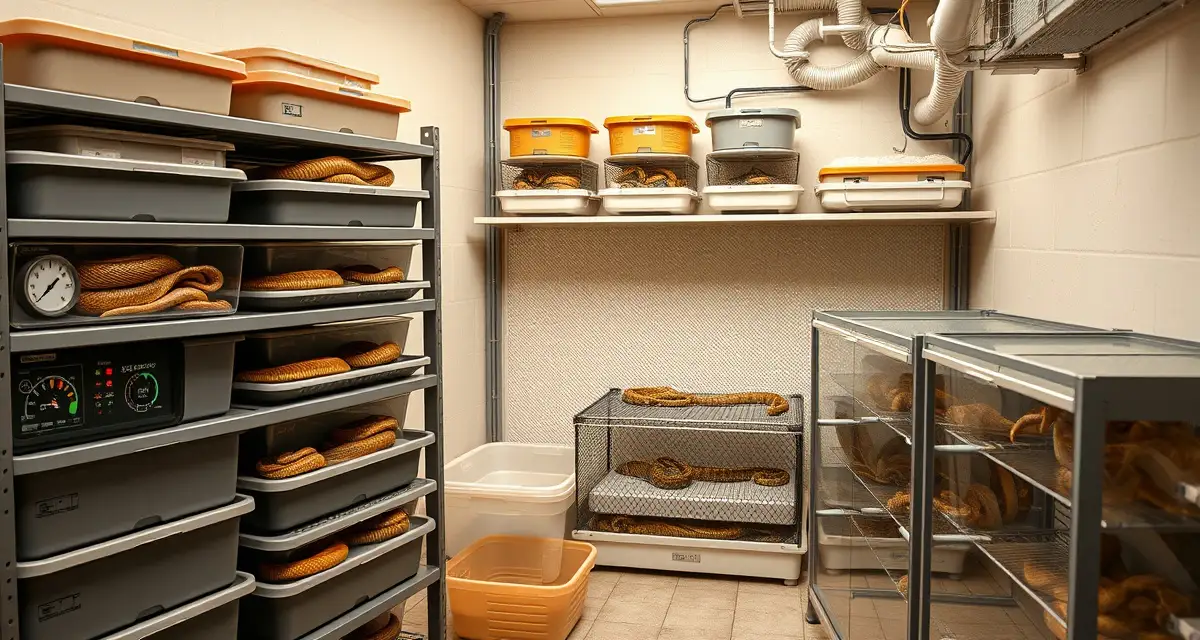
Reptile Rack Setup Guide: Building a Functional Breeding Operation
Racks are how you scale a reptile breeding operation. Individual glass terrariums are fine for a display collection of a dozen animals, but they become unmanageable when you're housing 50 or 100 snakes and trying to maintain consistent temperatures across all of them. Rack systems solve the space, efficiency, and temperature consistency problems simultaneously.
This guide covers the basics of rack selection, heat management, thermostat setup, and organizing your rack system for a breeding operation.
What a Rack System Is
A rack is a shelving system with individual enclosure tubs that slide in and out of each row. The tubs sit on solid shelves, and heat is typically delivered via heat tape or heat cable running along the back edge of each shelf. Animals sit directly on or near the warm surface, which creates the belly heat that snakes need to digest.
Commercial rack systems are available from multiple manufacturers including Animal Plastics (AP), Boaphile Plastics, Vision Products, and Pro Rack. DIY racks built from melamine or plywood are also common among experienced breeders who want custom dimensions.
The key structural features of any rack are:
- Consistent shelf spacing for uniform tub sizing
- Heat delivery system (heat tape, heat cable, or radiant heat panels)
- Secure tub fit that prevents escapes without requiring latches on every tub
Choosing Tub Sizes
Tub size depends on the species and the size of the animals you're housing.
For ball pythons, the standard sizes at different life stages:
- Hatchlings: 6-quart tubs work for the first several months
- Juveniles (200-500g): 15-quart or 28-quart tubs
- Sub-adults and adult males (500-1000g): 28-quart or 41-quart tubs
- Adult females (1000g+): 41-quart, 56-quart, or 70-quart tubs depending on size
Sterilite, Iris, and similar brands make the tubs most commonly used in commercial racks. Make sure your tubs fit your rack shelves correctly. Tubs that are too loose allow heat loss and potential escape. Tubs that are too tight are a daily frustration.
Heat Tape and Thermostat Setup
Heat tape is the standard delivery mechanism for most rack setups. It runs along the back edge of the shelf, and tubs slide over it. The heat travels through the tub floor to create a warm belly zone.
Key setup considerations:
Heat tape width: Typically 3-inch or 4-inch tape. Wider tape distributes heat more evenly but costs more. The warm zone should cover roughly 1/3 of the tub floor, allowing animals to thermoregulate by moving toward or away from the heat.
Thermostat is not optional: Never run heat tape on a dimmer or timer. Use a quality thermostat. For breeding operations, proportional thermostats (Herpstat, Spyder Robotics) maintain much more consistent temperatures than on/off thermostats and are worth the price difference.
Probe placement: Place your thermostat probe on the heat tape surface itself, not on the shelf or in a tub. This gives you the most accurate temperature reading and the most consistent control. Check your surface temps with an infrared thermometer regularly and verify against your thermostat reading.
Target temperatures: For ball pythons, a surface temp of 88-92F is standard. Ambient inside the tub should be 78-82F. Blood pythons prefer slightly cooler conditions: 84-88F hot side, 75-78F ambient.
Air Flow and Humidity
Rack systems that seal tightly retain humidity well, which is an advantage for tropical species like ball pythons and blood pythons. The main risk is excessive humidity leading to respiratory issues or scale rot.
Add ventilation if your racks are too humid. Small holes or vented lids can reduce humidity to appropriate levels. For species that prefer drier conditions (many desert lizards, some colubrids), you'll need more active ventilation.
Monitor humidity in representative tubs with a hygrometer. Aim for 60-80% for ball pythons, 70-90% for blood pythons, and adjust ventilation accordingly.
Organizing Your Racks for a Breeding Operation
Physical organization of your racks is a parallel problem to record-keeping organization. If your racks are organized thoughtfully, record keeping is easier because the physical locations map to your data system.
A few approaches breeders use:
By size/age cohort: Hatchlings in one rack section, juveniles in another, adults in another. Makes feeding efficient since animals at similar stages eat on similar schedules.
By pairing status: Breeding animals grouped together during breeding season for easy access to introduce pairs and monitor activity.
By species or project: If you work with multiple species, dedicated racks per species make temperature management easier since you can set each rack for one species' specific needs.
Label every tub with an animal ID that matches your reptile husbandry record keeping system. The most common and functional approach is a label inside the tub lid with the animal's ID, morph, hatch date, and source (breeder and pairing or acquisition source).
Rack Maintenance
Clean tubs at every animal interaction that involves waste, and do a full cleaning monthly for animals on clean dry setups, more frequently for messier species or sub-adults that are feeding regularly and growing fast.
Check thermostat probes monthly. Probes can shift position over time, which changes your effective temperature reading. Re-verify your surface temps with an infrared thermometer any time your animals' behavior changes (clustering at hot spot, avoiding hot spot, reduced feeding).
Inspect heat tape connections for any damage, particularly if tubs are slid in and out frequently. Heat tape connections that abrade can fail or become a fire hazard.
Integrating Racks with Your Record System
The rack is where your animals live. Your data system is where their history lives. The connection between the two should be frictionless.
When you pull a tub to feed, you should be able to log the feeding in under 30 seconds. When you move an animal to a larger tub, that move should update the animal's record. When a hatchling rack fills up and you start a new rack, your rack organization should stay legible.
HatchLedger tracks animal locations alongside feeding, weight, and breeding data, so your physical rack organization and your digital records stay in sync. This matters most during breeding season when animals are moving between racks for pairings and back, or when you're processing a full hatch and setting up 10 new tub assignments in a single day.
A well-organized rack system and a well-organized record system reinforce each other. Build both with the same intention and your breeding operation will be considerably easier to manage as it grows.